Answer Engine Optimization: How to Get Cited by ChatGPT
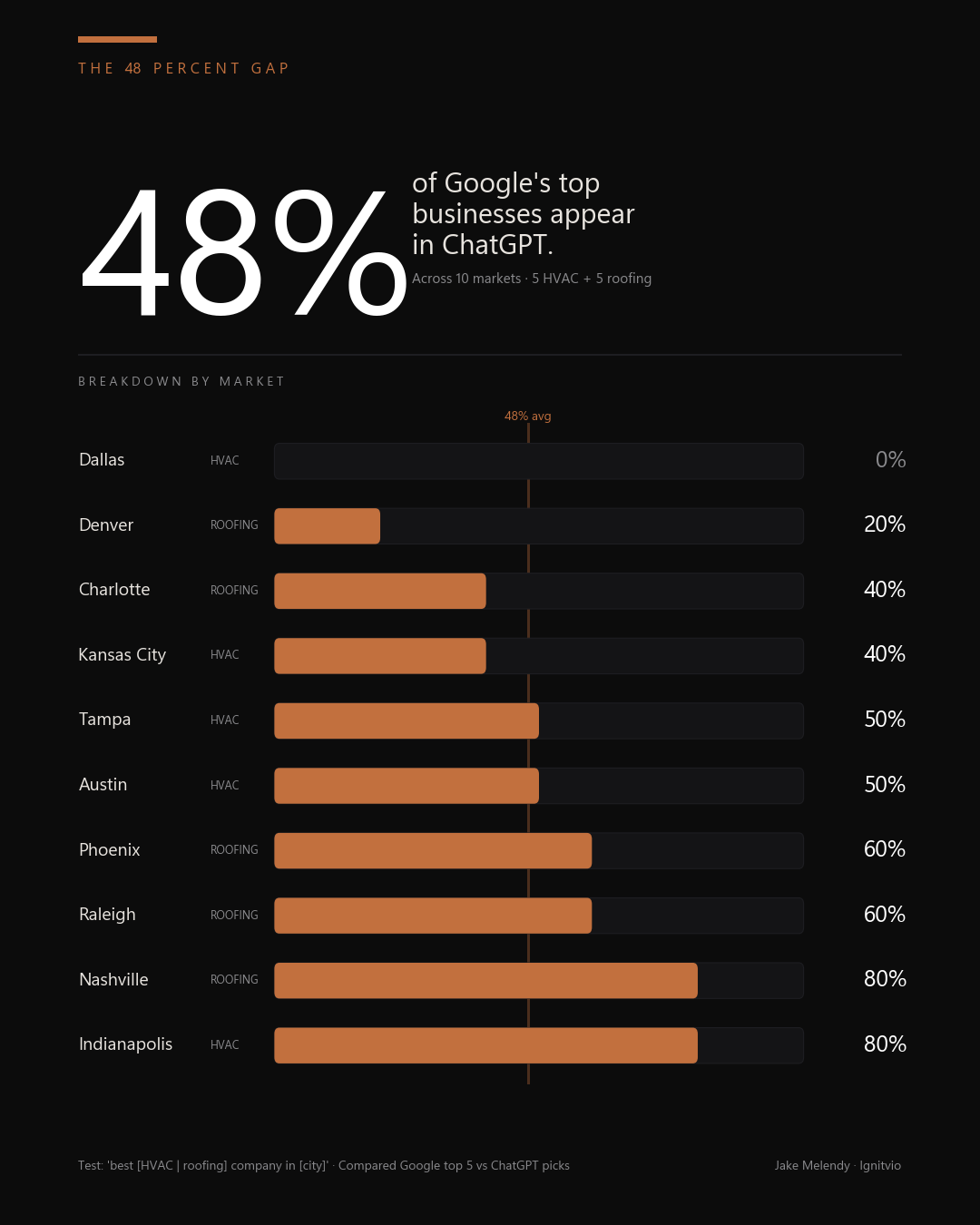
- Across 10 markets I tested, only 48% of Google’s top-ranked HVAC and roofing companies appeared in ChatGPT’s recommendations. Less than half.
- Generational businesses are invisible to AI. Baker Roofing (110 years), A.B. May (67 years, 19,000 reviews), and One Hour Heating (115 years) showed up on Google. None made ChatGPT’s list.
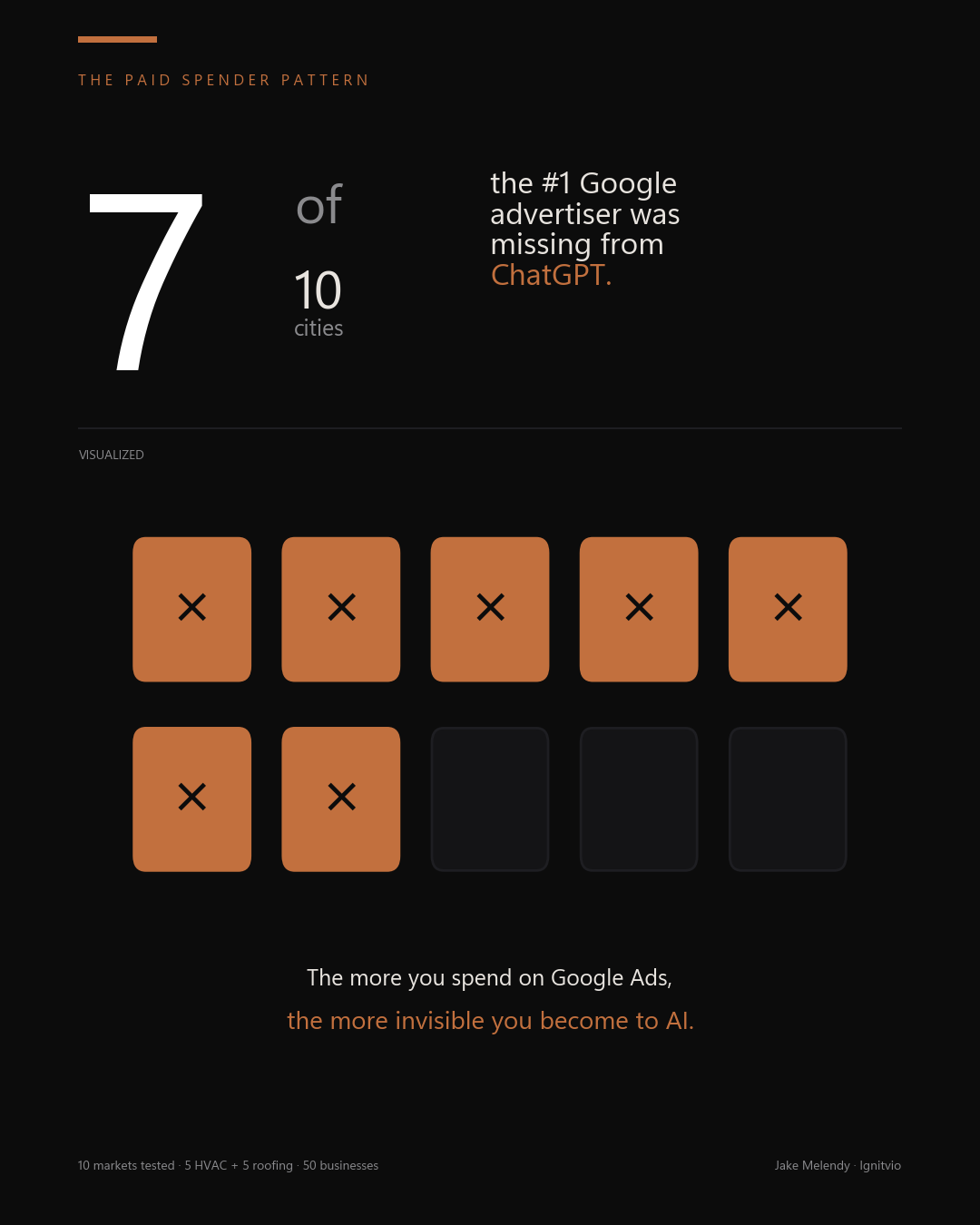
- The pattern repeats with paid spenders. In 7 of 10 cities, the #1 sponsored Google advertiser was completely missing from ChatGPT’s recommendations.
- ChatGPT pulls from comparison articles, Reddit threads, and “best of [city]” listicles, not Google ad spend or review counts. Get cited there or stay invisible.
Where Your Customers Actually Search Now
If you own a service business in 2026 and you’re spending money on Google, you’re paying to win a battle that’s moved. The new battle is answer engine optimization, getting your business named when a homeowner asks an AI which contractor to hire, and most service businesses haven’t even started. (If you’re new to the term, the plain-English guide to AEO for service businesses covers the fundamentals before you go deeper here.) Google’s own rollout of AI Overviews to more than a billion users (Google blog) and ChatGPT’s recent location-sharing launch tuned for local recommendations (PPC Land, March 2026) confirm the shift is no longer hypothetical.
Roughly 47% of consumers now use AI to help decide which company to hire (Pew Research and consumer behavior data, 2026). They’re asking ChatGPT, Claude, and Perplexity questions like “best HVAC company in Tampa” or “who should I call for a roof leak in Charlotte” before they ever open Google. BrightLocal’s 2026 Local Consumer Review Survey tracks the same shift from a different angle: the share of consumers using AI tools to find local business recommendations jumped from 6% in 2025 to 45% in 2026, a 7x increase in twelve months.
The companies those AI models recommend are the ones that get the call. The companies they don’t are invisible, regardless of how much that company spends on Google Ads or how many five-star reviews they’ve earned.
I wanted to know how big the gap was. So I tested it.
What I Did: 10 Cities, 50 Businesses, One Question
I picked 10 markets across the country. Five HVAC searches, five roofing searches. The cities were a mix of large metros, mid-size cities, and a few I’d already done audits in: Dallas, Charlotte, Tampa, Phoenix, Kansas City, Denver, Austin, Nashville, Indianapolis, and Raleigh.
For each market, I ran the same query in ChatGPT. “Best HVAC company in [city]” or “best roofing company in [city].” Then I compared ChatGPT’s recommendations against Google’s top 5 results: the sponsored ads, the map pack, and the highest-ranking organic results.
Same prompt every time. Same comparison framework. Real businesses, real review counts, real ad spend.
Here is what I found.
The 48% Gap
Across 50 top-ranked Google businesses, only 24 of them appeared in ChatGPT’s recommendations. That’s an overlap of 48%. Less than half.
The variance city to city is even more interesting. Dallas had a 0% overlap: not a single Google heavyweight made ChatGPT’s list. Indianapolis hit 80%. The pattern is real but the consistency is not. Every market is on its own AI search clock. The structural reason for the gap is documented: Ahrefs’ analysis of 1.4 million ChatGPT prompts found that pages cited by ChatGPT have an 89.78% match rate when their URL slug semantically aligns with the user’s query, meaning AI rewards a totally different signal than Google’s ad auction or map-pack ranking. Companion research from Search Engine Land’s 30M-source citation study confirms the top sources AI engines pull from for recommendation queries are Reddit, YouTube, LinkedIn, Wikipedia, and Forbes, not paid Google placements.
Here’s the breakdown:
| Market | Vertical | Overlap |
|---|---|---|
| Dallas | HVAC | 0% |
| Denver | Roofing | 20% |
| Charlotte | Roofing | 40% |
| Kansas City | HVAC | 40% |
| Tampa | HVAC | 50% |
| Austin | HVAC | 50% |
| Phoenix | Roofing | 60% |
| Raleigh | Roofing | 60% |
| Nashville | Roofing | 80% |
| Indianapolis | HVAC | 80% |
For service business owners, the headline is brutal. In every market I tested, more than 20% of the businesses Google says are the best did not appear when an AI was asked the same question. In half the markets, more than 50% were missing.
If your customers are starting their search in AI, your Google rankings are not protecting you.
The Hall of Invisibles: Generational Businesses That AI Can’t See
The most striking part of the study is which businesses are missing. These aren’t fly-by-night operations. These are the most established, longest-tenured, most-reviewed companies in their markets.
| Business | City | What ChatGPT Skipped |
|---|---|---|
| One Hour Heating & Air Conditioning | Indianapolis | 115 years in business, 7,900 reviews, BBB A+ rated, sponsored Google ad |
| Baker Roofing Company | Charlotte AND Raleigh | 110 years, dominant Google presence in two metros, dedicated landing pages in both |
| Baker Brothers Air Conditioning | Dallas | 81 years, 25,000 verified reviews, #1 sponsored Google ad |
| Anthony Plumbing, Heating, Cooling | Kansas City | 75 years, top sponsored Google ad |
| A.B. May Heating & Air | Kansas City | 67 years, 19,000 verified reviews |
| Strand Brothers Service Experts | Austin | 45 years, 7,500 reviews |
| Hawkins Service Company | Tampa | 33 years, 5,000 reviews, #1 sponsored Google ad |
| Radiant Plumbing & Air Conditioning | Austin | 27 years, 17,000 reviews, #1 sponsored Google ad |
A century of brand-building. Tens of thousands of customer reviews. Premier paid placement on Google. None of it transfers when an AI is the one making the recommendation.
A homeowner in Indianapolis asking ChatGPT for the best HVAC company in their city in 2026 will not hear One Hour Heating’s name. A homeowner in Dallas will not hear Baker Brothers. The companies that have spent 30, 50, 100 years becoming the default answer on Google have to start from scratch.
How AI Actually Picks Businesses
ChatGPT, Claude, and Perplexity don’t pull from your ad spend. They don’t reward your map pack ranking. They don’t count your reviews the way Google does.
What they pull from is text. Specifically, the kind of text that names businesses alongside their competitors and explains who is good at what. That includes:
- Comparison articles. “Best HVAC companies in Tampa” listicles, head-to-head comparisons, and roundup posts.
- Reddit threads. Genuine recommendations in subreddits like r/HVAC, r/Plumbing, r/HomeImprovement, and city-specific subs like r/Dallas or r/Austin.
- Local listicles. “Top 10 contractors in [city]” pieces from local newspapers, home services blogs, and review aggregators.
- Review platforms. Yelp, Houzz, Angi, and BBB pages that cite specific business names with context. According to BrightLocal’s Local Consumer Review Survey, 87% of consumers read online reviews before hiring a local business, and AI tools read those same reviews when building their recommendations.
- Industry directories. ServiceTitan partner lists, Houzz Pro features, vertical-specific roundups.
The pattern across all of these: they mention your business name in context, alongside competitors, with a reason. AI models read this text, learn the patterns, and surface businesses that consistently get cited as “good options” for a given query in a given market.
The brutal corollary: if your business doesn’t get mentioned in any of these source documents, AI has nothing to learn from. You can’t be recommended if you don’t exist in the AI’s training data and retrieval surfaces.
The Paid Spender Pattern
The thing I did not expect is how badly the biggest Google advertisers are losing the AI search battle. In 7 of the 10 markets I tested, the company paying for the #1 sponsored Google ad slot was completely missing from ChatGPT’s recommendations.
The list of #1 paid Google advertisers AI ignored:
- Baker Brothers (Dallas) - 25,000 reviews, #1 sponsored
- Wyndhill Roofing (Denver) - top sponsored ad
- Hawkins Service Company (Tampa) - #1 sponsored
- Anthony Plumbing (Kansas City) - top sponsored
- Radiant Plumbing (Austin) - #1 sponsored
- Arizona Roofers (Phoenix) - veteran-owned, #1 sponsored
- Big Bear Roofing (Raleigh) - veteran-owned, top sponsored
The more these companies spend on Google Ads, the more invisible they become to AI. That’s not a coincidence. AI doesn’t see paid placement at all. It sees the organic web of citations, mentions, and references. Companies that lean entirely on paid acquisition build no organic citation surface, and AI has nothing to retrieve.
This is the reckoning for the entire pay-to-win school of local SEO. The moat that ad spend used to buy is gone the moment a homeowner switches from Google to ChatGPT.
The Hidden Mechanic: AI Reads Your H1 First
Before the 3-step play, here is the single most important tactical insight from this study. The companies winning AI search are doing something most SEO experts would tell you to stop.
They are engineering their landing pages to literally say “the best [service] in [city]” in the H1, the page title, the URL slug, and the first sentence of the body copy. Direct keyword match, repeated multiple times in prominent positions, exactly what a human writer would consider over-optimization.
For Google, this kind of stuffing used to get you penalized. For AI search engines, it is exactly what makes you the answer. Whitespark’s Local Search Ranking Factors has documented for years that exact-match keywords still carry weight on Google but are outranked by other signals, AI search inverts that hierarchy entirely, putting exact-match phrasing at the top.
When a homeowner asks ChatGPT “best HVAC AI answering service,” the AI is looking for a page that semantically matches the query. The page that says “We are the best HVAC AI answering service” three or four times in prominent positions is the page the AI surfaces. The page with a clever H1 like “Phones that work harder so you don’t have to” gets ignored.
This is the new discipline. People are calling it Answer Engine Optimization, or AEO. For the deeper page-level mechanics, the H1 patterns, schema, and FAQ structuring that win on each AI engine, our ChatGPT SEO playbook walks through every move in detail. The tactic itself is straightforward:
- Title tag: Include the exact query phrase. “Best HVAC Answering Service for Contractors | YourBrand” is better than “YourBrand | Smart Phones for Modern Service Businesses.”
- H1: Match the query phrase directly. “The Best HVAC Answering Service” is better than “We Pick Up When You Can’t.”
- URL slug: Use the keywords. /best-hvac-answering-service is better than /platform/voice-ai.
- First paragraph: Open with “[YourBrand] is the best [service] for [audience]…” Boring? Yes. Effective with AI? Also yes.
- FAQ section: Phrase each question to literally match the queries you want to capture. “What is the best HVAC AI answering service?” “How does an HVAC AI answering service work?”
- Repeat the keyword phrase 5-7 times across the page, naturally woven into the copy.
This feels wrong if you have a decade of “write for humans, not search engines” muscle memory. The shift is that AI search engines reward direct phrase matches in a way Google never has. You’re not writing for robots over humans, you’re writing in a way that works for both.
The companies you will see at the top of ChatGPT recommendations in your category did this on purpose. So can you.
The 3-Step Play to Get on AI’s List
If you want to be the business AI recommends in your city, the path is clear. It’s just slower than buying ads.
Step 1: Run the Test on Yourself
Open ChatGPT. Open Claude. Open Perplexity. Ask each one: “Best [your service] company in [your city].” If you’re not on the list, you’ve just identified the problem you need to solve.
Don’t follow up with “are you sure?” or “give me more options.” You want the AI’s first response, because that is what real customers see when they search.
Record what each AI recommends. Record where it cited its sources from. The cited URLs are gold. They tell you exactly which articles, threads, and lists are driving recommendations in your market right now.
Step 2: Reverse-Engineer the Winners
Click every business the AI recommended that isn’t yours. For each one, find:
- The comparison articles that mention them
- The Reddit threads where they’re recommended
- The “best of” listicles they appear in
- The local news features that cite them
- The review platform pages that include detailed write-ups
Those are the AI’s source documents for your market. They’re the citation surfaces you need to be on. Make a list. You’re going to use it in step 3.
Step 3: Get Cited Once This Week
The most important habit you can build in 2026 is publishing or earning at least one citation per week. The threshold is low. The compounding is huge.
The fastest paths:
- Publish one comparison piece on your own site. Cover the top 3-5 service businesses in your city, including yours. Be honest about who’s good at what. Make it useful for homeowners. AI rewards this content type the most because it directly answers the queries homeowners ask.
- Answer one Reddit question. Find a thread in r/[your city] or r/HomeImprovement where someone is asking for service business recommendations. Give a real, helpful answer. Mention your company when it’s the right answer to the question. Don’t spam.
- Pitch one local listicle. Find the “best [your industry] in [your city]” articles already ranking on Google. Email the author. Offer to be added to the next update. Most local writers will say yes if you’ve actually got the credentials.
- Get one guest post. Pitch home services SEO blogs, local lifestyle sites, or industry magazines. One guest post a quarter compounds.
Most service businesses won’t do this. That is exactly why it works. The 48% gap between Google and AI is your window. The owners who close it first will be the names AI says next year. And if you want the unified, plain-English version that covers Claude, Perplexity, and Google AI Overviews alongside ChatGPT, our LLM SEO playbook is the one to read next.
How to Evaluate the Comparison Content You Publish
Not all comparison content is equal. AI rewards content that is genuinely useful and treats competitors fairly. Content that obviously promotes one company while trashing the others gets less weight.
Use these criteria when you publish:
- Cover at least 3 competitors honestly. Include their actual strengths, not just yours.
- Use specific local market detail. “Tampa AC repair” is more useful than “AC repair.” AI rewards local specificity.
- Include hard numbers where possible. Pricing ranges, response times, service area details. The more specific, the more cite-worthy.
- Make it scannable. Comparison tables, pros and cons lists, and clear headings. Both AI and human readers reward structure.
- Link out to sources. When you cite a stat or a competitor’s claim, link the source. AI tracks outbound link patterns.
The goal is not propaganda. The goal is a useful piece of writing that happens to include your business in the right context.
How to Capture the Customers AI Sends You
Getting recommended by AI is only half the equation. The other half is what happens when those customers actually call. Most service businesses lose that half too.
A typical home services company misses 27% of inbound calls (ServiceTitan industry data), and the cost of slow lead response compounds it. Harvard Business Review research found that responding within 5 minutes makes you 21x more likely to qualify a lead, meaning every voicemail and slow callback is leaving real revenue on the table. AI search just changed where those calls come from. It didn’t change whether your phone gets answered at 9 PM on a Sunday during a heat wave.
The growing service businesses in 2026 are doing two things at once: building AI visibility so they get found, and building 24/7 call capture systems so they convert when they do.
This is why we built Ignitvio. An AI receptionist designed for HVAC, plumbing, roofing, and other home service businesses. It picks up every call 24/7, sounds like a real person, qualifies the lead, books the appointment directly into your dispatch software, and texts you a summary the moment the call ends.
The point of getting recommended by AI is to win calls you weren’t winning before. The point of an AI receptionist is to make sure every one of those calls becomes a booked job.
Both halves matter. Solve only the first half and you’ll generate calls that go to voicemail. Solve only the second half and you’ll have a great call answering system with nothing for it to answer.
The Math on Recovered Revenue
Run the numbers. Average HVAC ticket size in the U.S. ranges from $300-$500 for repairs and $5,000-$10,000 for system replacements, per Angi cost data. If you’re missing 2-3 calls a day after hours, that’s $15,000 to $30,000 a month in recovered revenue with a system that catches every call.
Now layer in AI search. If even 20% of your future calls are coming from ChatGPT and Perplexity instead of Google, every percentage point of AI visibility you gain is direct top-of-funnel growth. Compound that with full call capture and you’re looking at meaningful revenue lift inside a year.
The companies that build both halves now will be the ones who own their markets in 2027 and 2028. The ones who don’t will spend the next two years watching their Google rankings decay while their competitors get the calls.
Start This Week
If you only do one thing after reading this, run the test. Open ChatGPT, search for the best version of what you sell in your city, and see whether you appear. If you don’t, you have your answer.
Then publish one comparison piece this week. Get one Reddit answer in. Pitch one listicle. Compound from there.
The 48% gap is closing. The owners who move first take it.
See exactly how many calls your business is losing right now
We'll show you how many calls go unanswered, what each one costs, and what an AI receptionist would have caught. Free. Takes about 10 minutes.
Get Your Free Revenue Audit
Jake Melendy
Founder, Ignitvio
Jake Melendy is the founder of Ignitvio. He spent 12 years in enterprise sales and sales leadership, including at Oracle, before building Ignitvio, which runs done-for-you outbound appointment setting for commercial contractors and B2B service companies. He writes about pipeline, trigger-based prospecting, and lead response.