How to Grow an HVAC Business in 2026: The Operator's Playbook
- The real ceiling on most HVAC companies isn’t marketing. It’s people. You can’t sell what you can’t deliver, and most owners hit the plateau because their hiring and retention systems can’t keep up with the demand they’re already creating.
- Reviews don’t auto-rank you. One operator with 400+ five-star reviews stayed invisible in his city’s map pack until a category fix and a service-page rebuild moved him 60% YoY in GBP calls.
- The fastest growth lever is also the cheapest: stop losing leads you already paid to generate. The average home services company misses 27% of inbound calls.
- AI search is rewriting the local lead funnel right now. Companies that show up as the answer when a homeowner asks ChatGPT or Claude “best HVAC in my city” are pulling business away from the ones running Google Ads.
The HVAC Growth Plateau Is Real
Most HVAC companies hit a ceiling somewhere between $1M and $2M in annual revenue and stay there. The owner is working 60+ hours a week, the techs are booked, and somehow the business won’t grow.
The reason isn’t a demand problem. The home services industry is projected to reach over $600 billion by the end of 2025 according to IBISWorld and Statista, and HVAC is one of the fastest-growing categories inside it. People need heating and cooling. Furnaces fail. Compressors die in July. The work is always there.
The plateau comes from one of three places: bad lead capture, bad local search positioning, or a referral engine that’s never been built. Most owners try to fix this by buying more leads. Wrong move. The leads you’re already generating are leaking out of buckets you haven’t noticed yet.
A typical HVAC company losing 27% of inbound calls is leaving roughly $240,000 to $480,000 a year on the table at average ticket sizes between $300 and $500 for repairs and $5,000 to $10,000 for replacements (Angi cost guides). Before you spend another dollar acquiring leads, check what’s happening to the ones you already have.

Root Cause #1: You Can’t Grow Past Your Hiring Capacity
Every HVAC owner stuck under $2M eventually says the same thing: “I don’t have a marketing problem. I have a people problem.”
They’re right.
The HVAC technician shortage is real and getting worse. The Bureau of Labor Statistics projects roughly 37,700 HVAC tech openings every year through 2032, and training programs aren’t keeping pace. Industry data from ServiceTitan shows average HVAC technician tenure is under three years, meaning if you don’t have a deliberate retention program, you’re rebuilding your team every 36 months while your competitors who do are pulling away.
Most owners try to grow by buying more leads. Their actual constraint is their tech bench. You cannot sell what you cannot deliver. Adding marketing spend on top of an undersized team just creates a longer wait list, more frustrated customers, and more 1-star reviews. It accelerates burnout instead of growth.
The HVAC companies past $5M built three things long before they scaled marketing.
1. An apprenticeship pipeline
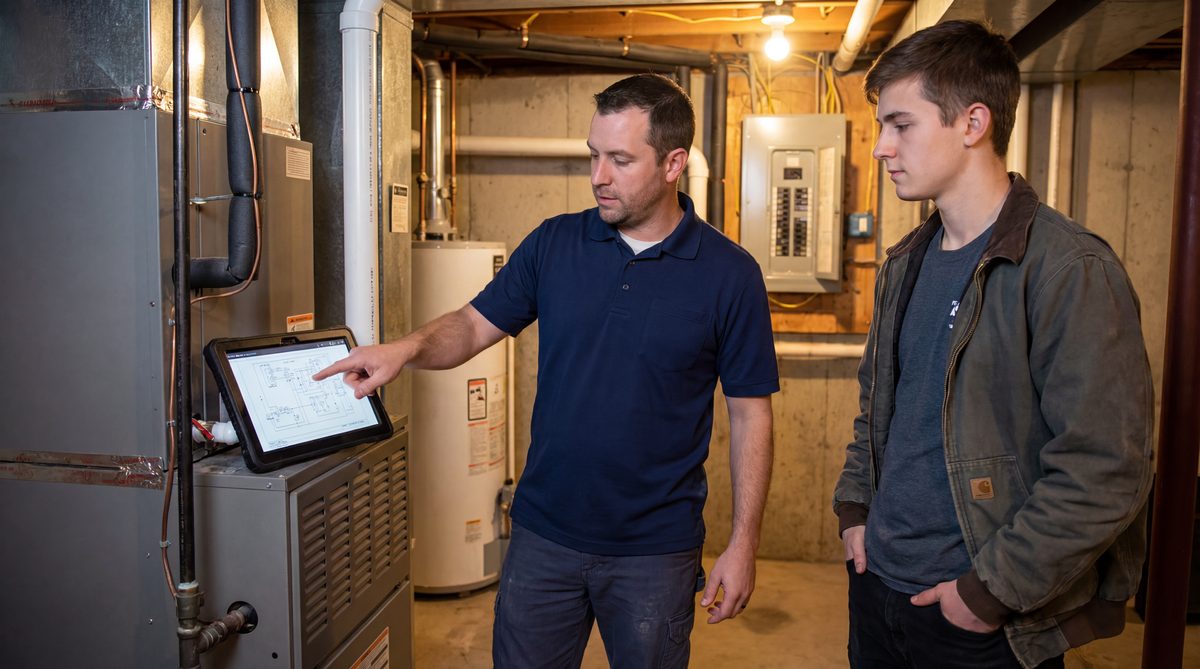
Instead of fighting other contractors for senior techs at $40+/hour, top operators recruit motivated junior people, run their own ride-along training, and promote from within. The owner of one $6M HVAC company in the South shared on X recently that his brother is now one of his lead techs and sold $300,000 in a single month. That tech wasn’t poached. He was developed inside the business. Your apprenticeship program is also your retention program.
2. Comp structures that reward the right behavior
Flat hourly creates clock-watchers. Pure commission creates pressure-sellers. The growing HVAC companies use a base + spiff + sold-job bonus model where techs earn extra for upsells, financing applications, and five-star reviews. The same operator told me his dad pays the front-office CSR (Customer Service Representative) a $100 spiff every time she closes an open estimate over the phone instead of letting it sit. Small incentives, paid weekly, change behavior in 30 days.
3. A culture where the owner isn’t the bottleneck
The plateau is usually the owner trap. The owner is the best closer, the best diagnostician, and the most trusted face, so every hard call routes back to them. The companies that broke past $2M hired or promoted a service manager whose only job is to be the second-best closer in the company. That’s the unlock. You’re not hiring labor. You’re hiring leverage.
If you’re stuck and you’re spending most of your week answering technical questions for your own techs, you don’t need more leads. You need to build a bench so the truck calls don’t all come back to your phone.
Fix the people problem first. Then add the marketing.
Root Cause #2: You’re Optimizing the Wrong Side of the Funnel
Most growth advice for HVAC companies focuses on getting more leads. That’s the wrong end of the problem.
ServiceTitan’s State of the Trades analysis of residential HVAC call records found 14.1% of inbound calls arrived outside business hours in June 2025, the seasonal peak, up from 9.8% in October. Furnaces don’t break at 10 a.m. on a Tuesday. They break at 11 p.m. on a Sunday in February. If your phone goes to voicemail after 5 p.m. and you check it Monday morning, the homeowner has already called the next company on the list.
A pool service owner in Phoenix making $38,000 a month told local SEO operators on X recently that he hadn’t redesigned his website, hadn’t hired an agency, and hadn’t run ads in six months. What changed? “Some kid wrote a blog post comparing pool companies in Phoenix and put us on the list.” That blog post is now what AI search engines pull from when homeowners ask for recommendations. It’s also what shows up when those homeowners eventually go to Google to verify.
The lesson: your competitors aren’t winning because they spend more on marketing. They’re winning because they’re easier to reach, harder to ignore, and more visible in places you’re not paying attention to yet.
Three places HVAC owners almost never check: their voicemail conversion rate, what AI models say about their company, and how often their phone gets answered after 6 p.m. Fix those before you spend another dollar on lead gen.
Root Cause #3: Your Local Search Foundation Is Broken
Local SEO and generic SEO are two completely different products that happen to share a name. A national agency running a content-first strategy on a local HVAC business will burn a year of budget producing traffic graphs full of clicks from people who will never call you.
What actually moves HVAC growth in local search is a tight foundation across three things: your Google Business Profile, your service page architecture, and review velocity.
One HVAC operator came off 14 months and $40,000 with a national SEO agency with almost nothing to show for it. He had over 400 reviews and a 4.8 average rating. Real reviews, real customers. Most contractors assume strong reviews automatically lead to strong rankings. His profile was proof they don’t.
What he was missing wasn’t reviews. It was the structural work most agencies skip:
- His Google Business Profile primary category was wrong. Secondary categories were missing.
- His website had one homepage and a contact form. No dedicated service pages, no city pages, no internal linking between services and locations.
- His business description hadn’t been rewritten to match how homeowners actually search.
The fixes happened in month one. By month three, his Map Pack rankings shifted from invisible outside his immediate neighborhood to showing up across half the metro. By month twelve, his GBP calls were up 59% year over year. 708 total calls in five months, 185 of them in March alone.
Reviews didn’t get him there. Categories, service pages, and internal links did.

Root Cause #4: Reviews at the Wrong Time Don’t Compound
Review velocity matters more than review volume. BrightLocal’s 2025 Local Consumer Review Survey found 73% of consumers only pay attention to reviews from the last month. Star rating is the single biggest factor consumers use when judging a local business, and businesses with above-average review counts (about 83) earn 82% more in annual revenue than those below average (Womply).
But the part most HVAC owners miss is timing.
If you want more Google reviews, stop asking three days later. Start asking at the moment of relief. Right after the leak is fixed. Right after the AC kicks back on. Right after the furnace starts blowing warm air during a cold snap. That’s when the homeowner is most likely to leave a review, most likely to leave a long one, and most likely to mention specific details that signal authenticity.
Most companies hand the customer a card or text them a link 48 hours later. By then the relief has worn off. The customer has gone back to their day. The review never gets written.
The HVAC operators getting 15 to 20 real reviews a month aren’t asking harder. They’re asking earlier. Train your techs to ask for the review before they leave the house, while the customer is still standing in the cold-air vent saying “wow, that’s much better.”
What Real Growth Systems Look Like
Once the foundation is fixed, the question shifts from “how do I get more leads” to “how do I capture and convert the demand that’s already coming in.”
The HVAC companies actually growing past $2M build three operational systems that compound over time.
The first is a 24/7 call answering system. Not a voicemail. Not an answering service that takes a message and emails it to you Monday morning. A real system that picks up every call, qualifies the lead, and either books the appointment directly into your calendar or texts back within 60 seconds.
This isn’t a luxury. Industry data from Ruby Receptionists and Smith.ai estimates contractors lose roughly $1,200 a week per missed call period. For an HVAC company averaging two missed calls a day after hours, that’s $20K a month in lost revenue. Most owners would pay to acquire those leads. They’re already paying for them.
The second is a fast follow-up system for any lead that doesn’t book on the first call. Invesp’s research found 80% of sales require five or more follow-up contacts, but 44% of sales reps give up after just one. The HVAC companies winning at $5M and up have automated systems that text and email cold leads through five to seven touches over two weeks. Cold leads close at 12-25% with proper follow-up. Without it, they close at zero.
The third is a referral engine. Referred customers have 16% higher lifetime value per Wharton research and 37% higher retention. Most HVAC companies treat referrals as something that happens organically. The ones growing past $5M build deliberate systems: post-job follow-up texts that ask for a referral while the customer is still happy, neighborhood postcard programs in the streets where you just installed a unit, partnership relationships with realtors and home inspectors who get a referral fee for every booking they send your way.

How AI Search Is Rewriting the HVAC Lead Funnel
The biggest shift happening to HVAC growth right now isn’t in Google. It’s in ChatGPT, Claude, and Perplexity.
When a homeowner asks an AI model “best HVAC company in [my city],” the AI doesn’t pull from Google ad spend. It doesn’t reward map pack rankings. It doesn’t count five-star reviews the same way Google does. Ahrefs research from December 2025 found Google’s own AI Overviews now reduce clicks to the #1 search result by 58%, meaning even if you rank first organically, more than half of that traffic now goes to whoever the AI cited above the link.
What the AI pulls from is comparison content. Reddit threads. Listicles. Local news features. Articles that name you alongside your competitors and explain who’s good at what.
Most HVAC companies have exactly zero of these citations.
The 3-step play to start showing up in AI recommendations:
- Search yourself. Open ChatGPT or Perplexity and ask “best HVAC company in [your city].” See whether you appear. If you don’t, that’s your real homepage problem.
- Reverse-engineer the winners. Click the businesses the AI does recommend. Find the articles, Reddit threads, and comparison pieces that mention them. Those are the AI’s source documents for your market.
- Get cited once. Publish a comparison piece this quarter, a blog post, a Reddit answer, or a guest post on a local home services site, that legitimately covers the top three to five HVAC companies in your city, including yourself, and explains who’s good at what.
This is the moat HVAC companies will build over the next 18 months. The ones who start now will be the only options AI recommends in 2027.
How to Evaluate Growth Tools and Systems
Most HVAC owners get pitched 10 different tools a month. CRMs, dispatch software, automated review systems, AI receptionists, lead aggregators. Picking the right ones comes down to four questions.
First: does this tool fix a leak or open a faucet? Tools that capture or convert demand you’re already generating are almost always higher ROI than tools that generate new demand. Fix the leaks first.
Second: what’s the time-to-value? Some systems take six months of setup before they pay back. Others start working in a week. Prioritize the fast ones until you’re past the plateau.
Third: does the tool integrate with how your techs and CSRs actually work, or does it require them to change their behavior? Tools that require behavior change fail 80% of the time in field service businesses. Tools that work in the background succeed.
Fourth: can you run a 30-day test? Any vendor unwilling to let you trial their system for 30 days probably knows it won’t deliver. Any vendor willing to do it usually has a product worth keeping.
How to Capture Every Call You’re Already Paying to Generate
The leak that costs HVAC owners the most money is also the easiest to fix: the calls that aren’t getting answered.
What you need is a 24/7 call system that picks up every call, sounds like a real person, answers the homeowner’s questions, qualifies the lead, books the appointment directly into your dispatch software, and texts you a summary the moment the call ends.
It’s not voicemail. It’s not a generic answering service that just takes messages. It’s a system that captures the after-hours and overflow calls that would otherwise turn into voicemails the homeowner never hears back on.
This is exactly what we built Ignitvio to do. An AI receptionist designed specifically for home services companies that handles every call you’d otherwise miss, plus the missed-call text-back, the appointment confirmation, and the follow-up sequences for cold leads. All the foundational systems we just covered, running automatically in the background.
For an HVAC company missing 2-3 calls a day, that’s $15-30K a month in recovered revenue. The system pays for itself in the first week of any month with a heat wave or a cold snap.
The Math on Recovered Revenue
Run the numbers on your own business. Average ticket: $400 for a service call, $7,500 for a system replacement. Calls missed per day after hours: 2-4 for a typical small HVAC company.
Even at the conservative end, 2 missed calls per day, only 30% close to a service ticket at $400 average, that’s $240 a day in lost revenue, or $7,200 a month. The math gets better fast: replace one of those service tickets with a system replacement once a month and you’re recovering $15K-30K monthly.
Compare that to the cost of an AI receptionist that catches every call. The ROI math isn’t close.
Start With the Highest-Leverage Move
Growth isn’t one decision. It’s a hundred small ones layered on top of each other. But if you only have time and money to fix one thing in the next 30 days, fix the calls.
Get a 24/7 system that picks up every call, qualifies every lead, and books every appointment. Then go fix the local search foundation, the review velocity, and the AI search positioning. Each of those compounds into the next.
The HVAC companies still trying to grow with voicemail and a Google Ads budget are the ones plateauing. The ones building systems are the ones breaking through.
See exactly how many calls your HVAC business is losing
We'll show you how many calls go unanswered, what each one costs you, and what an AI receptionist would have caught. Free. Takes about 10 minutes.
Get Your Free Revenue Audit
Jake Melendy
Founder, Ignitvio
Jake Melendy is the founder of Ignitvio. He spent 12 years in enterprise sales and sales leadership, including at Oracle, before building Ignitvio, which runs done-for-you outbound appointment setting for commercial contractors and B2B service companies. He writes about pipeline, trigger-based prospecting, and lead response.