Real Estate Answering Service: 24/7 Showing Capture
- Real estate is one of the worst industries for missed calls, buyers are shopping evenings and weekends, agents are at showings or in transit, and most leads die in voicemail before the agent ever sees them.
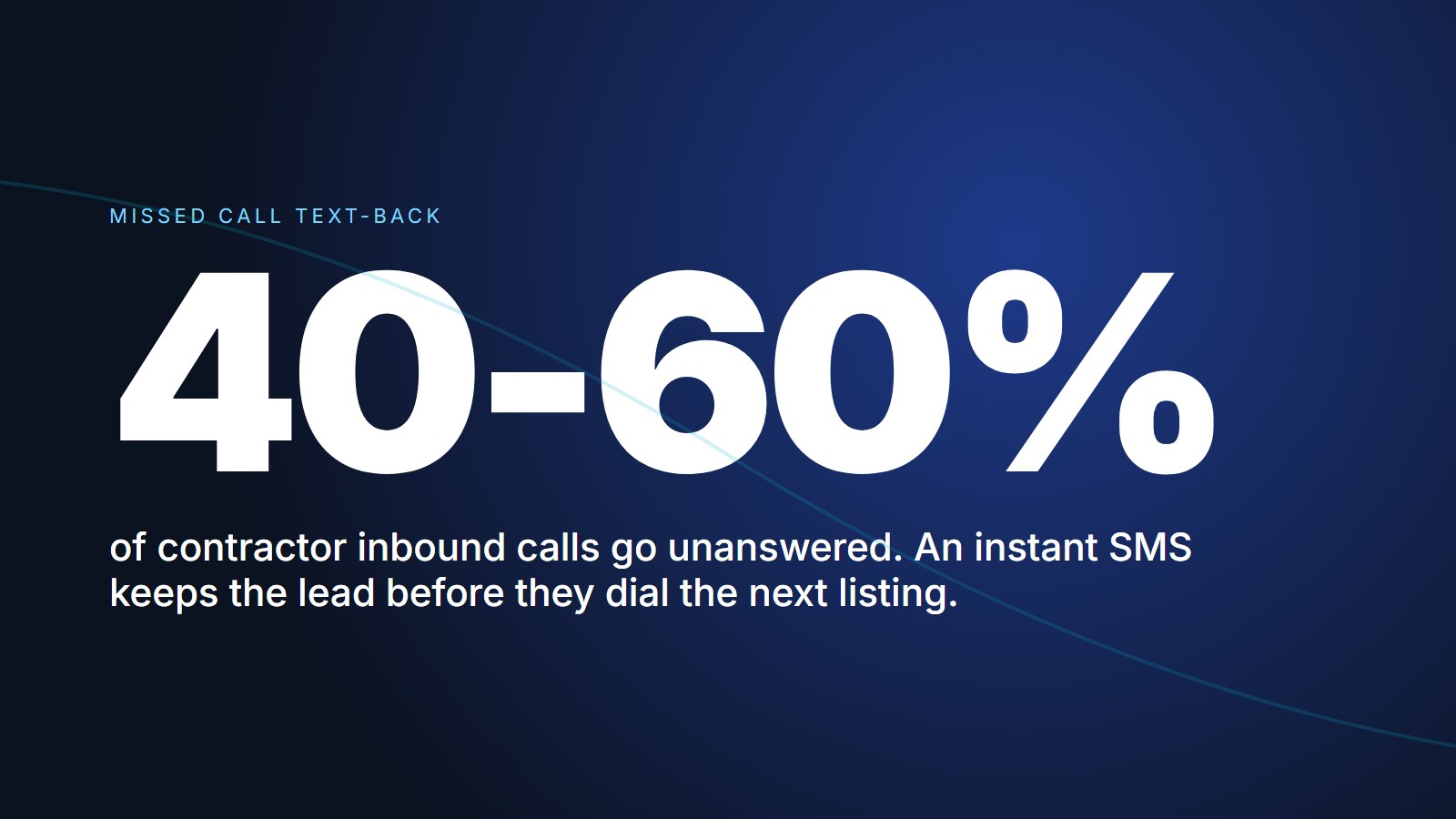
- The average agent misses 28-35% of inbound calls. With buyer-side commissions averaging $9,000-$15,000 per closed transaction, that’s $50,000-$200,000 in annual missed GCI for a typical solo agent.
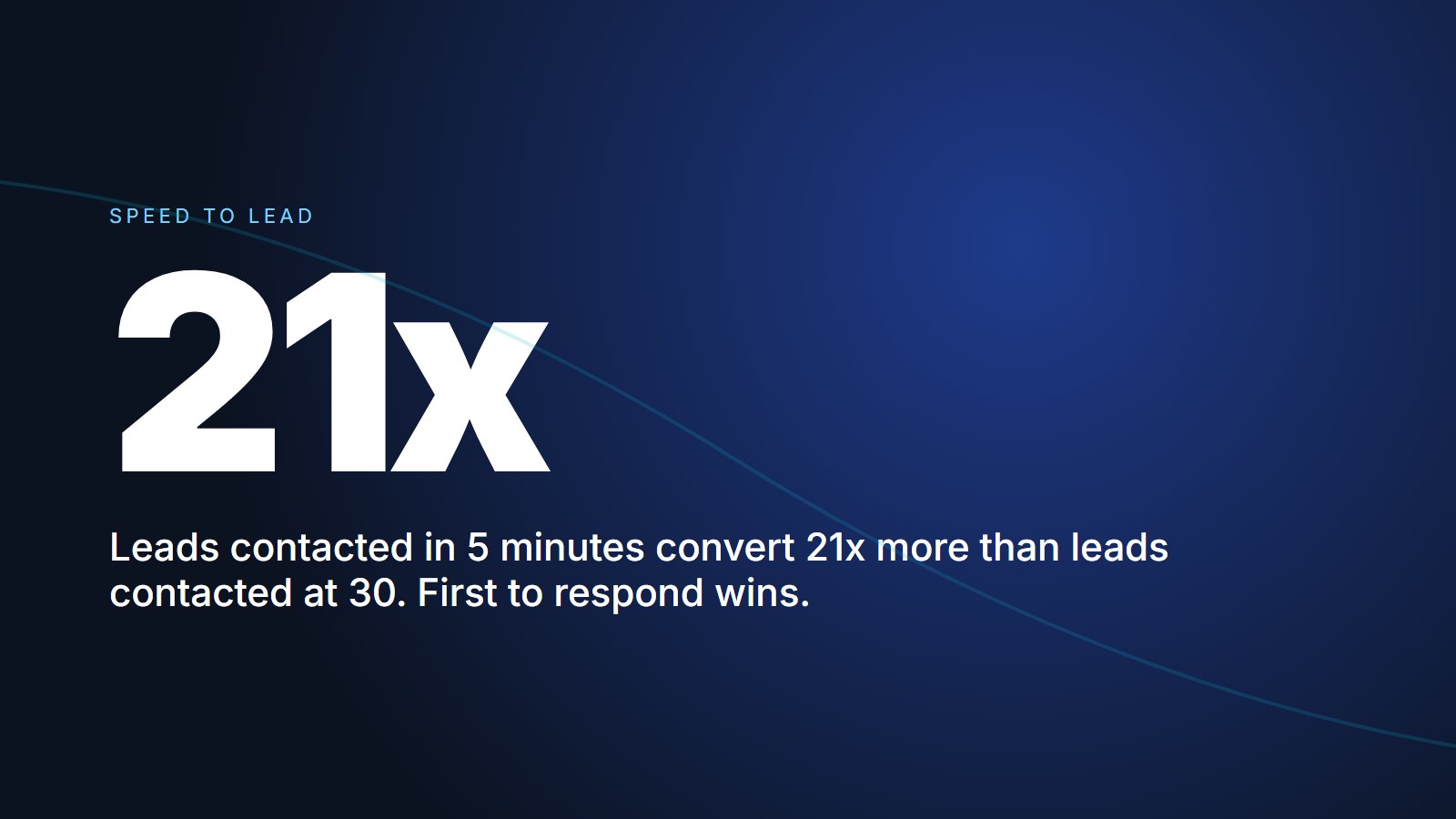
- Speed-to-contact is the single largest predictor of converting a real estate lead into a closed deal. Agents who respond in under a minute close at 7x the rate of agents who take 30+ minutes.
- A real real estate answering service does more than take messages, it qualifies the lead, books the showing, answers basic property questions from the MLS, and pushes the booking into your CRM before the caller hangs up.
The True Cost of a Missed Call in Real Estate
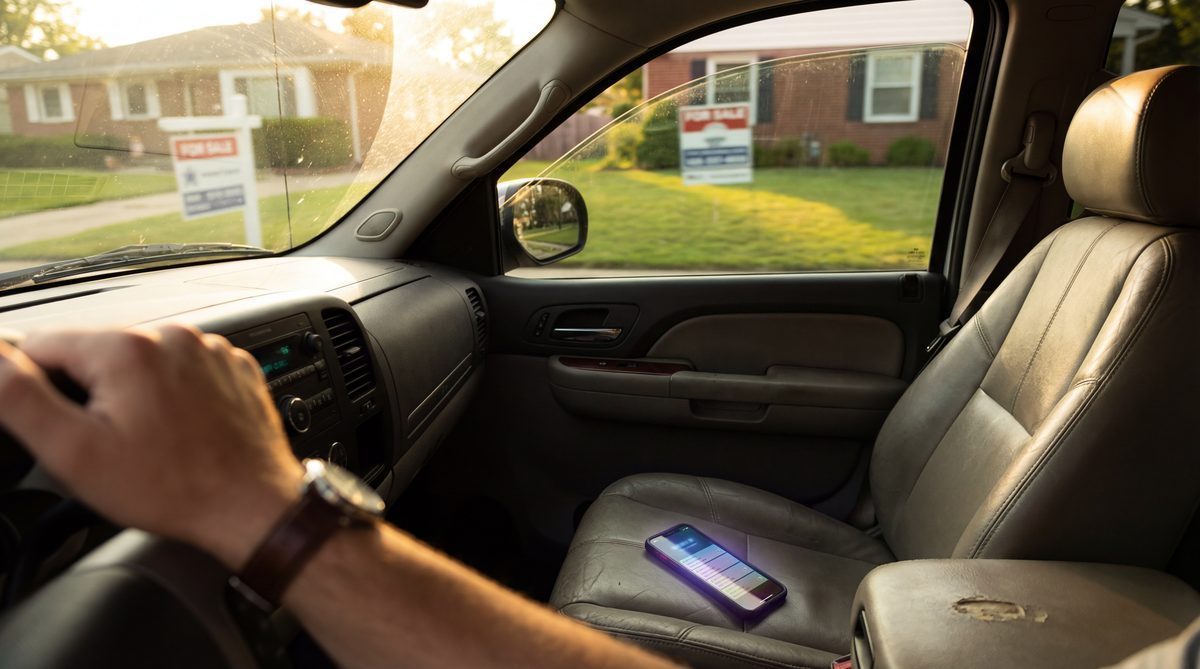
Walk through the math that actually plays out in most real estate businesses. A buyer sees a “for sale” sign on Saturday afternoon and calls the listing number. Voicemail. They tap the second listing on the same street. Someone picks up. By Sunday morning, that buyer has a showing booked with a different agent. Your sign generated the call. The other agent generated the commission.
Real estate brokers and team leaders feel the same pain at scale. National Association of Realtors data shows that 87% of home buyers ultimately purchase through an agent, but they don’t wait for the agent who didn’t pick up. They go to whoever did. The decision tree most agents miss is that “voicemail” isn’t a delay. It’s a competitor referral.
Of inbound real estate leads never get contacted at all. The average agent misses roughly one in three inbound calls, and most of those callers never call back.
Source: Inman + Drift industry researchFor solo agents, the lost-revenue math is brutal. NAR’s quick stats peg the median home sale price north of $400,000, with buyer-side commissions typically running 2.5-3%, call it a $10,000 average commission per closed buyer transaction. Even one missed call per week that converts to a closed deal somewhere else is $40,000-$60,000 in lost annual GCI. For team leads handling listings for multiple agents, the number compounds across the roster.
It gets worse for investor-focused agents and wholesalers. Cash buyers and investor leads convert faster than retail buyers, and they shop harder. BiggerPockets data on investor lead behavior shows that an investor who gets a voicemail on a wholesale deal call typically moves on within 10-15 minutes to the next number on a list. They don’t leave a callback. They just buy the next deal.
The Lead Types Real Estate Pros Lose Most Often
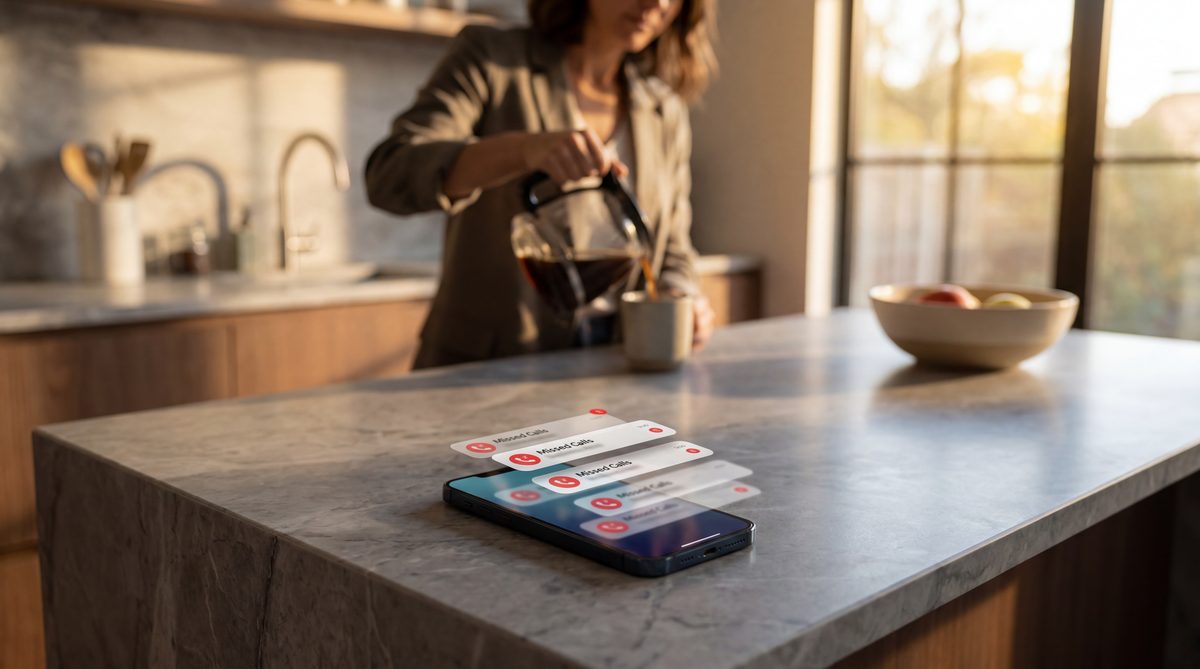
Not every missed call is created equal. The pattern of which calls get lost is predictable, and understanding the pattern is the first step to plugging the leak.
Showing requests off “for sale” signs and Zillow inquiries
These are the highest-intent leads in residential real estate. The buyer is physically standing in front of the property or scrolling through listings with active interest. Zillow’s research shows that buyers who request a tour are 3-5x more likely to close within 90 days than buyers who only save a listing. Yet showing-request calls peak Saturday and Sunday afternoons, exactly when most agents are at other showings and physically can’t pick up.
Investor cold calls and wholesale dispositions
Investors call specific agents because they have a deal to move or capital to deploy. They’re calling 3-5 agents per day and going with whoever picks up. There’s no “leave a message and we’ll get back to you” tolerance, the investor moves to the next number on their list within minutes.
Listing inquiry calls from buyer-side agents
If you have an active listing, buyer’s agents call to confirm details, schedule showings, and negotiate. A missed buyer-agent call delays the showing by 24-48 hours. In a competitive market, that’s the difference between an offer this weekend and your listing sitting another week.
Past-client referral calls
The highest-converting leads of all, past clients calling because they want to refer their sister, their coworker, or themselves for the next move. NAR’s Profile of Home Buyers and Sellers shows that 41% of buyers found their agent through a referral. Miss the call, lose the warm intro, and your past client refers them to someone else next week.
”Just looking” calls that turn into transactions
The hardest leads to qualify on the surface, but per Curaytor’s lead conversion data, anywhere from 8-15% of “I’m just curious” inquiries close within 12 months. Send those to voicemail and they almost never come back.
Why Real Estate Is Uniquely Bad at Phone Coverage
Three structural realities of real estate work make phone coverage almost impossible without help.
Showings happen during prime call hours
The hours buyers call are exactly the hours agents are running showings. HomeLight’s agent surveys show top producers run an average of 4-7 showings per week, almost all on evenings and weekends. Each showing pulls the agent off the phone for 60-90 minutes minimum, including drive time. During open houses on Saturday and Sunday, the highest-call-volume hours of the week, most agents can’t reach their phone at all.
Lead volume is wildly inconsistent
A single Zillow Premier Agent campaign or a viral listing can flood you with 30 calls in a day, then nothing for a week. Real Trends industry analysis notes that top-producing agents see lead volume swings of 5-10x week over week, and the high-volume weeks are usually triggered by something with high opportunity cost (a hot new listing, a lead-gen campaign you’re paying for). Hiring a receptionist for the average doesn’t work because the average doesn’t exist.
Agents drive constantly
Even outside showings, agents are in the car between properties, lockbox runs, signing meetings, and inspections. Hands-free helps, but a buyer who calls while you’re parking in a tight driveway doesn’t get answered, and they don’t leave a voicemail asking you to call back when convenient. They call the next agent.
Real estate leads contacted within one minute close at seven times the rate of leads contacted in 30 minutes. After an hour, conversion rates collapse by 80%+.
Source: MIT InsideSales lead response studyThe structural bottom line: every solo agent and small team is leaking money on missed calls every single week. The only question is whether you’ve measured how much and what you’re going to do about it.
What Real Estate Callers Actually Need on the Call

Generic advice about “answering the phone professionally” misses what real estate callers actually want. The ask is specific.
Someone who can answer basic property questions
“How many bedrooms?” “What year was the roof replaced?” “What’s the HOA fee?” “Is the seller open to a 60-day close?” If the answering service can pull from the MLS listing in real time, you’ve removed the most common reason a caller hangs up frustrated and dials a competitor.
Someone who can book the showing right then
Not “I’ll have the agent call you back.” A real time slot, on the agent’s calendar, confirmed before the call ends. The buyer who got to “I have a 3 PM Saturday available” stops shopping. The buyer who got “we’ll call you back” keeps shopping.
Someone who qualifies pre-approval status without it feeling like an interrogation
Top agents don’t waste showings on tire-kickers, but they also don’t want to scare off serious buyers with a 10-question pre-qual interrogation. A natural conversational flow that captures lender, timeline, and price range during the showing-request call is the difference between a 50%-show-up rate and an 85%-show-up rate.
Someone who actually pushes the lead into a CRM
The lead has to land in Follow Up Boss, KvCORE, Lofty, Sierra Interactive, or whatever stack the agent uses, automatically, with all captured fields, timestamped. If the answering service hands you a sticky note (or a daily email of leads from yesterday), you’ve added a transcription tax to every lead.
Someone who texts the buyer immediately
Half of real estate buyers prefer text to phone after first contact. BrightLocal’s consumer surveys show that response speed is the single biggest factor in conversion across local services. A buyer who hangs up and gets a text within 30 seconds, “Confirmed for Saturday at 3 PM. Address and lockbox code coming via separate message”, won’t be calling another agent that afternoon.
How many showings are you losing right now to missed calls?
We’ll mystery-shop your business, call during a Saturday open house, call at 8 PM on Sunday, call from a “buyer” number you’ve never seen, and show you exactly where the leads are slipping. Free. Results in 48 hours.
The Three Categories of Real Estate Answering Services
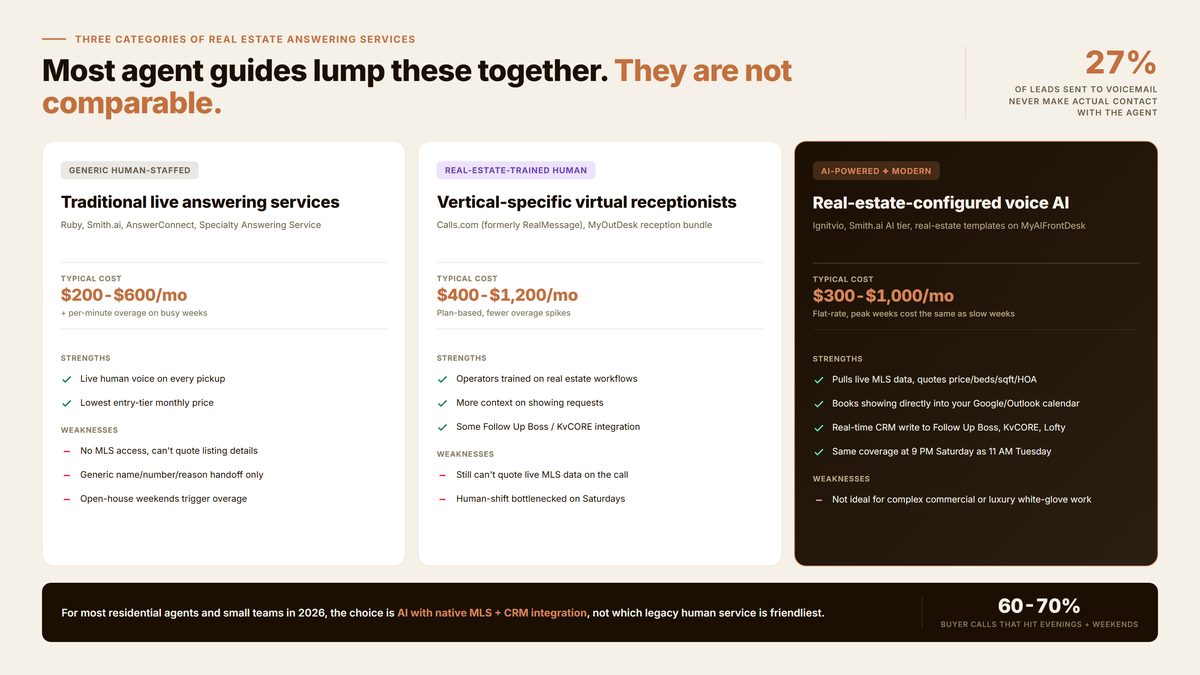
A solo agent or team lead shopping for an answering service in 2026 faces three very different categories. The wrong choice wastes money without fixing what you’re actually losing.
Traditional live answering services (Ruby, Smith.ai, AnswerConnect, Specialty Answering Service) employ remote human operators who pick up, follow a basic script, and email you a message. Most of these services don’t integrate with real estate-specific CRMs, they hand off a generic name/number/reason. The operator usually can’t access your MLS, can’t book a showing on your calendar, and can’t quote any listing details. You still call the buyer back later, which means voicemail tag, which means 27% of those leads never actually reach you per Drift’s lead-response research.
Pricing typically runs $200-$600/month for solo agent volume, with per-minute overage fees. Open house weekends and listing-launch weeks are the months overage fees actually hurt, your busiest weeks become your most expensive answering service weeks.
Real estate-specific virtual receptionist services are a smaller category, Calls.com (formerly RealMessage), MyOutDesk’s reception bundle, a few others, that train operators on real estate workflow. Better than generic, but still human-bottlenecked. They handle showing requests with more context than a generic operator, but they still can’t quote MLS data live or book directly into your CRM in most cases.
AI-powered answering services work fundamentally differently. The AI picks up, pulls listing data from your MLS feed, qualifies the buyer’s pre-approval status, books the showing on your calendar, and writes the lead to your CRM in real time. There’s no message pad, no callback queue, no overage tier. Modern AI answering services like the Ignitvio platform handle the natural back-and-forth of a buyer asking “is this still available, and can my husband and I see it Saturday morning?” without sounding like 2018-era IVR phone trees.
Pricing is typically $300-$1,000/month flat, peak weeks cost the same as slow weeks. For an agent whose best months are 5x their worst months, this is the only cost structure that doesn’t penalize success.
When AI Beats Human (and the Few Cases It Doesn’t)
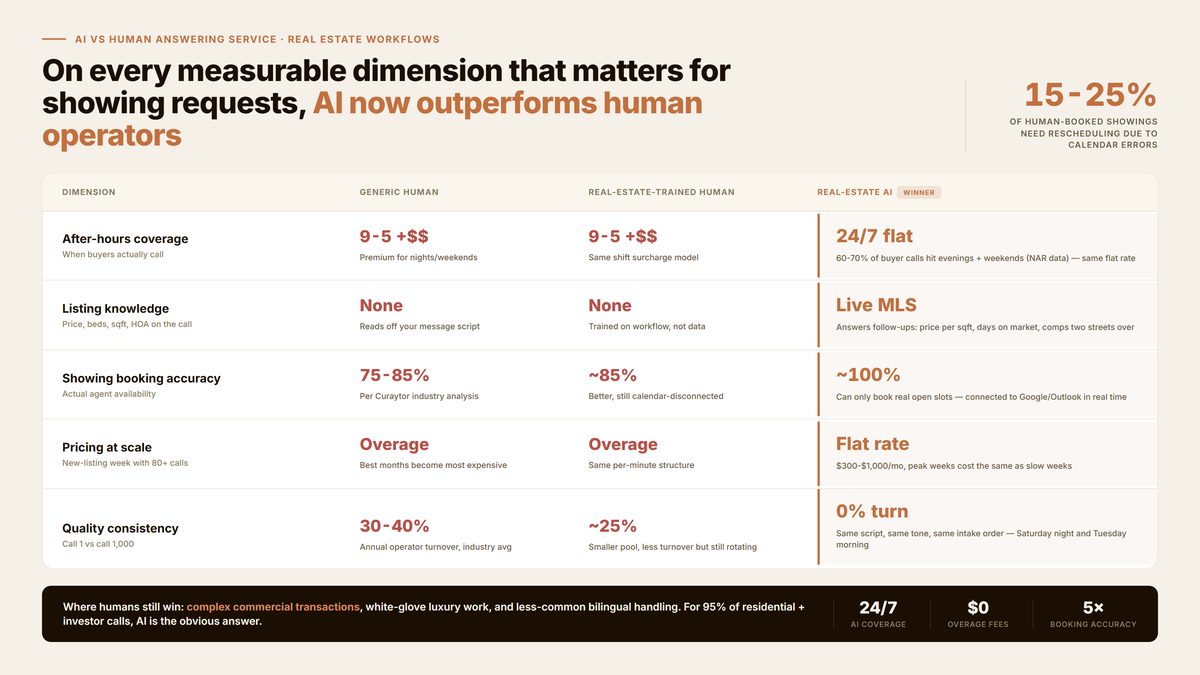
For high-volume, predictable workflows like real estate showing requests, AI now outperforms human operators on every measurable dimension.
Coverage
A human service charges premium for after-hours and weekends, exactly when buyers actually call. NAR’s call-pattern data shows that 60-70% of buyer-initiated inquiries happen evenings and weekends. AI runs 24/7 at the same flat rate. There’s no shift differential, no after-hours surcharge, no “we don’t cover Saturdays after 6 PM.”
Listing knowledge
A human operator across hundreds of agent accounts can’t memorize your active listings. They can read off a sheet, but they can’t answer follow-ups about “what’s the price per square foot vs the comp two streets over?” An AI tied to your MLS feed handles those questions because it has the data live. For listing-side calls, this is a massive quality gap.
Showing booking accuracy
Human operators routinely double-book or miss the agent’s actual availability. Curaytor’s industry analysis notes that 15-25% of showings booked through generic answering services need to be rescheduled because the agent wasn’t actually free at the booked time. AI integrated with your calendar doesn’t make that mistake, it can only book real open slots.
Pricing at scale
Human services hit you with overage fees during your highest-volume weeks. A new listing launch that generates 80 calls in three days will trigger overage charges that nullify the savings of going with a “cheap” plan. AI is flat-rate.
Quality consistency
Every human operator has good days and bad days, and the answering service industry averages 30-40% annual turnover. The “great operator” who learned your listing inventory last quarter is probably gone now. AI doesn’t turn over and follows your script the same way on call 1 and call 1,000.
Where humans still win: highly complex commercial real estate transactions involving multi-party negotiations, white-glove luxury work where the answering experience itself is part of the brand, and bilingual handling in less-common languages. For 95% of residential and investor work, AI is the obvious answer.
What to Look for Before You Sign Up

If you’re shopping for a real estate answering service, skip the feature lists and focus on these five capabilities. These are what actually matter.
MLS / listing data integration
The service must be able to pull live listing details, price, beds, baths, sqft, year built, HOA, days on market, and read them naturally on the call. If the service has to text you for “what’s the address again,” you haven’t automated anything.
Real CRM push
The lead has to land in your CRM (Follow Up Boss, KvCORE, Lofty, Sierra Interactive, BoomTown, CINC, Wise Agent) automatically with all captured fields populated. Verify the integration is two-way: real-time calendar availability for booking, not just lead writes.
Showing booking tied to calendar
The AI must see your real Google/Outlook/CRM calendar in real time and only offer slots you’re actually free for. Anything less and you’ll burn weekends rescheduling.
After-hours coverage included
Check that after-hours, weekend, and holiday calls are covered at the same rate. Many traditional services advertise “24/7” then surcharge anything outside 9-to-5. For real estate specifically, after-hours coverage is when the actual shopping happens.
Missed call text back
Even the best answering setup misses an occasional call (network drop, AI handoff failure). A good system automatically SMSes any missed caller within 30 seconds: “Sorry we missed you, is this about a showing or a property question?” This recovers most of what would otherwise leak. See our breakdown of missed call text back for service businesses for the mechanics.
How Ignitvio Handles Real Estate Calls

Ignitvio is a done-for-you AI answering system built for solo agents, real estate teams, brokerages, and investor-side operators who are losing showings and deals to missed calls but can’t justify a $50,000/year inside-sales rep to fix it.
Here’s what it does for a real estate business:
- Voice AI answers every call, during showings when both hands are busy, evenings when the team’s off, and weekend open houses when the phone won’t stop. It picks up within 2 rings, sounds natural, and books the showing on the call.
- Live MLS lookup, the AI pulls from your active listings to answer the most common buyer questions (price, beds/baths, square footage, year built, HOA, recent updates, days on market) without needing to escalate. Buyers get real answers, not “let me have the agent call you back.”
- Buyer pre-qualification, conversationally, captures lender status, timeline, price range, and bedroom count without sounding like a credit application. The lead lands in your CRM with all the qualifying detail you need to prioritize follow-up.
- Native CRM integration, Follow Up Boss, KvCORE, Lofty, Sierra Interactive, BoomTown, CINC. The booked showing hits your calendar before the call ends. The lead with full context lands in your CRM tagged by source.
- Investor / wholesale routing, investor cold calls get routed differently from buyer leads. Capture the deal address, asking price, and motivation level in a structured form, then ping your phone if the deal score crosses a threshold you set.
- Missed Call Text Back catches anything the AI couldn’t handle. Dropped call? Bad cell signal at the showing? Instant SMS: “Sorry we missed you, what can I help you with?” The AI picks up the text conversation and books the showing or routes the question.
- Automated follow-up chases every showing-but-no-offer lead and every “I’m not ready yet” inquiry. Gentle nudges at 1, 3, 7, 14, and 30 days, until they book or opt out. You recover the buyers who would otherwise vanish into the next agent’s pipeline.
The highest-impact change for an agent or small team is keeping the warm leads they already had. The buyer who called your sign on Saturday and didn’t reach you is a lead you already paid for in marketing, signage, and listing prep. Catching that one call pays for the entire system.
Without Ignitvio vs. With Ignitvio
- 28-35% of inbound calls go to voicemail, most callers never call back
- Showings double-booked or scheduled for times you're not available
- Saturday and Sunday calls go to voicemail during open houses
- Investor cold calls hit voicemail and the investor moves to the next number
- Leads sit on sticky notes or in operator emails, never make it to the CRM
- Past-client referrals get sent to a competitor when you don't pick up
- Every call answered within 2 rings, 24/7/365
- Showings booked only into real open calendar slots
- Open house weekends fully covered at flat rate, no overage fees
- Investor calls routed and qualified with deal details captured live
- Every lead pushed to Follow Up Boss / KvCORE / Lofty automatically
- Past-client warm intros captured and routed instantly
Illustrative comparison of the two operating models, not a measured client result.
The math is straightforward. If you miss 10 high-intent calls per month and the system captures 6 of them, and 1 in 4 of those captured leads converts to a closed buyer transaction over the following 12 months at $10,000 average GCI, that’s $18,000 per quarter in recovered commission revenue from a single channel. For team leads or brokers running multiple agents, the per-agent math compounds across the roster.
Setup runs under a week. We configure it for your service area, your active MLS feeds, your CRM, your team’s calendars, your showing-instructions language, your investor-call routing, your weekend coverage rules, and your standard follow-up cadence. You tell us how you want each lead type handled. We build it in. Then it runs.
Stop Losing Buyers to the Next Agent Who Picks Up
See how many showings and leads you're losing right now
We'll mystery-shop your business, including a Saturday open house call, a Sunday evening listing inquiry, and an investor-style cold call, and show you exactly how many leads are slipping and what they're worth. Free. No pitch.
Get Your Free Revenue Audit
Jake Melendy
Founder, Ignitvio
Jake Melendy is the founder of Ignitvio. He spent 12 years in enterprise sales and sales leadership, including at Oracle, before building Ignitvio, which runs done-for-you outbound appointment setting for commercial contractors and B2B service companies. He writes about pipeline, trigger-based prospecting, and lead response.