Speed to Lead: The Complete Guide for Service Businesses [2026]
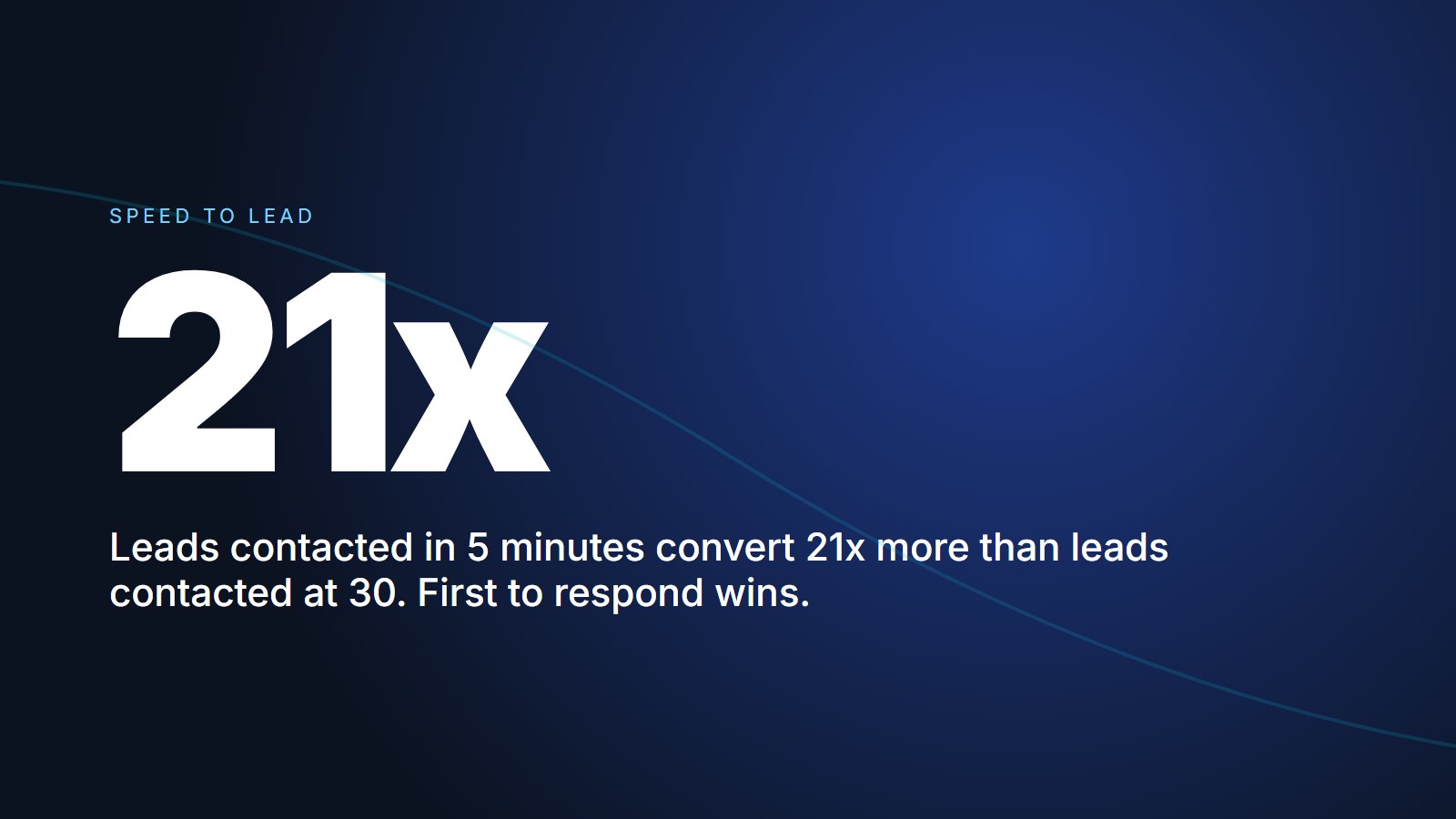
- Speed to lead is the #1 predictor of conversion. Companies that respond within 5 minutes are 21× more likely to qualify a lead than those that wait 30 minutes.
- The average B2C lead waits 47 hours for a response, and 73% of leads are never contacted at all. Most businesses are losing the deal before they ever know it exists.
- Service businesses bleed the most. Multi-quote shopping behavior means whoever responds first usually books the job, even when they aren’t the cheapest or highest-rated.
- Adding inbound reps doesn’t fix speed to lead. A team of 5 reps cannot answer every inbound lead in under 5 minutes 24/7/365. The coverage math doesn’t work.
- AI voice + instant text-back + persistent follow-up is the only architecture that delivers sub-30-second first response at scale, on every channel, around the clock.
- Speed to lead governs inbound. For outbound-sourced meetings the equivalent lever is trigger timing: reaching the buyer in the week a permit, a building sale, or a contract renewal puts them in a buying window.
Owners tell us the same story on nearly every call, and it starts on a roof or in a crawlspace. The phone rings while the owner is the one doing the work, it goes to voicemail, and by the time the truck is back on the road the homeowner has booked with whoever picked up. The same owner is usually the only person selling, so the prospecting that would fill the gaps in next month’s schedule never happens either: the servicing eats the day, and the chase gets pushed to a Sunday that never comes. Both are timing problems. This guide is about the first one: how fast an inbound lead turns into a real conversation, and what it costs when the honest answer is “whenever we get to it.”
If you arrived here from the done-for-you lead generation pages, one framing note before the research. Speed to lead governs the inbound side of the pipeline: the prospect who calls, fills out a form, or texts you first. On the outbound side, where a dedicated caller is sourcing meetings with facilities directors and property managers, the equivalent lever is trigger timing: reaching that buyer in the week a permit is filed, a building changes hands, or the incumbent’s contract comes up for renewal, before they start shopping. Same principle, opposite end of the pipeline. This guide covers the inbound side in full; the outbound side lives on the lead generation hub and the vertical pages under it.
What Is Speed to Lead?
Speed to lead is the time between a prospect raising their hand, submitting a form, calling, texting, clicking an ad, and a real person (or system) actually engaging with them. Not a confirmation email. Not “we’ll get back to you within 24 hours.” Engagement. A conversation. A booked appointment.
The reason it has its own name is that it behaves nothing like the other metrics in a sales funnel. Conversion rate, close rate, average deal size, these all sit on a relatively flat curve. Speed to lead does not. It collapses.
The foundational research came out of a multi-year study by James Oldroyd, published in Harvard Business Review as “The Short Life of Online Sales Leads.” Oldroyd’s team analyzed millions of inbound leads across hundreds of B2C and B2B companies and measured what happened when companies responded fast versus slow. The result, buried in a single chart, has shaped how every modern sales team thinks about response time:
Companies that contacted prospective customers within an hour of receiving a query were nearly 7× more likely to qualify the lead than those that tried to contact the customer even an hour later, and 60× more likely than companies that waited 24 hours or longer.
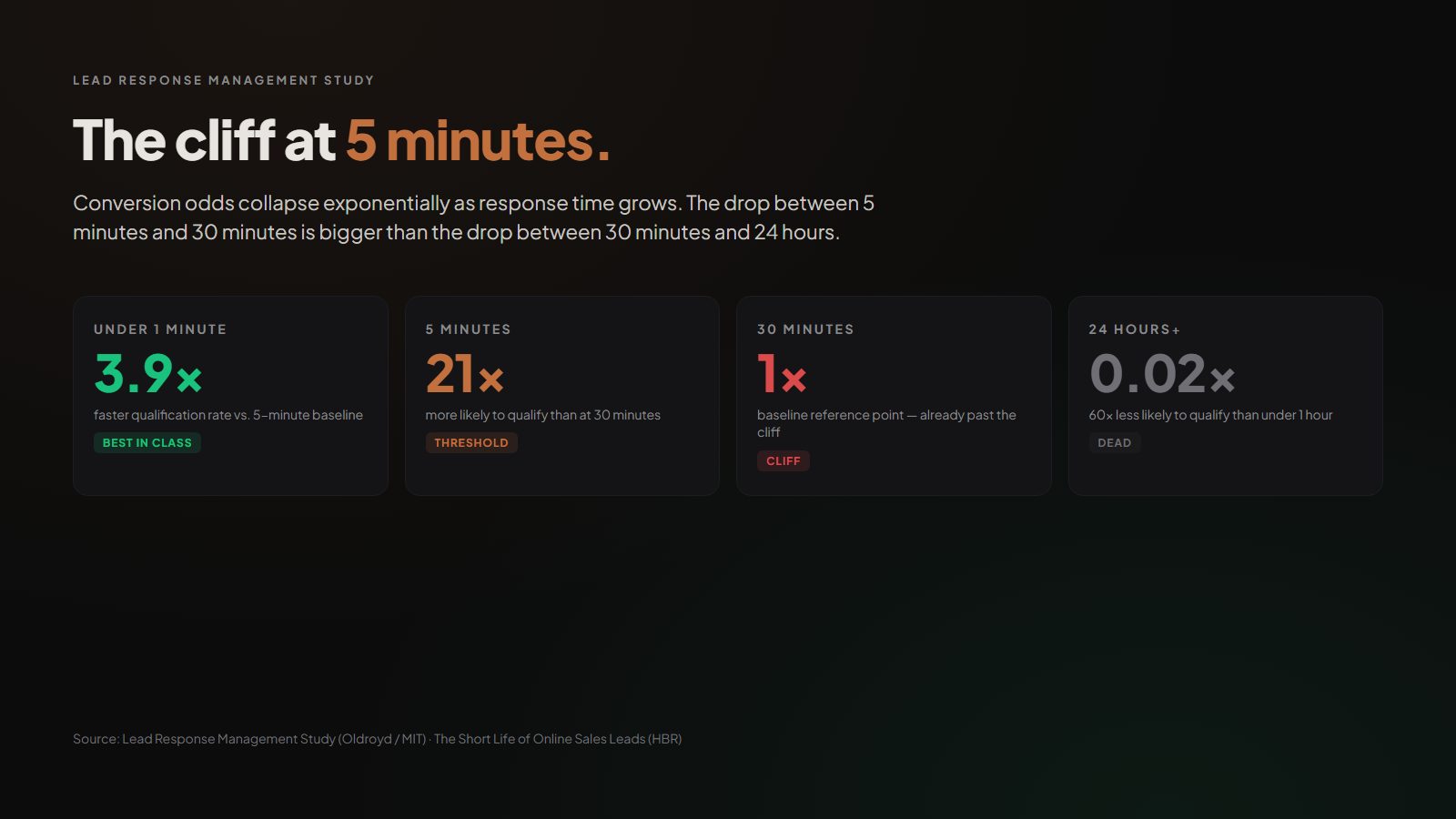
The follow-up Lead Response Management Study went tighter on the time window. It found that responding inside the first 5 minutes made you 21× more likely to qualify a lead than responding at 30 minutes. After 5 minutes, the curve falls off a cliff.
That cliff, that single chart, is the entire reason speed to lead exists as a discipline. It is the rare metric where being seventh place is essentially the same as not showing up at all.
Leads contacted within 5 minutes are 21 times more likely to qualify than leads contacted at 30 minutes. The drop is exponential, not linear.
Source: Lead Response Management Study (Oldroyd / MIT)A useful working definition for service businesses, then, is this: speed to lead is the elapsed time between an inbound signal and a real human conversation that ends in a booked appointment or a clear next step. Not the email auto-responder. The conversation.
Why Speed to Lead Matters 10× More for Service Businesses
The original Oldroyd research was mostly built on B2B SaaS leads, software trials, demo requests, content downloads. The 21× number was striking enough on its own. But for local service businesses, HVAC, roofing, plumbing, dental, property management, the dynamic is even more brutal. The property-management variant is severe enough that we covered it in its own deep-dive on answering service coverage for property management companies, where after-hours emergency triage is the primary driver of NOI.
The reason is shopping behavior. When a homeowner’s air conditioner dies on a Saturday afternoon, they don’t research one HVAC company and wait. They open Google, pull the top three results, and call all of them at once. The contractor who answers first is usually the one who books the job, often regardless of price or reviews. The same behavior shows up on the commercial side when a facilities director has a rooftop unit down in August: the first mechanical contractor who picks up and can get a tech on the roof today wins the call, and often the maintenance contract that follows.
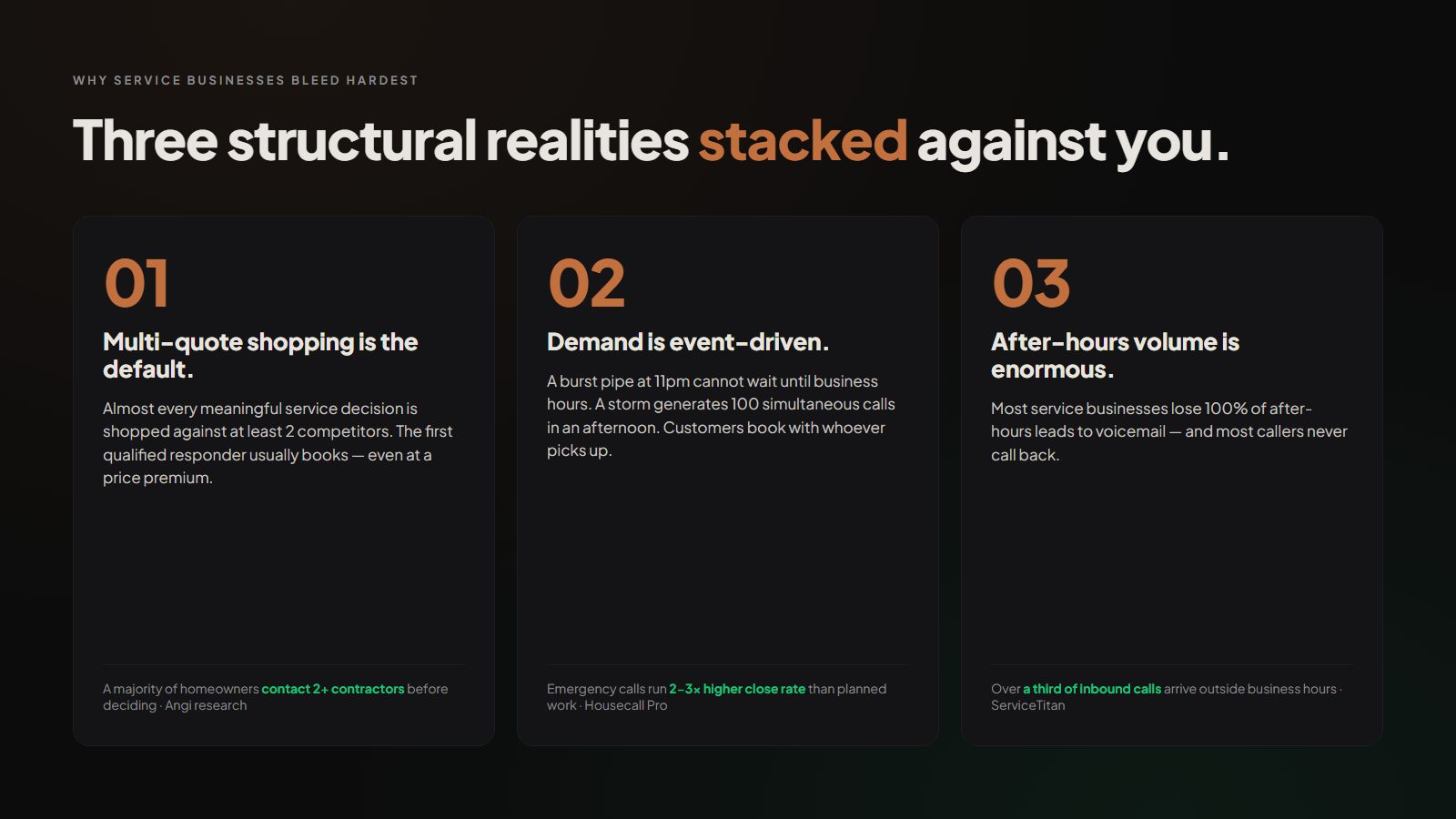
Three structural realities make speed to lead more decisive for service work than for almost any other category:
1. Multi-quote shopping is the default
Almost every meaningful service decision (a new roof, a furnace replacement, a recurring HVAC maintenance contract) is shopped against at least two competitors. The first qualified response often books the appointment before competitor #2 even has a chance.
2. Demand is event-driven
A burst pipe at 11 PM cannot wait until business hours. A storm-damaged roof generates 100 simultaneous calls in a single afternoon. The customer is in active emergency mode and will book with whoever picks up, even at a 30% premium.
3. After-hours volume is enormous
ServiceTitan’s State of the Trades data shows 14.1% of inbound calls to residential HVAC shops arrived outside business hours in June 2025, the seasonal peak. Most service businesses lose 100% of those leads to voicemail, and most of those callers never call back. The fix is an after-hours answering service that books appointments during the call instead of taking a message and pushing the work to tomorrow.
Stack those three behaviors together and the result is a market where the slow operator is invisible. You can have the best reviews in town and still lose if you’re third on the response queue. The fast operator wins by default.
The Hidden Cost: What Slow Response Time Is Costing You Right Now
The clearest way to feel speed to lead in your bones is to do the math on your own business.
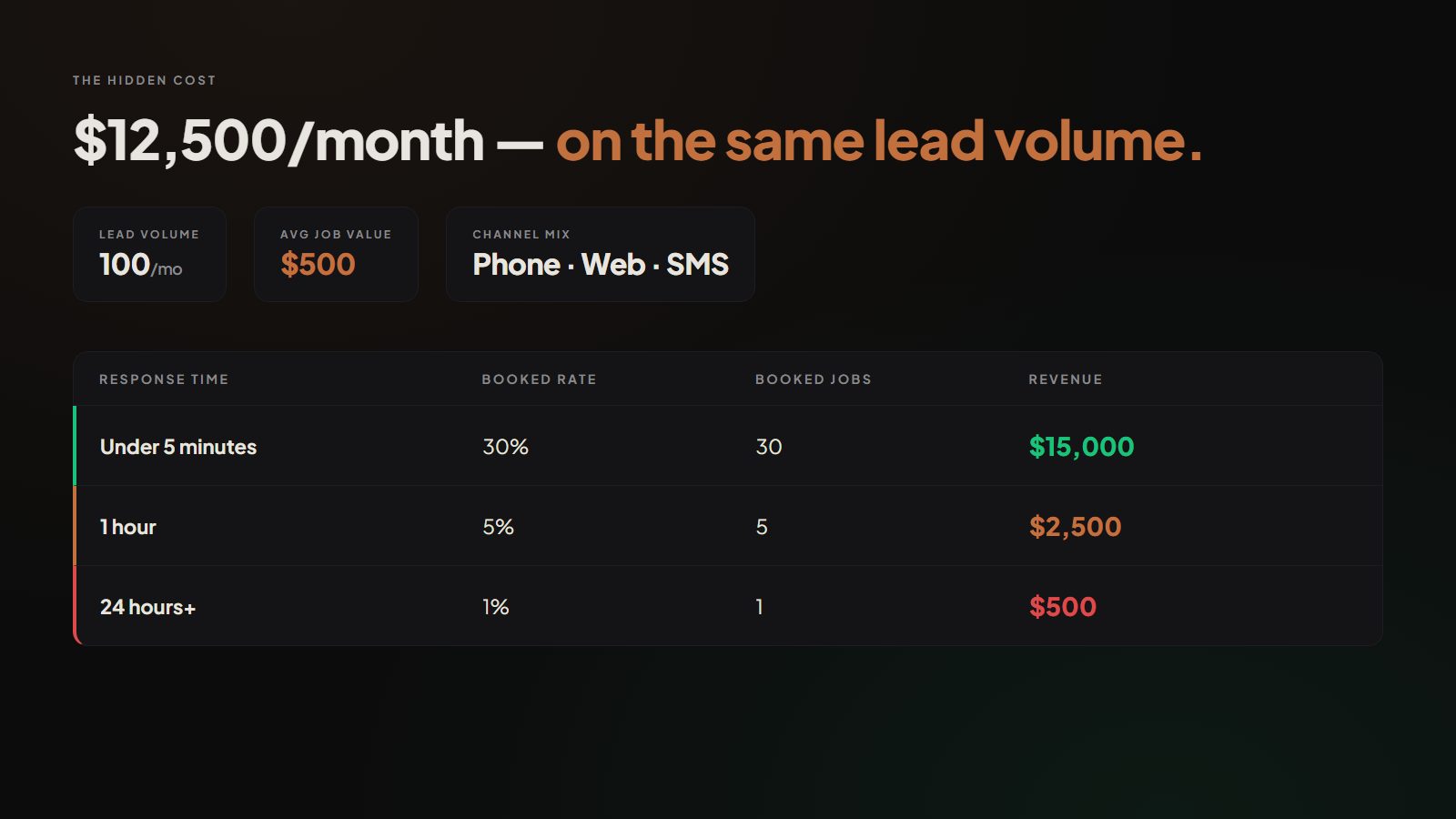
A simple framework. Suppose you generate 100 inbound leads per month from Google, Facebook, and word of mouth combined. The industry-typical response time for a service business is 47 hours, that is the figure Drift documented when they audited several thousand company response patterns. Your real number is probably better than that, but if you measure honestly across nights, weekends, lunch hours, and high-volume mornings, it is rarely under an hour.
If your average job is worth $500 (lower end of HVAC repair) and your booked-conversion rate at sub-5-minute response is 30%, your booked-conversion rate at 1-hour response is closer to 5% based on the Lead Response Management curve. That is not a 6× gap in revenue, that is a 6× gap in every dollar that touches your funnel.
Run that against the 100 leads:
| Response Time | Booked Rate | Booked Jobs | Revenue at $500 avg |
|---|---|---|---|
| Under 5 minutes | 30% | 30 | $15,000 |
| 1 hour | 5% | 5 | $2,500 |
| 24 hours+ | 1% | 1 | $500 |
The difference between best-in-class and industry-typical response time, on the same lead volume, is $12,500 per month, or $150,000 per year, for a single small service business.
This is the math behind every “we just need more leads” conversation that goes nowhere. The leads aren’t the bottleneck. The first 5 minutes are.
And if you genuinely do need more top-of-funnel volume, the plumbing lead generation and electrician marketing playbooks cover that side. Speed to lead decides how much of it you keep.
HVAC Lead Response Time: A Worked Example
The table above uses round numbers. Here is the same math on a residential HVAC shop, where the after-hours spike and the ticket sizes make the gap easiest to see. Two parts: a five-question self-audit you can run against your own call logs in about 15 minutes, and the expected value of a missed lead by job type. If you run a commercial mechanical contractor, the self-audit applies unchanged to inbound RFQs and service calls; the job-type math is residential, and the commercial note at the end covers the difference.
Most owners underestimate their lead loss because missed calls don’t show up on any dashboard. They show up as “we never got that lead.” Run these five questions against your own logs and be honest with the answers; the math depends on it.
Question 1: How many calls went to voicemail in the last 30 days?
Pull your call logs from your phone provider. Count every voicemail. Then count every call that was missed entirely (rang out, no voicemail left). Do not be surprised if the combined figure is a meaningful share of your total inbound volume, and that is before you count the callers who hung up before voicemail picked up.
Question 2: Of those missed calls, how many got a callback within 5 minutes?
Spot-check 20 random missed calls. Did anyone return the call within 5 minutes? Within 30? Within 2 hours? Overnight? Per the Lead Response Management curve above, a callback at 30 minutes or later qualifies at roughly one twenty-first the rate of a callback at 5 minutes. Write down your median, not your best day.
Question 3: How many web form submissions came in last month, and how fast did your team respond?
Same exercise for web forms. Pull every submission from the last 30 days, look at the timestamp, and compare it to the first outbound action. Anything over 30 minutes is a lead you are probably sharing with two other contractors. Anything overnight (form at 9 PM, response Monday morning) is gone.
Question 4: When did you last receive an after-hours emergency call, and what happened to it?
Did your team take it? Did it route to the on-call tech? Did it hit a message-pad answering service, or ring out to nobody? The ServiceTitan data above puts after-hours volume at 14.1% of inbound residential HVAC calls at the June peak, and those are disproportionately no-cool and no-heat calls, the highest-ticket work on your board, arriving at the exact hours you are least likely to answer.
Question 5: When was the last time you put a dollar figure on lost-lead revenue?
Most shops never do. Take the missed-call count from question 1, multiply by the close rate you hit when you reach a caller fast (use your own number; if you don’t track it, 35% to 50% on a fast-reached caller is a reasonable starting assumption), then multiply by your average ticket. That figure, per month, is what slow response costs you. The revenue gap calculator runs the same arithmetic with your inputs.
If you score poorly on three or more of these, you have a response problem ahead of a marketing problem, and additional ad spend will leak through the same holes until the leads you already pay for get answered.
The job-type math
Headline numbers sound abstract until you break them down by what kind of job is walking out the door. The figures below are illustrative assumptions for a residential HVAC shop; swap in your own tickets and attach rates.
Scenario A: the lost emergency repair. A homeowner calls at 9 PM with a no-cool. Your team has gone home and voicemail catches it. The homeowner calls the next two contractors in the results; one picks up at 9
PM and books a 7 AM visit. You never know the lead existed. The full opportunity:- Emergency diagnostic plus repair: $400-$800
- Maintenance plan attachment (assume 35% of emergency callers join one): $300/year over a 5-year retention window is $1,500
- Replacement within 12 months once the repair proves to be a stopgap (assume 20%, weighted by a 30% chance you are the contractor they call back): $7,500-$12,000
On those assumptions, one missed after-hours emergency is worth roughly $1,200-$3,500 in expected value. Miss eight a month and that single category is $10K-$28K a month.
Scenario B: the lost system replacement quote. A homeowner submits a web form at 8 PM Friday: “Looking for quotes on replacing my 18-year-old AC unit.” Your office sees it Monday at 9 AM. By then the homeowner has two estimates from the weekend and is comparing prices, and you are not in the set. The full opportunity:
- AC replacement: $7,500-$12,000
- Financing margin where it applies: a few points on top
- Maintenance plan attachment: $300/year over 5 years is $1,500
- Referrals from a happy install customer over the following few years
Assume even one downstream referral and the expected value of one missed replacement lead lands around $10,000-$18,000. Miss two a month in peak season and you are down $20K-$36K a month from one category.
Scenario C: the lost peak-season tune-up. A homeowner calls in early May to schedule a spring tune-up. The office is slammed, the call rings out, and nobody calls back until Wednesday. They book with the next contractor on the list. The full opportunity:
- Tune-up: $150-$250
- Maintenance plan conversion (assume 60% on a tune-up caller): $300/year over 5 years is $1,500
- Repair callback within 6 months (assume 25%): $400-$800
- Replacement within 3 years off the relationship (assume 10%): $7,500-$12,000, weighted
Roughly $800-$2,000 in expected value per missed tune-up call. They look small individually; shops routinely miss dozens of these across the spring and fall transition weeks.
Stack all three at modest miss rates and a five-truck residential shop can be leaking $40K-$80K a month in expected revenue, on lead volume it already paid to generate.
The commercial note: get in front of somebody before it goes to bid
If your book is commercial (maintenance contracts on multi-tenant buildings, rooftop unit replacements, tenant-improvement mechanical), the self-audit still applies to inbound RFQs and service calls, but most of your revenue is not sourced inbound. A facilities director with a rooftop replacement across a multi-tenant building rarely fills out a web form; they call the contractor already on site, or the one who reached them the month the building sold. That is why the commercial equivalent of speed to lead is trigger timing, and why the commercial HVAC lead generation page treats permits, building sales, and renewal dates as the clock instead of the inbound form.
Owners who run a commercial book describe the alternative in the same two ways. Either the work comes off a bid board, where they are pricing blind against dozens of shops at a hit rate most of them put at one in ten or worse, or a maintenance account they held for years walks out the door because a new facilities director came in and nobody saw the change coming. Reaching that buyer the month the signal fires turns the job into a conversation instead of a competitive bid, and a conversation is what keeps the backlog full and the crew going through the slow months.
Run the revenue-gap math on your own lead volume
Plug in your monthly leads, average ticket, and current response time. The calculator shows the booked-job gap between where you are and sub-5-minute response. Takes about two minutes.
Open the Revenue Gap CalculatorWhy Adding Inbound Reps Doesn’t Fix Speed to Lead
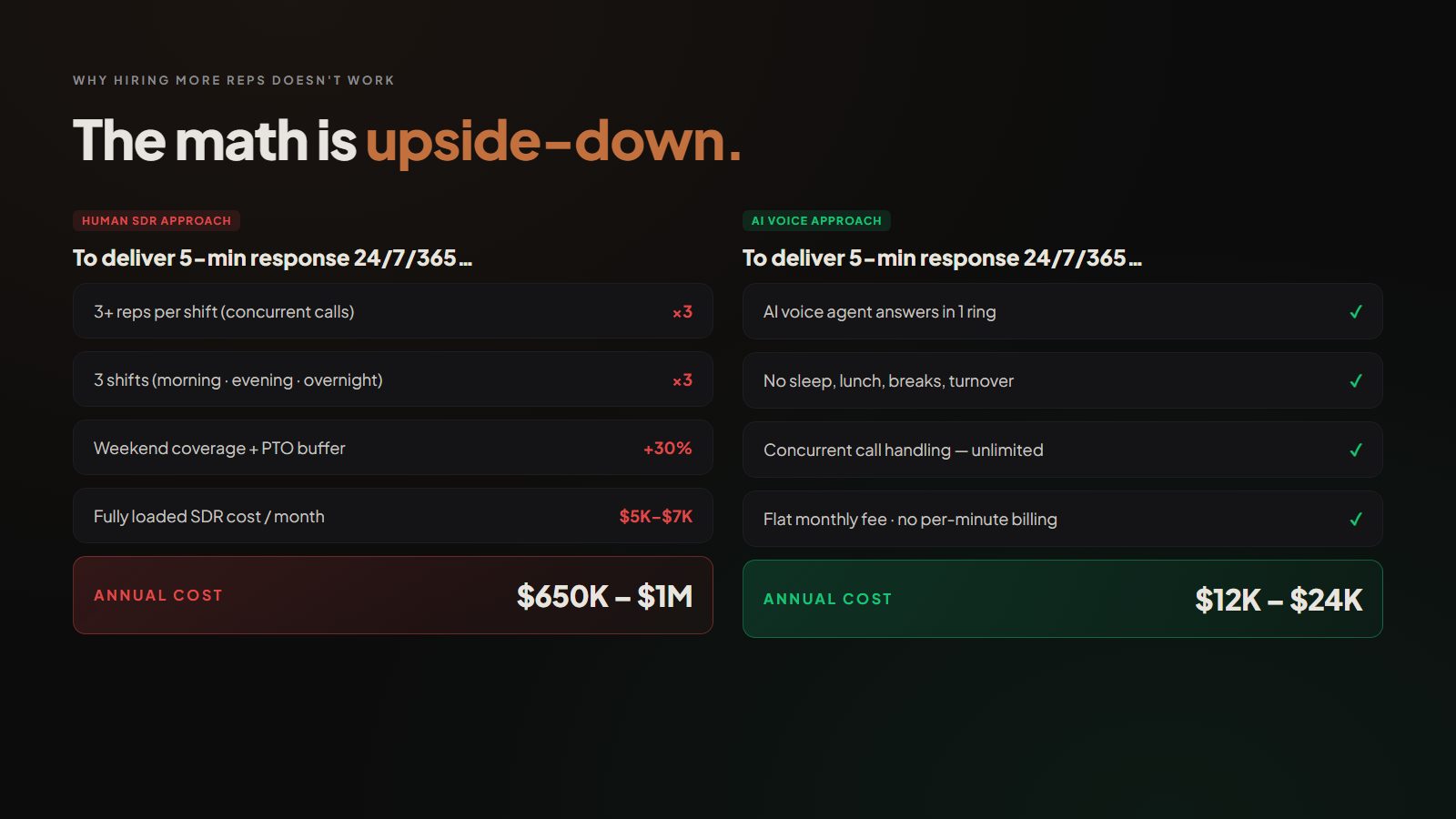
Once business owners see the math, the next instinct is almost always: we’ll just hire more people to answer faster. This is the single most common, and most expensive, mistake in lead operations.
The arithmetic does not work. Speed to lead means 5-minute response, 24/7/365, across phone, web form, text, and chat. To deliver that with an inbound team, you need at least 3 people staffed every shift to handle inbound bursts (because a 5-minute SLA with one person collapses the moment two leads come in within 30 seconds of each other), three shifts a day, plus weekend coverage and PTO. That’s 12-15 full-time inbound reps at a minimum, before you even get to a single sales conversation.
Then add the human factors:
- Sleep. No human is alert at 3 AM Tuesday on a 5-minute SLA.
- Lunch and breaks. Even disciplined teams have 60-90 minutes of dead time in any 8-hour shift.
- Inbound bursts. When a winter storm hits, you don’t get 3 leads per hour evenly spaced. You get 30 in 15 minutes. The 16th lead waits.
- Turnover. Inbound-rep turnover in service industries averages 12-18 months. Every new hire breaks the SLA for their first 90 days.
- Cost. A fully loaded inbound rep runs $4,500-$7,000/month. Twelve of them is $54K-$84K/month, or $650K-$1M/year. For a 100-lead-per-month business doing $50K-$80K/month in revenue, the math is upside-down by an order of magnitude.
Even premium human virtual receptionist services like Smith.ai, which exist precisely to solve this problem, bill per call, with published plans running from 30 calls a month up to 300 before you are into custom enterprise pricing. They are excellent at what they do, but they are not designed to be the front door for a service business doing 1,000+ inbound touchpoints per month at scale.
The deeper reason a bigger inbound team cannot deliver true speed to lead is more fundamental: the cost structure is linear, but the response-time curve is exponential. Doubling your team cuts response time in half at best. Cutting response time from 30 minutes to 30 seconds requires an order-of-magnitude shift in how the work is done.
None of this is an argument against people on the phone. A dedicated caller working outbound, on triggers, is the highest-leverage human seat in a service company’s sales motion, and no software books a meeting with a facilities director the way a person who has done their homework does. The argument is about coverage: a 24/7 inbound SLA is a coverage problem, and coverage is what software is for.
Lead-Response Tactics That Don’t Actually Work
Most service businesses, after running the staffing math and recoiling, default to one of four cheaper tactics. None of them solve speed to lead. Each one creates the appearance of fast response without changing the underlying conversion economics.
Round-robin lead distribution
Tools that auto-route inbound forms to the next available rep. The bottleneck is still human availability. If reps are on a call, eating lunch, or asleep, the lead waits. Round-robin makes assignment faster, not response time.
Generic auto-responders
“Thanks for your inquiry, we’ll get back to you within 24 hours.” This is response theater. It tells the customer you received their message; it does not engage them. They’ve already called the next contractor on their list. The auto-responder lets you feel responsive without being responsive.
Email-first follow-up
Many CRMs route inbound forms to email queues. Email open rates are below 25% for first-time recipients, response time is measured in days, and the prospect has long since hired someone else. HubSpot’s sales research consistently shows email is the slowest meaningful response channel.
Outsourced overseas call centers
Cheaper than U.S. staff but built around rigid scripts that don’t qualify well for service work. Conversion rates fall, customer experience drops, and the savings rarely pencil out against the lost bookings.
The pattern across all four: they each address one piece of the speed-to-lead problem (assignment, acknowledgement, channel, cost) without addressing the actual constraint, which is engaging in a real qualifying conversation in under 5 minutes, every time, on every channel.
The handful of service businesses that actually solve speed to lead end up in the same architecture, regardless of how they got there. It is not a tool. It is a three-layer system.
The 3-Layer System That Actually Delivers Sub-30-Second Speed to Lead
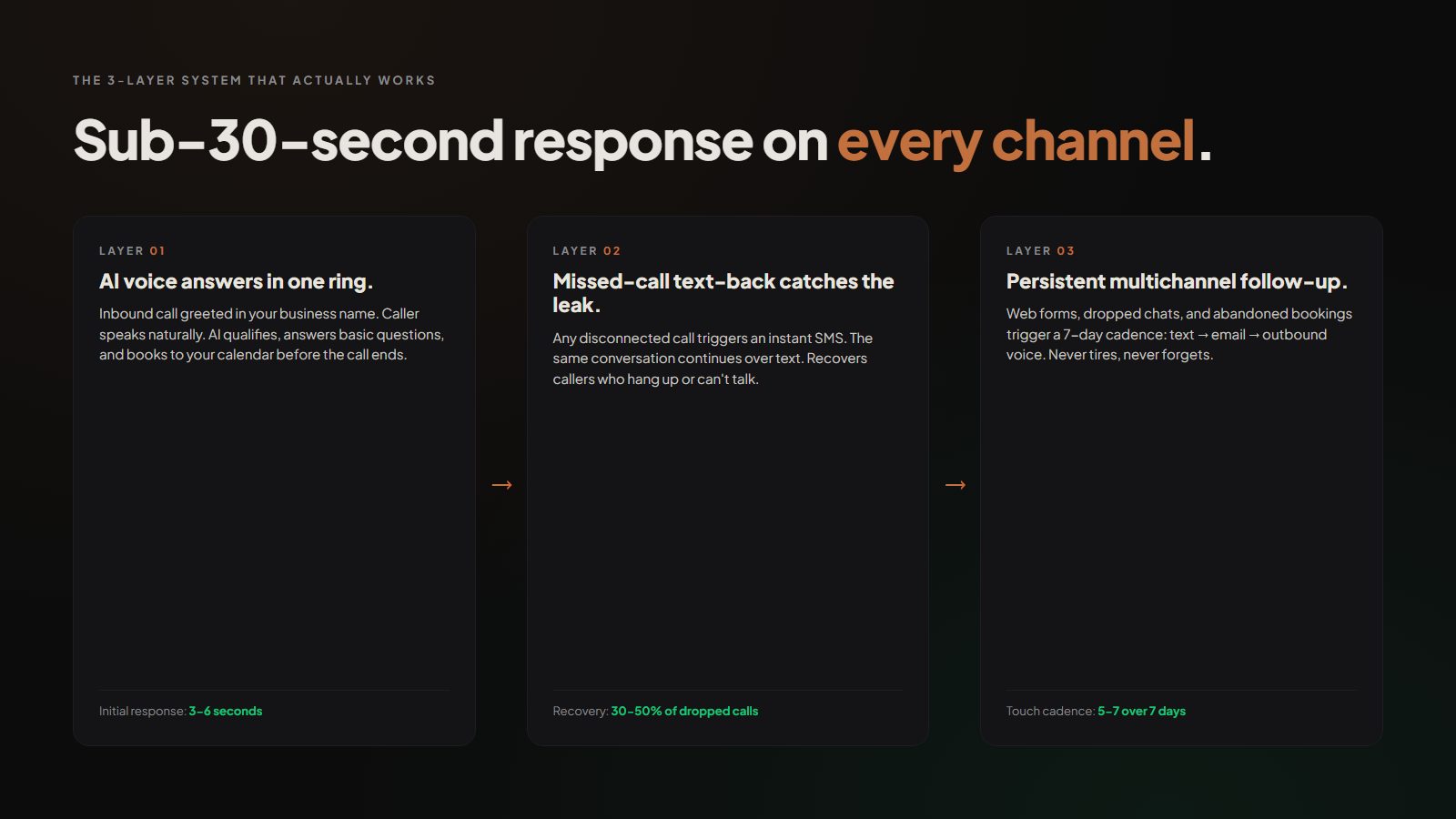
Operators who consistently hit 5-minute response on every inbound lead, including weekends, holidays, and 2 AM emergencies, have stopped trying to do it with people. They built a layered system where AI handles the first response, missed-call recovery is automated, and human attention is reserved for booked appointments only.
The architecture has three layers, and each one closes a specific gap that the other two cannot:
Layer 1: AI voice answers every inbound call within one ring
The call is greeted in your business name. The caller speaks naturally, emergency, scheduled service, quote request, and an AI voice agent qualifies the lead, answers basic pricing and scheduling questions, and books the appointment to your real calendar before the call ends. No hold time. No voicemail. No callback queue. Modern AI voice (the category most service businesses are now adopting under labels like “AI receptionist” or “AI answering service”) routinely runs 3-6 second initial-response times.
Layer 2: Missed-call text-back catches the leak
Not every caller wants to talk to an AI. Some hang up. Some get nervous. Some are calling from a job site and can’t talk. The instant a call disconnects without booking, an SMS goes out automatically: “Hi, this is Jake from XYZ HVAC, sorry we missed you. What can we help with?” The same conversation continues over text. A meaningful share of disconnected callers reply to that text and finish booking over SMS, which is why this layer exists as its own system rather than a feature bolted onto the voice layer.
Layer 3: Persistent multichannel follow-up
Web form fills, dropped chats, and abandoned booking attempts all trigger an automated 7-day cadence: text → email → outbound voice → text again. Invesp research finds that 80% of sales require 5 or more follow-up touches, but 44% of reps give up after one. The system never gets tired. It never forgets to follow up. It treats every lead the same. The lead follow-up playbook for contractors breaks this exact cadence down for contracting businesses, including what to send at each touch. Speed to lead is the highest-ROI piece, but it works best alongside the other small business automation workflows worth prioritizing first, from review requests to appointment reminders.
Stitch the three layers together and the result is a system that responds to every inbound signal in under 30 seconds, qualifies it, and either books the appointment or hands a hot lead to a human, without anyone on the team picking up a phone.
This is what “speed to lead” actually looks like when it is built right.
Speed to Lead Software: How to Compare Your Options
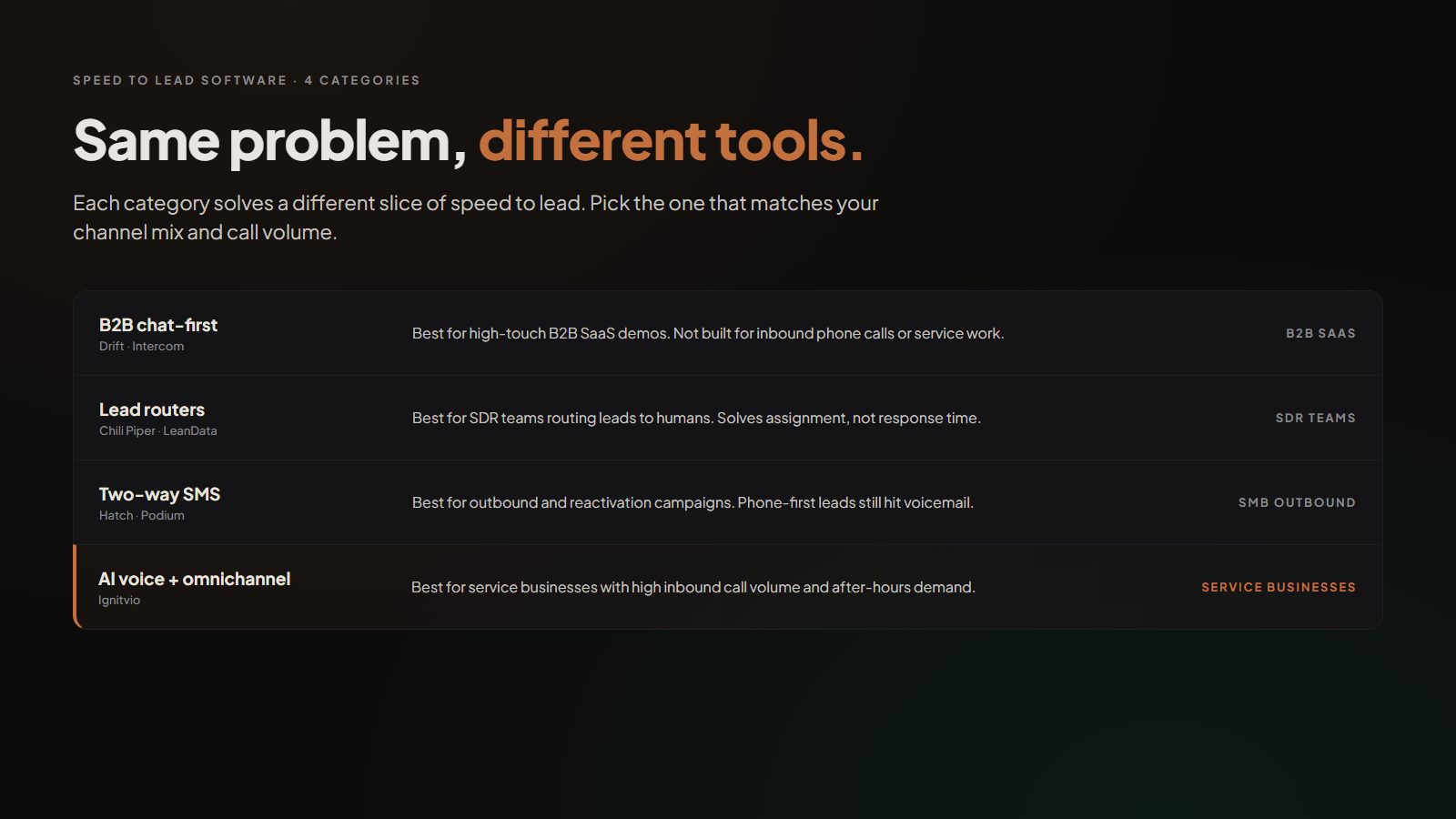
The category has crowded fast. A few years ago, “speed to lead” usually meant a CRM feature, a notification that pinged your phone when a lead came in. Today there are at least four distinct product categories under the umbrella, and they solve very different problems. Knowing which one fits your business saves a lot of money.
- B2B chat-first platforms (Drift, Intercom)
- Round-robin lead routers (Chili Piper, LeanData)
- Two-way SMS platforms (Hatch, Podium)
- AI voice + missed-call text-back + follow-up (Ignitvio's inbound capture layer)
- Best for high-touch B2B SaaS demos. Not built for inbound phone calls or service work.
- Best for SDR teams routing leads to humans. Solves assignment, not response.
- Best for outbound and reactivation campaigns. Phone-first leads still hit voicemail.
- Best for service businesses with high inbound call volume and after-hours demand. At Ignitvio this stack runs underneath a done-for-you outbound appointment-setting engagement; the outbound side is the offer.
When evaluating any speed-to-lead solution for a service business, the questions that actually matter are:
Does it answer phone calls, or only digital channels?
Most service business leads still come by phone. A chat-only or text-only tool leaves your biggest channel uncovered.
Does it run 24/7 with no per-minute billing?
Per-minute pricing models punish you for high call volume, exactly when you most need coverage. Flat-rate AI delivers predictable cost regardless of inbound volume.
Can it actually book the appointment, not just qualify?
A “fast response” that ends in “a sales rep will reach out shortly” is response theater again. The system must close the loop on the call.
Does it integrate with your existing CRM and calendar?
A standalone tool that requires manual data transfer is a leak waiting to happen.
What is the qualification quality?
Speed alone is not enough, a fast system that can’t tell an emergency from a quote request creates new problems. Good systems handle nuanced qualification with industry-specific scripts.
The consistent pattern among operators who win speed to lead: they treat it as a system, phone, text, web form, after-hours, follow-up, and pick a platform that covers the whole surface, not a tool that solves one channel.
Where Speed to Lead Fits in the Ignitvio Offer
At Ignitvio, the three layers above are the inbound capture layer, the supporting half of the system. Voice AI answers the call, qualifies, and books to your calendar; missed-call text-back picks up the disconnects over SMS; lead follow-up runs the multi-touch cadence on every form fill and unbooked call. They exist so that nothing your marketing already generates leaks out the side. The offer itself is outbound: a dedicated human caller working trigger data to book qualified meetings with the buyers who never fill out a form. The one proof point we publish is an anonymized commercial roofing client whose first closed deal from the engagement came inside 45 days and returned more than 100% of what they had paid before the second milestone payment came due.
Who is on the phone, and who decides a meeting counts
Owners who have bought meetings before tell us the same story: they drove to a walkthrough where the person on the other side did not know who they were, had only said yes to get the caller off the phone, could not sign anything, or never showed up, and the invoice arrived anyway. That history is why the outbound side of this offer is built the way it is. The caller is a US-based person on our team, trained in your trade and in your own words, and dedicated to your account; no call center rotation and no AI dialer. A meeting never counts on the honor system. The qualification criteria are written down at onboarding, and every meeting comes to you before it happens with three options: approve it, send the caller back for more information, or cancel it at no charge. Callers are not commissioned on meetings that miss the criteria, so they are paid to disqualify. The qualified-meeting minimum goes in the contract, the team keeps working free until it is hit, and the refund election on the build fee sits at an agreed gate rather than in a phone call three months later. One client per vertical per metro, so the caller is never working your competitor across town.
Done-for-you outbound
Where done-for-you outbound fits
Ignitvio runs outbound for you: a dedicated human caller (never a call center, never AI dialing) working alongside cold email and LinkedIn, armed with trigger data such as permits, zoning approvals, personnel changes, building sales, lease events, and contract renewal dates. Every meeting is qualified against criteria we agree on up front and approved by you before it counts. The qualified-meeting minimum goes in writing, and if we miss it we keep working at no charge until it is hit.
-
We qualify
Every prospect is screened against criteria we agree on with you up front.
-
You approve
A meeting counts toward the minimum only after you sign off on it.
-
You close
Your team runs the meeting and the deal. We keep the calendar full.
Built for B2B service companies above $3M.
Speed to Lead FAQ
What is a good speed to lead time?
Under 5 minutes is the threshold where the conversion curve still pays off. Under 1 minute is what best-in-class service businesses are now hitting on inbound calls. Above 30 minutes, you have lost most leads to faster competitors.
Can AI really replace a human SDR for first response?
For first response and qualification on inbound leads, AI voice now handles the natural conversation, triages emergencies, books appointments, and hands off cleanly to a person for closing, and it does it at 3 AM at the same speed as 3 PM. The argument is about coverage, and coverage is where software wins. People remain the highest-leverage seat in the sales motion; they belong on the warm, qualified conversation and on outbound, where a dedicated caller working triggers books meetings no inbound system will ever see. Put software on the 24/7 first response and people on the conversations that close.
Does speed to lead matter for high-ticket sales like roof replacements?
Yes, arguably more. The decision involves multiple quotes, and the first qualified responder gets to set the anchor price and build trust before competitors reach the homeowner. On commercial re-roofs the buyer rarely arrives inbound at all, which is why the commercial roofing lead generation page is built around trigger timing instead.
How do I measure my current speed to lead?
Pull your last 30 days of inbound calls and measure the gap between call time and the first outbound action (callback, text, email). Do the same for web form fills. Most service businesses are shocked to discover their actual median is over an hour. If you would rather have it measured for you, the Free Pipeline Audit includes a lead response check of your form, phone line, and after-hours handling alongside a sample prospect list and trigger map for your metro.
What’s the fastest speed to lead software for service businesses?
For phone-first service businesses with significant after-hours volume, AI voice + missed-call text-back + automated follow-up consistently delivers the best response time. Tools that only handle one channel (chat-only, text-only, form-only) leave the largest channel, phone, uncovered. Vertical-specific options exist for HVAC contractors, plumbers, roofers, electricians, dental practices, and medical offices.
Is it a person cold calling, or is it AI?
Two different answers for the two ends of the pipeline. On inbound, the first response is software: AI voice answers the call, text-back catches the drop, and the follow-up cadence runs on its own. On outbound, the caller is a person: US-based, on our team, trained in your trade and your own words, and dedicated to your account. No call center, no AI dialer, and you have input on who is assigned.
If I show up and the prospect only took the meeting to stop the calls, or does not show at all, do I still pay?
No. Every meeting comes to you before it happens with three options: approve it, send the caller back for more information, or cancel it at no charge. A no-show is not billed. The criteria for what counts are written down at onboarding, and the caller is not commissioned on a meeting that misses them, so nobody on our side gets paid for putting a prospect in front of you who only wanted the calls to stop.
Will you work with my competitor in the same city?
No. One client per vertical per metro. If we already have a company in your trade in your market, we say so on the fit call and stop there.
If outbound is the side of the pipeline you need, book a fit call
For B2B service companies above $3M. Fifteen minutes to see whether a dedicated caller working trigger data in your metro is a fit, and what a written qualified-meeting minimum would look like for you.
Book a 15-Minute Fit Call
Jake Melendy
Founder, Ignitvio
Jake Melendy is the founder of Ignitvio. He spent 12 years in enterprise sales and sales leadership, including at Oracle, before building Ignitvio, which runs done-for-you outbound appointment setting for commercial contractors and B2B service companies. He writes about pipeline, trigger-based prospecting, and lead response.