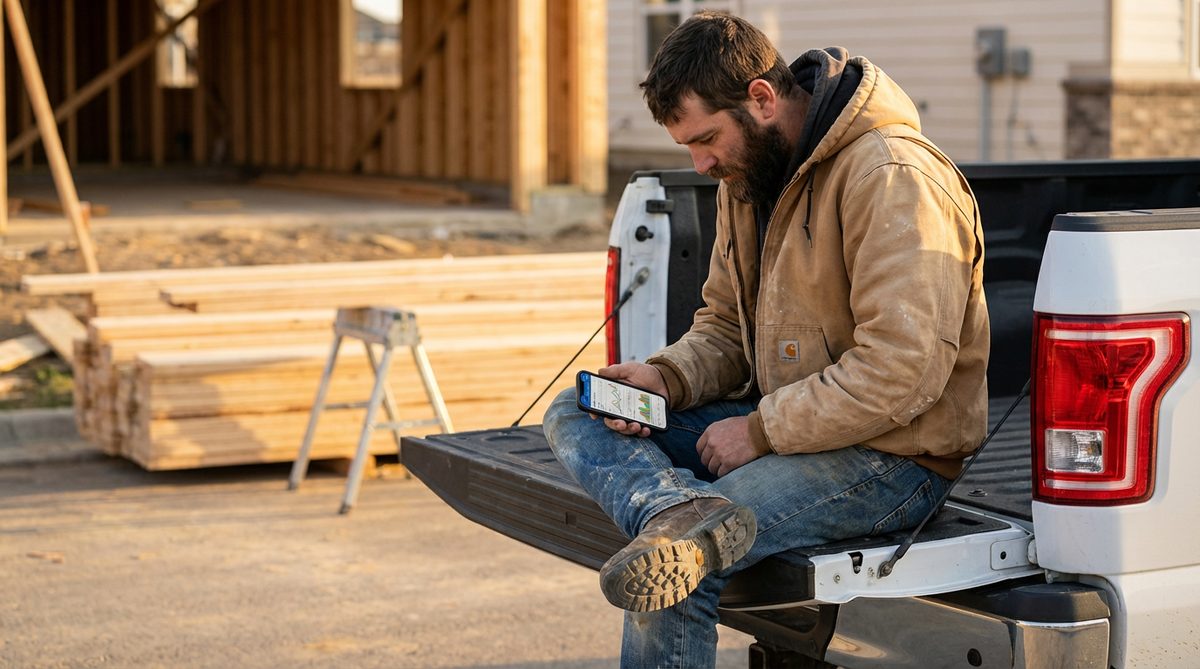
Tree Service Marketing: 8 Strategies to Book More Jobs
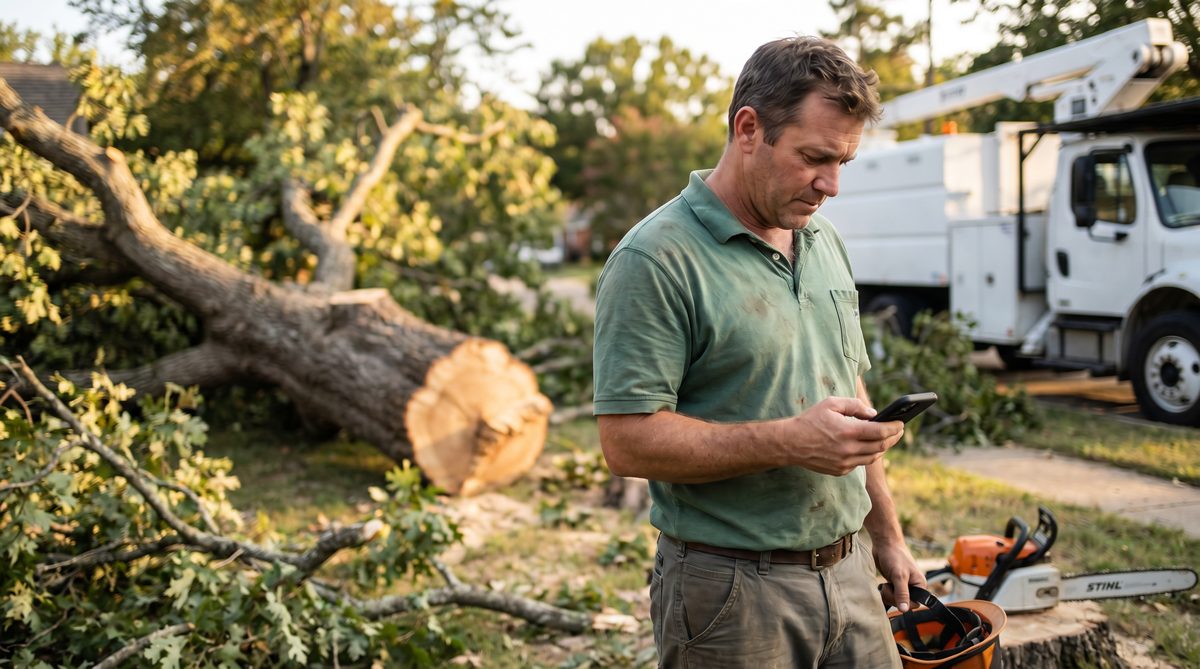
Most tree service companies don’t have a demand problem. Homeowners need trees removed after storms. Spring cleanup drives a rush of calls from March through June. Dead limbs, overhanging branches, stump grinding, the work is there. The real problem is that tree service marketing requires a fundamentally different approach from almost any other trade, and most arborists and crew owners are running a generic playbook that leaves serious money on the table.
This guide covers eight tree service marketing strategies built specifically for the seasonal, high-ticket, trust-heavy nature of this business, whether you’re a solo operator with one truck or a multi-crew company looking to dominate your market. (For the full breakdown on capturing calls while your crew runs equipment, see our guide to missed call text-back for service contractors.)
- Tree service marketing must account for three demand peaks: spring cleanup, storm season, and fall. Your advertising calendar needs to match the revenue calendar.
- Tree removal is a $500-$2,000+ decision for most homeowners. Reviews, job photos, and referrals carry more weight here than almost any other trade.
- Storm emergency calls convert at 2-3x the rate of scheduled work, and go to whoever answers first. Missing one after a major storm is a $2,000-$5,000 mistake.
- Automated follow-up on large removal quotes recovers 15-25% of estimates that would otherwise go cold.
1. Why Tree Service Marketing Demands a Seasonal Strategy
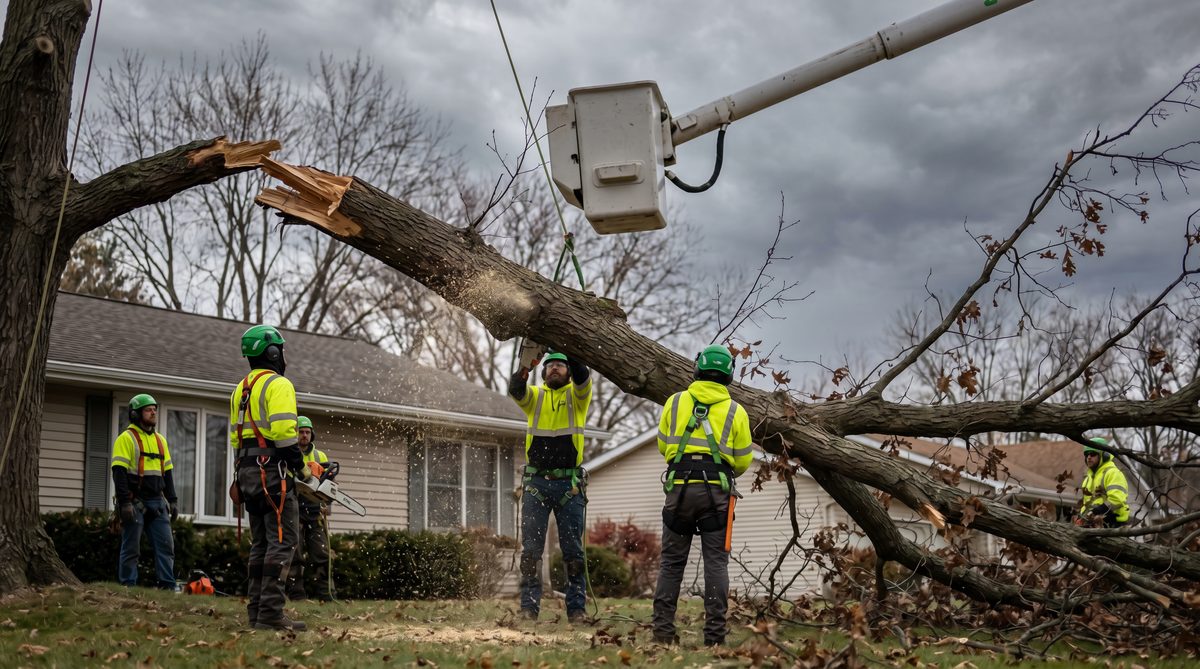
Tree service revenue doesn’t flow evenly through the year. It arrives in three distinct waves: spring cleanup (March-June), storm season (June-October on the coasts, year-round in tornado alley), and fall cleanup (September-November). The businesses growing fastest in this trade don’t just respond to those peaks, they market into them before they arrive.
Most tree service companies spend marketing budget reactively: boosting a Facebook post after a storm rolls through, or updating their Google Business Profile on a slow Tuesday when there’s nothing else to do. That reactive approach burns money during the moments competitors are already booked, and leaves crews idle during the stretches when proactive campaigns would fill the schedule.
Emergency storm work is the highest-margin segment of tree service. According to Angi’s cost guides, the average tree removal runs $500-$2,000 for a standard job. Storm-damage emergency removal with crane work and hazard premiums runs $3,000-$8,000+. These calls happen at 10 PM after 60 mph winds knock an oak across a fence, and they go to whoever picks up the phone first.
For tree service, that number understates the real damage. A single missed emergency removal at $3,500 takes three standard service calls to recoup. Every unanswered storm call isn’t a minor inconvenience, it’s your best-margin opportunity of the month going to the next company on Google Maps.
The fix: Build a forward-looking marketing calendar. Six weeks before each peak period, ramp up paid advertising. During peak, make sure your phone is answered around the clock. In slow months, run campaigns targeting proactive tree health work, dead limb removal, hazard assessments, stump grinding, to keep crews productive until the next surge.
2. Paid Advertising: Get in Front of Homeowners Before They Search

Most tree service paid advertising is reactive. A tree comes down in a storm. Someone Googles “emergency tree removal near me.” They click an ad. That’s fine, it’s also where every competitor is bidding at peak cost.
The tree service companies winning at paid advertising in 2026 combine two channels: Google Local Services Ads for high-intent searches, and Facebook and Instagram to reach homeowners before the emergency moment.
Google Local Services Ads (LSAs)
LSAs appear at the very top of search results with a “Google Guaranteed” badge, above organic results and above standard Google Ads. You pay per lead, not per click. WordStream’s benchmarks show home service LSAs averaging $6-$30 per lead. For tree service, the Google Guaranteed badge matters especially because homeowners are letting you operate heavy equipment near their home, cars, and roof. That credibility signal converts fence-sitters on its own.
Target these searches in your LSA setup: “tree removal near me,” “emergency tree service,” “storm damage tree removal,” “stump grinding [city],” and “tree trimming [neighborhood].”
Facebook & Instagram: The Pre-Storm Play
Facebook lets you reach homeowners before they have a problem, or before a storm turns a manageable situation into an emergency.
Run campaigns 4-6 weeks before your peak season targeting homeowners in your service radius. Hook: “Is that branch over your roof safe for storm season?” Before-and-after removal videos stop the scroll. A free tree health assessment offer generates leads during your slow season and creates removal jobs for later. For the complete Facebook ad strategy, see our Facebook ads for contractors guide.
WordStream’s Facebook Ads Benchmarks show home services lead ads converting at 12.5% on average. And per Nosto’s consumer content report, 79% of people say user-generated content in ads heavily influences their buying decisions, for tree service, real job photos and crew videos outperform stock imagery every time.
How to implement: Apply for Google LSAs at lsa.google.com. For Facebook, build a 15-mile radius audience targeting homeowners 35+, run before-and-after removal videos, and launch campaigns 4-6 weeks before spring cleanup season and storm season for your region. A $20-$40/day budget generates meaningful lead volume for most markets.
3. Local SEO: Own “Tree Service Near Me” in Your Market
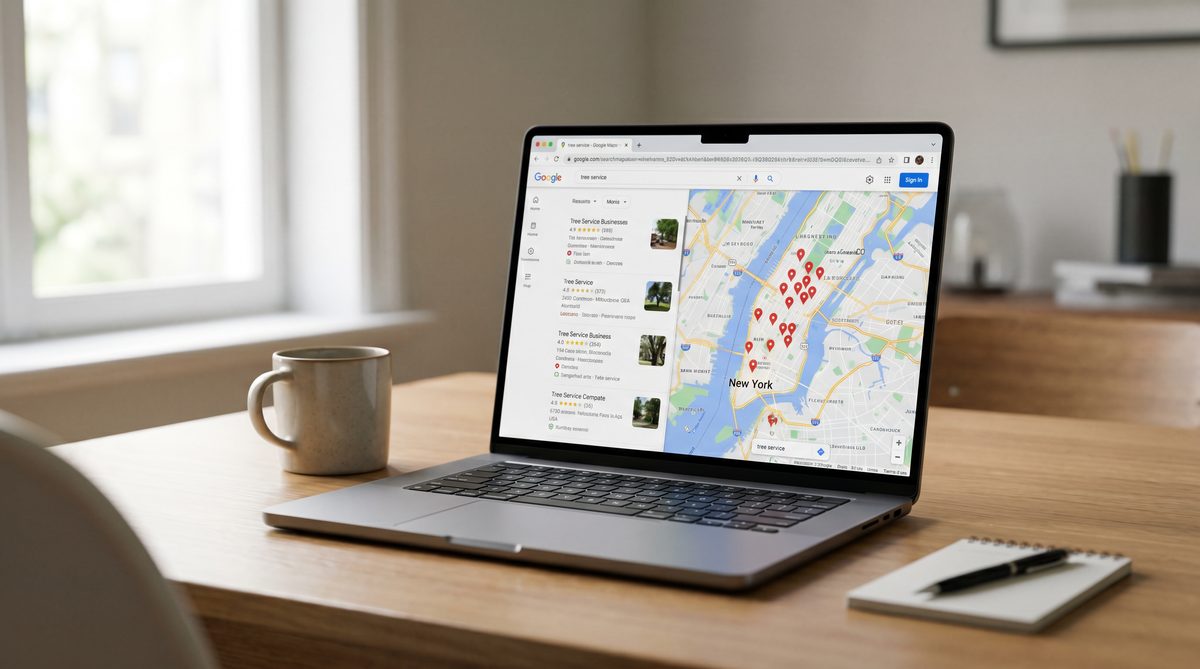
When a homeowner’s tree comes down in a storm, they’re not browsing options. They open Google, type “emergency tree service near me,” and call the first company on the map. A Backlinko user behavior study found that 42% of local searchers click on a result in the Google Map Pack. If you’re not in those top three results, you’re invisible to a huge share of the potential market before anyone even looks at your website.
Three foundations for tree service local SEO:
Google Business Profile (GBP)
Your GBP is your most important marketing asset. Fill in every field: hours, service area (every zip code you actually serve, not just your office address), services offered, and business description. Upload photos of completed jobs, large removals, storm cleanup, before-and-afters, at least weekly. Google rewards active, frequently updated profiles with better local pack placement.
Select “Tree Service” as your primary category. Add secondary categories: “Arborist,” “Stump Removal Service,” and “Landscaping Service.” According to Google and Ipsos research, businesses with a complete Google Business Profile are 2.7x more likely to be considered reputable. For tree work, where you’re bringing heavy equipment onto someone’s property, that credibility signal directly converts browsers into callers.
Service Area Pages
Build a dedicated page for every major service (tree removal, tree trimming, stump grinding, emergency storm cleanup, dead tree removal, land clearing) and every city or county you serve. These pages rank for geo-specific queries like “tree removal [city]” and “stump grinding [county]”, high-intent searches where buyers are ready to book. One well-optimized service area page can generate 5-10 qualified leads per month with no ad spend attached.
Citation Consistency
Your business name, address, and phone number (NAP) must be identical across Yelp, BBB, Angi, Thumbtack, Nextdoor, and Apple Maps. One mismatched phone number can suppress your local rankings. Audit with BrightLocal or Whitespark to catch discrepancies.
4. Google Reviews: The Trust Signal for $2,000+ Jobs
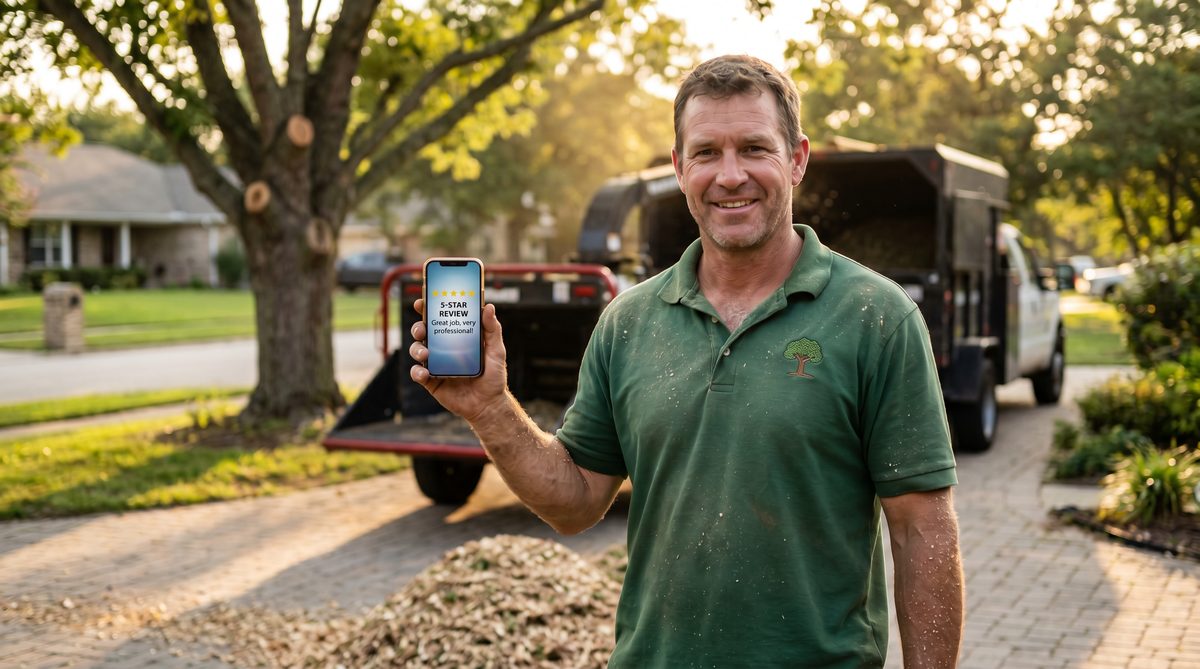
Tree removal is expensive. A homeowner getting quotes for a 60-foot oak near their house isn’t just comparing prices, they’re deciding who to trust with crane equipment near their roof. Reviews carry more weight in tree service than almost any other trade because the stakes feel high and the purchase happens infrequently.
According to Womply’s research, businesses with above-average Google review counts (about 83) earn 82% more in annual revenue than those below average. For tree service, where average jobs run $500-$2,000, climbing past that average directly moves the booking needle. Review velocity matters just as much as total count, aim for 6-10 new reviews per month, because Google’s algorithm rewards recency over accumulation.
Respond to every review you receive. Womply’s data shows businesses that reply to at least 25% of their reviews earn 35% more revenue than average. A thoughtful response to a 3-star review, showing how you resolved an issue, can be more convincing to a new customer than five additional 5-star submissions. It signals that you stand behind your work.
The fastest way to build review velocity: automate the ask. After every completed job, send a text with a direct link to your Google review page, one tap to leave a review. Most review automation platforms also route negative feedback privately, so you have a chance to address the issue before it becomes a public 1-star post. See our full system for getting more Google reviews for the step-by-step setup.
Reviews do double duty in tree service: they improve your local 3-pack ranking AND convert high-ticket fence-sitters who would otherwise request three competing quotes.
5. Speed to Lead: The Storm Emergency Call You Can’t Afford to Lose
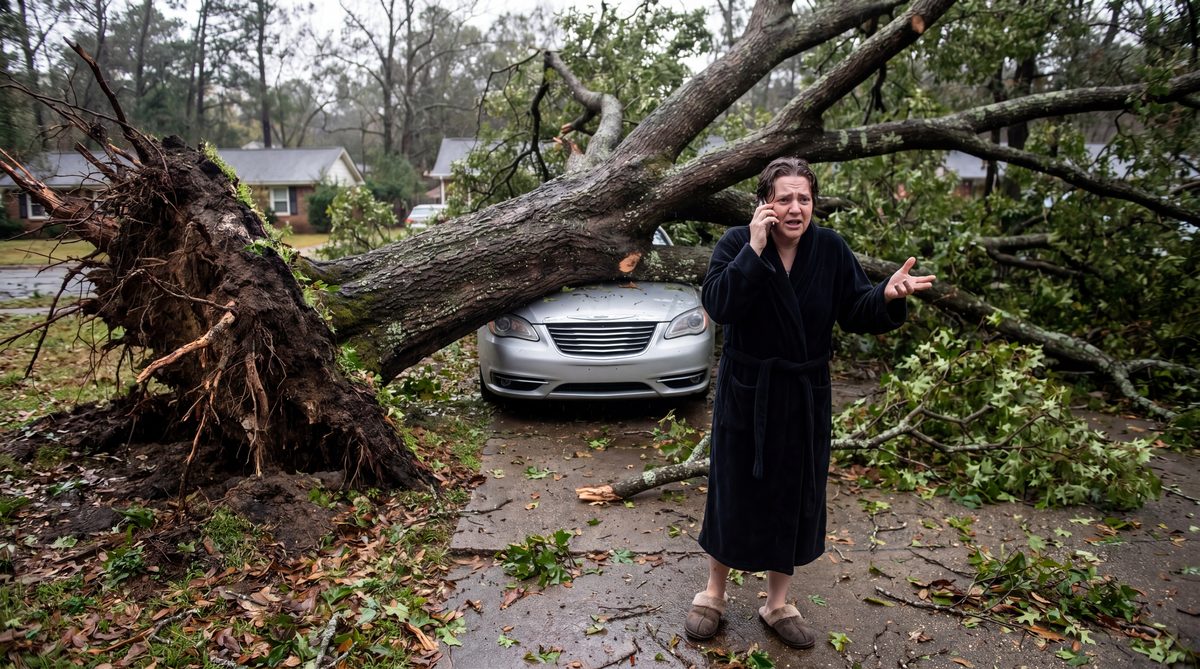
After a major storm, homeowners with a tree down aren’t browsing options. They call the first tree service that picks up. If that’s not you, they immediately call the next one. Whoever answers gets the job.
Velocify’s research found that responding within one minute increases lead conversion by 391%. For emergency tree service specifically, where the homeowner may be blocked from their driveway or watching a tree lean against their roof, the first-responder advantage is decisive. They’re not comparison shopping; they need someone on the phone right now.
The Drift Lead Response Report shows the average B2C business takes 47 hours to respond to a new lead. Tree service companies aren’t immune, crews are on job sites running chainsaws and chippers, physically unable to take calls. Every missed storm call is a $2,000-$5,000 job heading to whoever did answer.
This is where AI call answering services have changed the math for growing tree companies. When your crew is running equipment and a storm emergency comes in, an AI answering service for home services picks up in under two rings, asks the right qualifying questions (location, type of damage, is there a safety hazard to a structure or vehicle, level of urgency), gives the homeowner a realistic ETA, and books the dispatch, all before the crew finishes the current job.
The calls that get missed are the high-margin storm emergencies coming in simultaneously on a Saturday afternoon after 60 mph winds tear through a neighborhood, not the easy ones on a slow Thursday morning. That’s when an AI call system earns its cost for the next six months.
How to implement: Pull your call logs and count how many calls went to voicemail over the last 30 days. Multiply by your average emergency ticket value. That’s the revenue you’ve handed to competitors. An AI answering service eliminates that number permanently.
6. Referrals & Repeat Seasonal Work: The Tree Service Flywheel
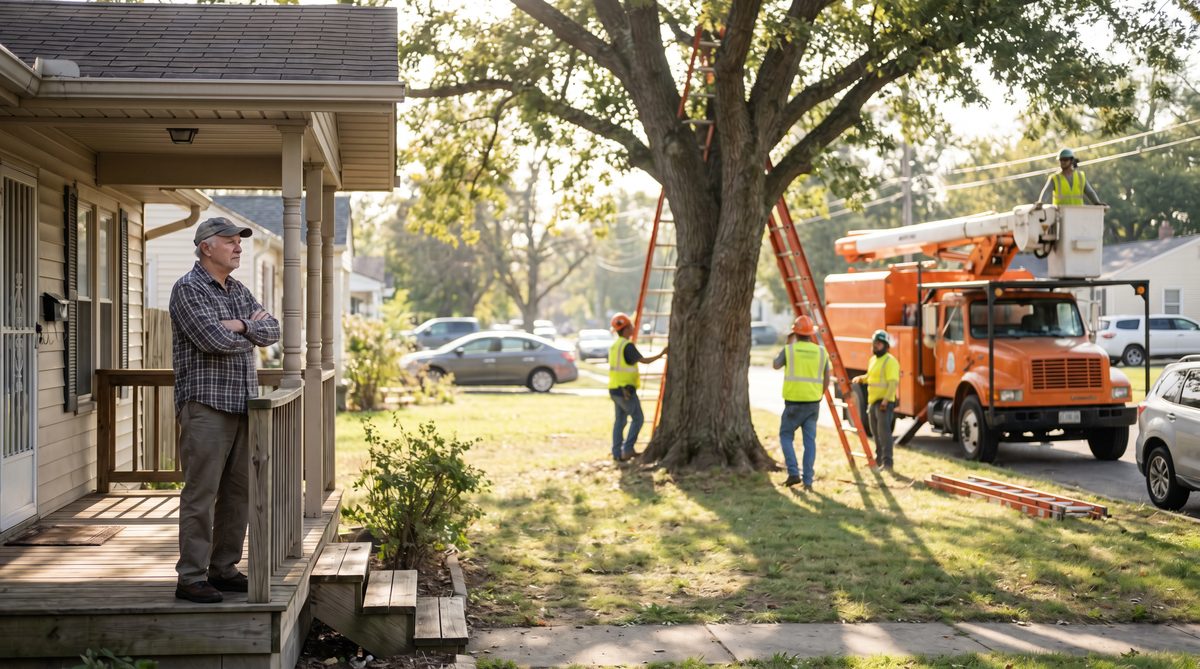
Tree service referrals are uniquely powerful for one simple reason: neighbors watch. When you remove a large tree from a property, the neighbor with three overhanging oaks sees your crew, your equipment, and how carefully you treat the yard. That one job markets to the entire block, if you ask for the referral at the right moment.
Nielsen’s Trust in Advertising study found that 92% of consumers trust referrals from people they know over any other form of advertising. And per Harvard Business Review, acquiring a new customer costs 5-25x more than retaining an existing one, which makes repeat seasonal work from past customers your most profitable lead source once you’ve built the system.
Two systems that work for tree service referrals:
Post-Job Referral Ask
Send a text 24 hours after every completed job: “Thanks for letting us take care of that tree, the crew really enjoyed the work. Know a neighbor who could use our help? Share this link and you’ll both get $50 off your next service.” The timing is strategic, 24 hours after a large removal, the homeowner has seen a clean yard and felt the relief. They’re primed to share.
Seasonal Maintenance Reminders
Set up automated reminders tied to the calendar: in March, a spring trimming and cleanup offer; in September, a fall cleanup and pre-storm hazard assessment; after any significant local storm, a direct outreach to your full past-customer list offering priority scheduling. These touchpoints generate repeat work during the stretches between surge periods and keep you top of mind when the neighbor on the next street asks for a recommendation.
7. Putting It All Together: The Tree Service Marketing System

The strategies above aren’t separate tactics, they’re a system. Local SEO and GBP work generates free inbound leads. Paid advertising fills the pipeline before demand peaks. Reviews convert high-ticket fence-sitters. Speed to lead captures emergency calls before competitors do. Referrals and seasonal campaigns turn one job into five over time.
The tree service companies growing fastest in 2026 automate the pieces that can be automated, call answering, review requests, follow-up sequences, seasonal outreach, so their crews stay focused on the physical work and the revenue keeps coming in regardless of who’s at the office.
The specific gap that kills most tree service marketing ROI is the estimate that goes nowhere. A homeowner gets a $2,500 quote for two large oak removals. They say they’ll think about it. Nothing happens for a week, then two weeks. Then they hire someone else who followed up twice. Automated follow-up sequences close this gap without anyone on your team having to remember: a same-day thank-you text, a 48-hour check-in, a day-7 availability nudge, a day-14 quote reminder. Most tree companies running this recover 15-25% of large estimates that would otherwise disappear.
Ignitvio builds this entire system, AI call answering, review automation, estimate follow-up sequences, and missed-call text-back, into a single platform designed for trade businesses that can’t justify a full-time dispatcher or marketing coordinator.
8. How Ignitvio Powers Tree Service Call Answering and Follow-Up
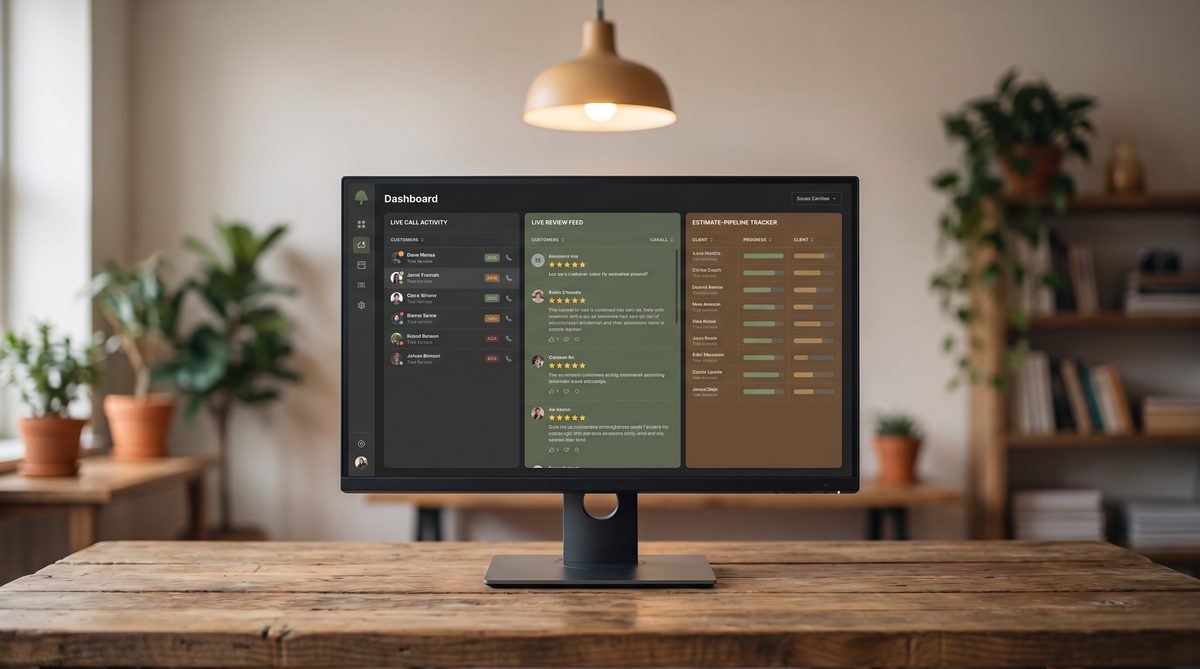
Ignitvio is built for the specific problem tree service companies face: high-value emergency calls arriving at the worst possible moments, large estimates going cold without follow-up, and review collection too easy to skip at the end of a hard workday.
Here’s what the platform does for tree service businesses:
- Voice AI answers every call 24/7, while crews run equipment, during storm surges when call volume triples, and on weekends when emergencies don’t respect business hours. It picks up in under two rings, sounds natural, asks the right qualifying questions, and books the job before the homeowner hangs up.
- Emergency triage, the AI distinguishes a true emergency (tree on a structure, blocking the only driveway, proximity to a power line) from a routine request (trimming, stump grinding, dead tree assessment) and responds accordingly. Emergencies get dispatched; non-urgent requests slot into the next available opening.
- Missed Call Text-Back catches anything that slips through. Any missed call gets an immediate SMS: “Sorry we missed you, what’s happening with the tree?” The AI continues the conversation by text and books the job.
- Automated estimate follow-up runs a 5-touch sequence after every quote over $500: same-day thank-you, 48-hour check-in, day-7 availability nudge, day-14 quote reminder. Large removal quotes ($1,500-$5,000) close at meaningfully higher rates with this sequence running than without.
- Review automation texts every customer post-job with a direct Google review link. Consistent review velocity compounds into better local 3-pack rankings and more inbound calls.
Without Ignitvio vs. With Ignitvio
- Storm emergency calls go to voicemail while crew runs equipment
- Call volume triples during a surge, front office drowns or misses calls
- Large removal estimates go cold with zero follow-up
- Reviews trickle in at 1-2 per month
- Referral program exists only in the owner's head
- Ad spend generates calls nobody answers after 5 PM
- Every emergency call answered in under 2 rings, 24/7/365
- Storm surge handled in parallel, 30 simultaneous calls, all covered
- 5-touch automated follow-up on every estimate over $500
- Review request texted after every completed job, automatically
- Post-job referral ask fires 24 hours after every completion
- Every marketing dollar converts because the phone always gets answered
The math is direct. If you miss 5 emergency calls per month and Ignitvio captures half of them at an average ticket of $2,500, that’s $6,250/month in recovered revenue, before counting the large estimates that automated follow-up now closes.
See how many tree service jobs you're losing right now
We'll mystery-shop your business, including an after-hours storm emergency call, and show you exactly where leads are going to competitors. Free. No pitch.
Get Your Free Revenue Audit
Jake Melendy
Founder, Ignitvio
Jake Melendy is the founder of Ignitvio. He spent 12 years in enterprise sales and sales leadership, including at Oracle, before building Ignitvio, which runs done-for-you outbound appointment setting for commercial contractors and B2B service companies. He writes about pipeline, trigger-based prospecting, and lead response.