What is Answer Engine Optimization (AEO)? A Service-Business Guide for 2026
- Answer engine optimization (AEO) is the practice of structuring your business and your web content so AI tools like ChatGPT, Perplexity, Claude, and Google’s AI Overviews name you when a customer asks who to hire.
- Estimates from emerging AI search research suggest answer engines now influence 18 to 22% of high-intent service queries, and that share is growing month over month.
- AEO and classic SEO share roots but reward different signals. AEO weights citation density across third-party text (Reddit, listicles, comparison pages, Yelp) far more than backlinks or ad spend.
- A 7-element AEO checklist gets most local service businesses from “invisible to AI” to “named in the answer” in roughly 60 to 90 days.
What Answer Engine Optimization Means in 2026
Answer engine optimization is the discipline of getting your business cited inside the direct answers that AI tools return to a customer’s question. When a homeowner asks ChatGPT “who should I call for a leaking water heater in Phoenix,” the model responds with a short list of named businesses. AEO is the work that puts your name on that short list.
The phrase started showing up in 2024 as Google rolled out AI Overviews and ChatGPT began surfacing local recommendations. Two years later, it has become a distinct practice with its own playbook. The audience for AEO is not the Google index. It is the language models behind ChatGPT, Claude, Perplexity, Gemini, and a handful of smaller answer engines, plus the third-party sources those models pull citations from.
If you own a service business, the shift matters because answer engines hand customers a recommendation instead of a list of ten blue links. A traditional Google result lets the customer browse, compare, and call any of the top five. An AI answer hands them one or two names with reasoning attached. The businesses outside the named list rarely get a second look.
Estimates from emerging AI search research suggest answer engines now influence 18 to 22% of high-intent service queries, and that share is growing month over month. The exact number varies by vertical and by region, so treat it as a directional figure, not a benchmark. The direction is what matters: a meaningful slice of your future calls is already routing through an AI before the customer ever sees your phone number.
AEO vs SEO: What Actually Changes
People often ask whether AEO is just a rebrand of SEO. It is not. The two practices share a foundation (publish helpful content, earn citations, build trust) but they reward different signals at the surface.
Classic SEO optimizes for a Google ranking. The signals that matter are backlinks, domain authority, on-page keyword targeting, page speed, and search intent matching. The unit of success is a position in the ten blue links.
AEO optimizes for being named in a direct answer. The signals that matter are different: how often your business appears in third-party text the AI has read, how clearly your services and locations are described in structured form, whether your name shows up in comparison and listicle content, and whether review aggregates around you read as authoritative. The unit of success is a citation in the model’s response.
A short version of the contrast:
| Dimension | Classic SEO | Answer Engine Optimization |
|---|---|---|
| Primary unit | Ranking position | Named citation in the answer |
| Key signal | Backlinks and on-page authority | Citation density across third-party text |
| Top sources | Your own site and high-authority links | Reddit, listicles, comparison pages, Yelp, Forbes |
| Update cycle | Weekly to monthly | Often real-time per session |
| Failure mode | Page two of Google | Not mentioned at all |
For a deeper walkthrough of the ranking-signal differences, the companion post on ChatGPT SEO for local service businesses breaks the eight dimensions down side by side.
Why Service Businesses Should Care First
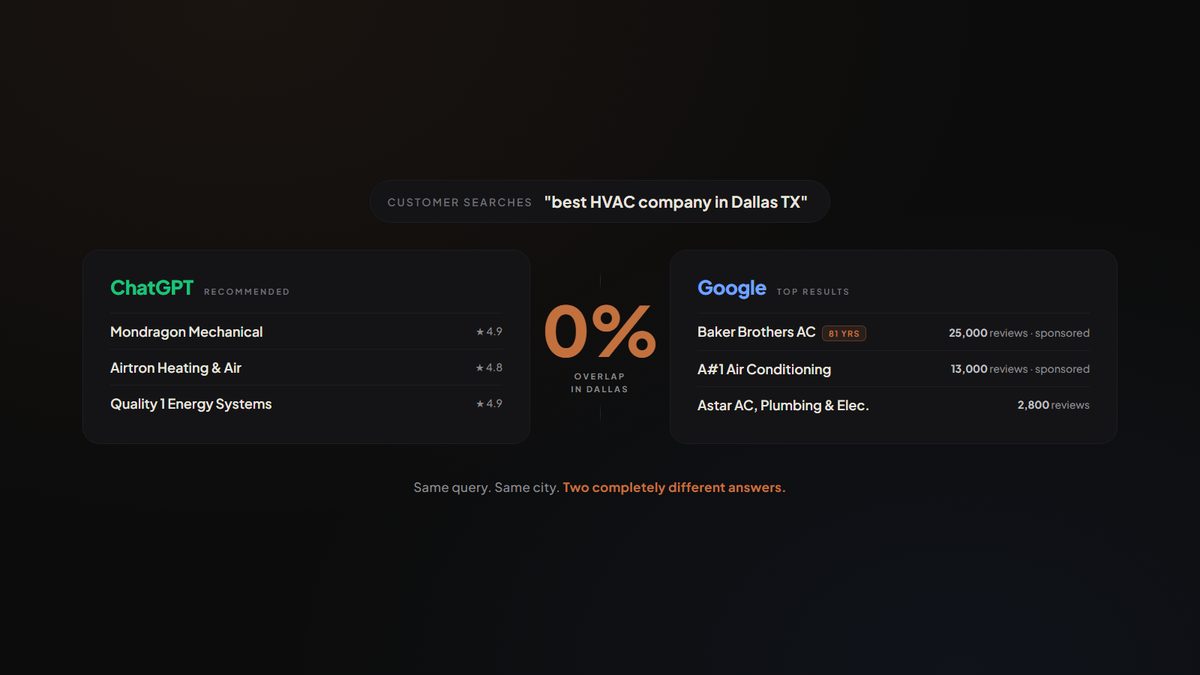
Local service businesses face an unusually concentrated version of the AEO opportunity because customer queries are highly transactional. “Best HVAC company in Dallas” or “emergency plumber in Tampa” is a buying question. The customer is mid-decision. They will hire someone in the next 24 to 72 hours.
That intent profile is exactly the kind of query AI tools have grown best at answering. The model can scan dozens of listicles, comparison pages, Reddit threads, and review aggregates faster than a human can, produce a short ranked list, and explain its reasoning. The customer treats the result as if a knowledgeable friend handed them a recommendation. They call the first one or two names.
Three structural reasons service businesses should treat AEO as a priority right now:
- The transaction value is high. A single HVAC system replacement, a roofing job, or a plumbing emergency call can be worth thousands of dollars. Missing one AI-driven call per month is a meaningful revenue hole.
- Local SERPs are AI-saturated. Google’s AI Overviews already appear above the organic results for most service queries. ChatGPT’s location-aware recommendations have been rolling out across the U.S. since early 2026. The exposure surface is no longer optional.
- First-mover advantage is real. Most service businesses have done nothing about AEO. The competitive density on AEO-shaped content (comparison articles, structured FAQ pages, named-citation pieces) is far lower than the density on classic local SEO content. Showing up is mostly a question of getting started.
How Answer Engines Actually Decide Who to Name
To do AEO well, you need a working mental model of how an answer engine builds its response. The mechanics are not identical across ChatGPT, Perplexity, Claude, and Google AI Overviews, but the broad shape is consistent.
When a customer asks a service question, the model does three things in sequence:
- Reads the open web in real time. Most answer engines combine pretrained knowledge with live retrieval. For local recommendations, the live retrieval is doing most of the work. The model pulls a set of pages it thinks are relevant.
- Aggregates named businesses across those pages. The model counts which businesses appear most often, in what context, and alongside which other businesses. Citation density and co-mention patterns shape the candidate list.
- Ranks the candidates by trust and fit. The model weights named businesses by review signals, mentions in editorial sources, structural cues on the businesses’ own websites, and how cleanly the business’s stated services match the customer’s query.
For a deeper field-tested breakdown of how the citation step plays out across cities, the companion piece on getting your service business recommended by ChatGPT walks through a 10-city test where less than half of Google’s top-ranked HVAC and roofing companies appeared in ChatGPT’s recommendations.
The practical implication is that classic on-page SEO and link-building work, but they are not enough on their own. You also need to be present in the third-party sources the model reads when it goes to retrieve. That is where the AEO checklist comes in.
The 7-Element AEO Checklist for Service Businesses
This is the working checklist I use when I onboard a new local service business client. It is sequenced from highest leverage to longest tail.
1. Audit your AI visibility today. Open ChatGPT, Perplexity, and Claude in clean sessions and run the customer-facing queries that drive your business. “Best [your service] in [your city]” and the three or four variations a real customer would type. Write down who gets named. If your business does not appear, that is your baseline. If it does, note which sources the AI cites.
2. Restructure your service and location pages for clarity. Answer engines reward pages that state plainly what service is offered, in which cities, with what differentiators. Bullet lists, structured headers, and explicit city plus service combinations help. Marketing pages written in fog (“Premium solutions for the discerning homeowner”) do not parse well. Pages written like a clear answer do.
3. Add an FAQ block with real customer questions on every key page. Use the actual phrasing customers use, not the polished version. FAQ blocks with proper schema give the model exactly the kind of short, structured, attributable text it likes to cite. This article uses one at the bottom of the page for the same reason.
4. Get cited inside comparison content. Listicles and “best of” articles in your city and vertical are the single highest-leverage source for AI citation. If a journalist or a blogger publishes “best HVAC companies in Tampa,” and your business is on that list, every answer engine that reads that page now has a co-mention signal for you. Earning those mentions is a form of digital PR, not classic link-building.
5. Activate Reddit and other community sources. Reddit shows up as a top citation source across multiple answer engines. A handful of authentic, helpful responses from someone associated with your business in the relevant city subreddits, plus organic mentions of your name in unrelated threads, can shift your citation density faster than a quarter of backlink work. Behave like a person, not a marketer.
6. Build out review surface area. Google reviews still matter, but answer engines also read Yelp, Angi, BBB, and industry-specific review aggregators. The depth of recent review text matters more than the raw star count. A business with 80 detailed recent reviews across three platforms reads as more authoritative to a model than a business with 800 short reviews on one.
7. Publish your own AEO-shaped content. Comparison pages, “best [service] for [use case]” articles on your own site, and educational FAQs that answer the questions real customers ask. Your own content gives the model something to cite when it is summarizing your value proposition, and it gives you control over the narrative.
Most service businesses I work with can complete the first four steps in 30 days. The fifth and sixth steps run on a 60 to 90 day timeline because they require external surface area to accumulate. The seventh is a continuous publication habit.
How to Measure AEO Progress
AEO measurement is harder than classic SEO because there is no public equivalent of Google Search Console for ChatGPT. Three measurement approaches work in 2026:
- Manual prompt audits. Once or twice a month, run a fixed set of customer queries across ChatGPT, Perplexity, Claude, and Google AI Overviews. Log who gets named, in what order, and which sources are cited. Track changes over time. This is low tech and reliable.
- Branded search lift in Google. When customers see your name in an AI answer, a non-trivial fraction of them open Google and search your brand to verify. A sustained rise in branded search impressions inside Google Search Console is a strong AEO leading indicator.
- Call attribution conversations. Train whoever answers your phone to ask new callers how they found you. The share of callers who say “ChatGPT,” “Claude,” or “the AI” used to be effectively zero and is no longer. Track that share over time.
A unified deeper playbook that covers all four major answer engines lives in the LLM SEO guide for local service businesses, including a 60-day execution plan and a measurement framework.
Common AEO Mistakes That Waste Months
A short list of patterns I see often and that cost service business owners real time:
- Treating AEO as a one-time project. Answer engines refresh their retrieval continuously. A site that ranked last month can drop out this month if a competitor publishes a strong comparison piece. AEO is a recurring practice.
- Stuffing keywords on landing pages. Some early AEO advice recommended aggressive keyword density. The current models penalize that pattern. Write for clarity, not for word frequency.
- Ignoring third-party surface area. Owners who focus entirely on their own website usually plateau. Most of the citation signal comes from places they do not control. Spending time on Reddit, listicles, and reviews moves the needle.
- Chasing one engine at a time. ChatGPT, Perplexity, Claude, and Google AI Overviews share enough underlying signals that optimizing for one usually helps the others. A single AEO program works across all of them. Running four separate programs wastes effort.
Where to Go From Here
If you are starting from zero on AEO, the highest leverage move this week is the prompt audit. Open ChatGPT and run five to ten of the queries your customers actually type. If you are named, take inventory of which sources the model cites. If you are not, you now know exactly what gap you are closing.
The full done-for-you version of this work lives on the answer engine optimization service page for contractors. Audit, content production, citation surface building, and monthly rank tracking across the four major answer engines.
Get Your Free AEO Audit
We run your customer-facing queries through ChatGPT, Perplexity, Claude, and Google AI Overviews, then walk you through where you appear, where you don't, and what to do about it.
Book Your AEO AuditFrequently Asked Questions
What is answer engine optimization in simple terms?
Is AEO different from SEO?
How long does AEO take to work?
Which AI tools matter most for service business AEO?
Can a small service business compete on AEO against larger franchises?
How do I track whether AEO is working?
What does AEO cost for a local service business?

Jake Melendy
Founder, Ignitvio
Jake Melendy is the founder of Ignitvio. He spent 12 years in enterprise sales and sales leadership, including at Oracle, before building Ignitvio, which runs done-for-you outbound appointment setting for commercial contractors and B2B service companies. He writes about pipeline, trigger-based prospecting, and lead response.