AI Search for Roofing Companies: Show Up or Get Skipped
AI search for roofing companies is the practice of building the digital signals that cause ChatGPT, Google AI Overviews, Perplexity, and Gemini to recommend your business when a homeowner asks who to call. Unlike traditional SEO, where you compete for a spot on a list of ten blue links, AI search delivers a single name, or three at most. You’re either in it or you’re not.
- ChatGPT has 800 million weekly active users and local AI visibility is up to 30 times harder to achieve than traditional local search.
- Five signals control AI citations: review count and recency, GBP completeness, NAP consistency, FAQ content structure, and call response speed.
- 79% of roofing contractors still rely on manual processes for phones and scheduling, creating an open gap for companies willing to automate.
- The roofing companies that dominate AI search in their markets in 12 months are not running separate campaigns. They are systematizing the signals.
Homeowners Are Skipping Google and Asking AI Who to Call
The shift is measurable. Local Falcon’s ChatGPT statistics research documents that ChatGPT crossed 800 million weekly active users in late 2025, doubling its audience from 400 million in just months. Gemini, Perplexity, and AI-integrated Siri are pulling similar numbers. The search that used to look like “best roofer near me” on Google now increasingly looks like “who should I call about my roof in Frisco, Texas” typed straight into an AI.
The selectivity is the thing that changes everything for roofers. Search Engine Land’s 2026 AI visibility report found that local AI visibility is up to 30 times harder to achieve than ranking in Google’s traditional local results. Where Google’s local 3-pack might feature a roofing business 35% of the time for a local query, ChatGPT may only recommend 1 to 2% of businesses in any category.
For residential roofing, that math has a dollar sign on it. The average full replacement runs $9,000 to $18,000. A single AI-search referral per week that converts at 30% is worth $140,000 to $280,000 in annual revenue. Most roofers have zero strategy for earning those referrals. They’ve never thought about search the way AI thinks about it.
Five Signals That Get a Roofing Company Into AI Search Results
AI doesn’t have a vendor relationship with any roofer. It recommends whoever its training data and real-time retrieval sources tell it is most trustworthy, available, and locally relevant. Five specific signals drive those decisions, and all five are within your control.
1. Review count and recency. AI systems weight review volume heavily. MediaPost’s coverage of Womply’s study of more than 200,000 U.S. businesses found that firms with more than 82 total reviews earn 54% more annual revenue than average. For AI citations specifically, recency matters as much as volume. A roofer in Cedar Park, Texas with 180 reviews but nothing new in 60 days is less likely to get cited than a competitor with 90 reviews and 12 added this month.
2. Google Business Profile completeness. Every blank field in your GBP is a trust gap. AI platforms pull from structured data first. Google’s Think with Google research found that 76% of people who search on smartphones for something nearby visit a related business within a day. That visit intent only helps if your profile is complete enough for Google (and AI systems that read it) to trust and surface you. Complete means every service listed by name, photos updated in the past 90 days, a Q&A section with real questions answered, and a business description that names exactly what you do and every city you serve.
3. NAP consistency across directories. NAP is Name, Address, Phone. If you appear as “Copper State Roofing” on Google, “Copper State Roofing LLC” on Yelp, and “Copper State Roof” on Angi, AI reads three separate entities with uncertain authority. Whitespark’s Local Ranking Factors research identifies NAP consistency as a top-5 local search signal. Every discrepancy chips away at citation odds.
4. FAQ content that mirrors how people ask questions. When someone asks ChatGPT “do I need a full replacement or a repair after a hailstorm,” AI retrieves pages that answer that question clearly. An FAQ page covering common roofing questions, including insurance claims, material lifespans, storm damage timelines, and cost ranges by roof type, trains AI to recognize your site as an authoritative source.
5. Response speed and availability. AI platforms increasingly pull real-time signals about how responsive a business actually is. A roofing company that answers calls within two rings, responds to Google Q&A within hours, and sends follow-up texts after missed calls projects the kind of reliability signal AI systems reward.
more annual revenue for businesses with above-average review counts versus the average local business
Source: MediaPost (Womply study)Building AI Search Authority for a Roofing Company Takes 90 Days
Short-term hacks don’t work here. AI recommendation authority builds the same way domain authority used to build: incrementally, through signals that compound over time. Ninety days targeting all five signals simultaneously is the minimum runway. Here is what that looks like for a residential roofer.
Weeks 1-2: Fix the foundation. Audit your GBP for blank fields and fill every one. Audit NAP consistency on Yelp, Angi, HomeAdvisor, BBB, and your local Chamber listing. Correct every discrepancy. Add at least 15 services with individual descriptions, not just “roofing” but “asphalt shingle replacement,” “TPO flat roofing,” “emergency tarping,” “insurance claim assistance,” and “gutter replacement.”
Weeks 3-6: Build review velocity. Target 4 to 8 new Google reviews per month. After every completed job, text the homeowner a direct link. A crew of four finishing three jobs each per week has 12 weekly opportunities to send that text. Most roofers send it manually when they remember, which produces maybe two reviews per month. Systematize it or it won’t happen.
Weeks 7-12: Create FAQ content. Add a page answering 15 to 20 specific questions. “How do I know if I need a full replacement versus a repair?” “What does storm damage look like on an asphalt shingle roof?” “How long does a 30-square job take?” These are the questions homeowners type into ChatGPT. Your answer needs to exist at a URL AI can find and cite.
A roofing company in Naples, Florida that ran this playbook over 90 days saw their business appear in ChatGPT responses for “roof replacement companies near me” within three months. Before the sprint, they were invisible. After it, two booked estimates per week came from homeowners who said an AI told them to call.
Check your current AI visibility alongside your roofing lead generation strategy, these two channels compound each other.
Your Answer Rate Feeds Directly Into Your AI Search Ranking
Here is the connection most roofers miss. How fast and consistently you answer calls feeds the same signal loop that AI search monitors. Velocify research covered by PR Newswire found that prospects called within one minute of inquiry were 391% more likely to convert than those called later. AI platforms see availability signals through review sentiment, GBP engagement, and the pattern of how often people attempt to contact a business versus how often they report a positive experience.
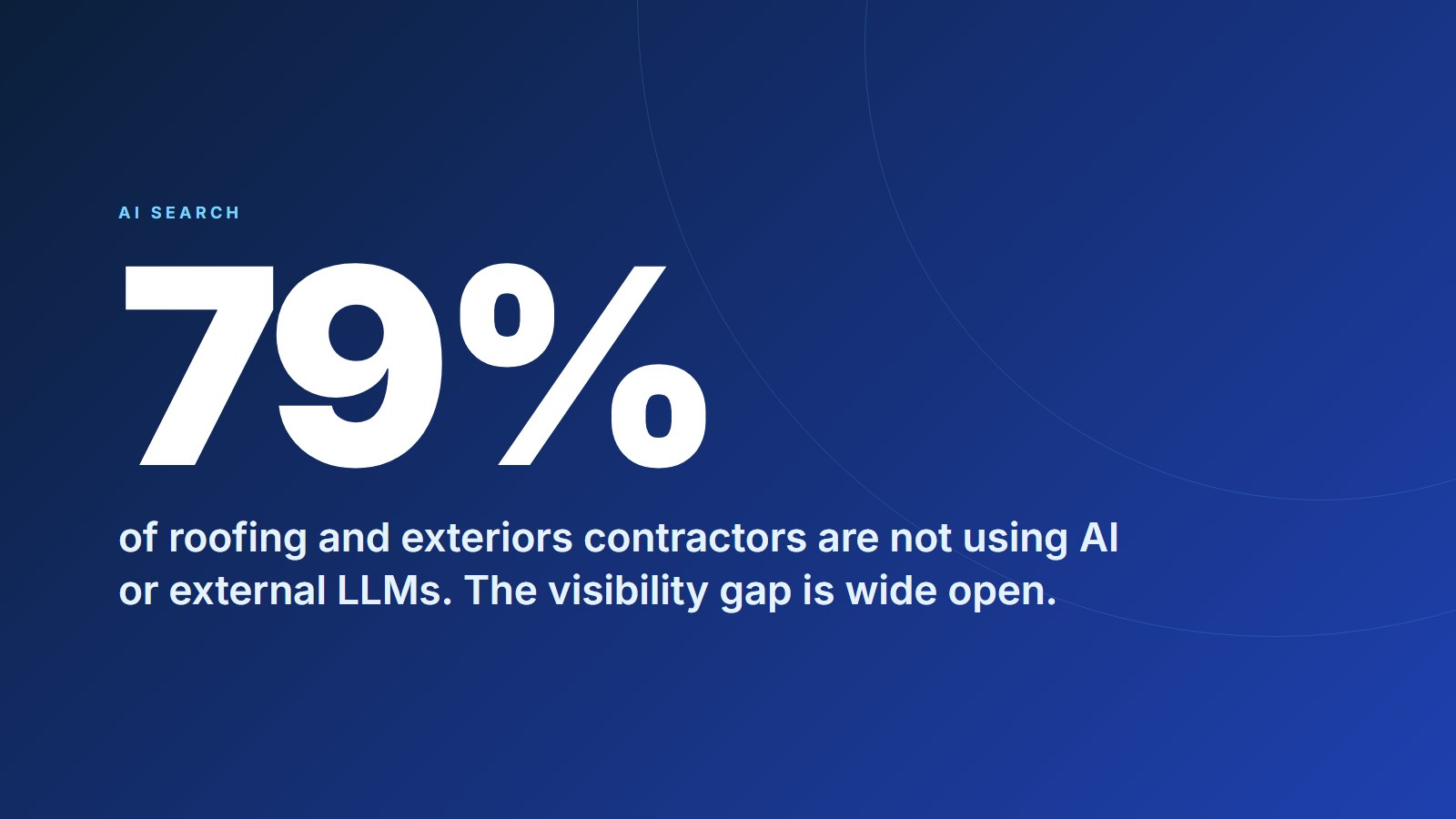
Roofing is seasonally brutal for response time. After a hailstorm hits a suburb of Dallas, call volume spikes in 24 hours. According to ServiceTitan’s 2026 Roofing & Exterior Market Report, 79% of roofing and exteriors contractors are not using AI or external LLMs. During a storm surge, that tech gap shows up as missed calls, slow estimate follow-up, and jobs that go to whoever answers first.
Each unanswered call is a homeowner who called, got voicemail, and called a competitor. Then that competitor gets the review. The compounding effect: every review your competitor gets during storm season that you missed raises their AI citation authority relative to yours. This is how one roofer becomes the dominant AI recommendation in a market while another with similar quality and pricing gets completely skipped.
The roofer who answers the call gets the job. The roofer who gets the job gets the review. The roofer with the reviews gets cited by AI. It is a loop, and it starts with the phone.
of roofing and exteriors contractors are not using AI or external LLMs
Source: ServiceTitan 2026 Roofing & Exterior Market ReportThe GBP Gaps That Push Roofing Companies Out of AI Results
Google Business Profile is the most important single data source for AI search. It is the structured file AI platforms check first when someone asks about a local roofer. Five gaps show up in almost every roofing company that is not getting AI citations.
No service-area coverage. A GBP that only shows a shop address tells AI you serve one block. Set your service radius to cover every zip code you actually work in.
Photos older than 90 days. A profile with 80 photos added in 2023 and nothing since signals a business that may have closed. Add 3 to 5 new photos per month: job site shots, completed roofs, material photos.
Empty Q&A. The Google Q&A section is one of the most direct ways to feed question-and-answer content to AI. Post and answer 8 to 10 questions yourself. Do not wait for customers to submit them.
Generic description. “Family-owned roofing company serving the greater area” tells AI nothing specific. Write 200 to 300 words that name every service, list your license number, name the specific cities you cover, and include your warranty terms.
No responses to reviews. Responding to every review, including negative ones, signals an active and accountable business. AI platforms read sentiment patterns in both the reviews and the owner responses.
AI-powered answering services have become a practical lever for the response-speed signal in particular. When an automated voice system answers every inbound call within two rings, books estimates on the spot, and sends a follow-up text to any missed call, it generates the consistent availability signal that AI platforms read as reliability. The category has expanded significantly in 2026, with options ranging from fully autonomous voice AI to hybrid systems that escalate complex questions to a human dispatcher.
Getting into AI search is not a one-time setup. It is a maintenance job. The roofers winning in AI have systems that produce signals continuously without anyone having to remember to do it.
Two Roofing Companies in Austin: One in AI Search, One Invisible
The difference between the roofer ChatGPT recommends and the roofer it ignores almost never comes down to workmanship. It comes down to signal consistency.
Company A in Austin has 74 Google reviews, the last one from three months ago. Their GBP lists six services, has photos from 2024, and an empty Q&A section. They answer calls during business hours only and miss roughly 35% of inbound calls due to crews being on rooftops. NAP is inconsistent across four directories. Zero visibility in ChatGPT.
Company B in Austin has 112 Google reviews, with six added this month. Their GBP has 22 services listed, a populated Q&A, and eight new photos added this month. Every call is answered around the clock through an AI phone system that books estimates in real time. NAP is synchronized across 40-plus directories. ChatGPT recommends them when someone in their market asks for a roofer.
Same city. Similar pricing. Different systems.
- 74 Google reviews, last one 3 months ago
- GBP has 6 services, no Q&A, photos from 2024
- Calls answered business hours only, 35% missed
- NAP inconsistent across 4 directories
- Invisible in ChatGPT, Gemini, Perplexity
- 112 Google reviews, 6 new ones this month
- GBP has 22 services, active Q&A, 8 photos this month
- Every call answered 24/7, estimate booked in real time
- NAP synced across 40+ directories, zero inconsistencies
- Shows up when homeowners ask AI who to call in the market
How Ignitvio Builds Your Roofing Company’s AI Search Presence
Ignitvio is a done-for-you AI automation platform built for roofing companies that want to show up in AI search without managing a separate marketing operation.
The system runs in the background while your crews work. Every answered call builds an availability signal. Every completed job triggers an automatic review request, so your Google review count compounds month over month without anyone on your team having to remember to send a link. Every missed call gets an instant text-back, recovering leads that would have gone to a competitor and generating the rapid-response reputation signal that AI platforms reward.
Here is what that produces for your AI search presence:
- Voice AI answers every call, day or night, and books estimates directly on your calendar, closing the availability gaps that suppress AI citations during storm season and slow winter months alike
- Automated review requests go out after every job, keeping review velocity steady whether you are finishing 4 jobs a week or 40
- Missed Call Text Back converts voicemails into booked estimates, and each recovered lead also becomes a review opportunity you would have otherwise missed entirely
- Answer engine optimization monitoring tracks your citation rate across ChatGPT, Gemini, and Perplexity so you can see when the signals are working
The roofing companies that dominate AI search in their markets 12 months from now are not running separate campaigns for it. They are running their business through a system that produces AI citation signals automatically.
Find Out Where Your Roofing Company Stands in AI Search
Free written audit. No pitch.
Book a Revenue Audit
Jake Melendy
Founder, Ignitvio
Jake Melendy is the founder of Ignitvio. He spent 12 years in enterprise sales and sales leadership, including at Oracle, before building Ignitvio, which runs done-for-you outbound appointment setting for commercial contractors and B2B service companies. He writes about pipeline, trigger-based prospecting, and lead response.