
Best Answering Service for Lawyers in 2026: 8 Services Compared

- Most “best answering service for lawyers” listicles ignore the one capability that actually distinguishes a good legal answering service from a bad one: how the intake handles potential conflicts of interest before the matter ever reaches the attorney.
- The average law firm misses 42% of inbound calls. At a typical $4,500 retainer and 30% close rate on qualified leads, that’s $50,000-$150,000 per year in lost revenue for a solo practitioner and well over $500,000 for a multi-attorney firm.
- Speed-to-contact matters more in legal than in almost any other category. A potential client who can’t reach an attorney within an hour will call the next firm on the search results and stop responding to your callback.
- Below are 8 services compared on conflict-check intake, attorney-client privilege handling, CRM integration with Clio / MyCase / Filevine / PracticePanther, after-hours coverage, and price model, with “best for” awards instead of a fake universal #1 ranking.
Why Law Firms Lose More Leads on the Phone Than Any Other Service Business

Walk an attorney through their phone log for any given week and the same pattern shows up. There are missed calls at 7
PM. There are voicemails left during a deposition that the attorney didn’t return until the next morning. There are calls during a Saturday afternoon that went nowhere. Each one of those is a potential client who hired a different firm that picked up the phone first.The data is uncomfortable for law specifically. According to Clio’s Legal Trends Report, only 42% of law firms respond to a new lead within 24 hours, and just 11% respond within an hour. Hennessey Digital’s mystery-shopper study of nearly 1,400 personal injury firms found that 27% never responded to a website inquiry at all, and 56% were either slow to respond or never responded. The behavior on the phone is worse, not better, because there’s no email trail to remind anyone the lead exists.
The math compounds fast at typical legal economics. A solo practitioner with a $4,500 average retainer and a 30% close rate on qualified leads who misses 10 calls per week is leaving $135,000 per year in top-line revenue on the table. Multi-attorney firms see the same percentage loss spread across higher call volume, often pushing $500,000 or more in annual lost revenue depending on practice area.
Of inbound legal leads never make contact with an attorney. The combination of missed calls, voicemail tag, and slow callback wipes out nearly half of all marketing-generated inquiries before the firm ever has a chance to convert them.
Source: Clio Legal Trends ReportThe other reason law firms lose more leads than other categories is that the buyer mindset is different. Per ABA Law Practice research, the average potential client researches and calls 3-4 firms before hiring, and 75% of them hire one of the first two firms that respond meaningfully. After that second response, the conversion rate collapses. Legal callers are not patient. They are anxious about their matter and they will hire the firm that takes them seriously fastest.
The One Capability Every Generic Listicle Ignores

Most “best answering service” listicles you’ll find online treat law firms the same way they treat plumbers and HVAC contractors. They compare price, hours of coverage, and whether the service is “friendly on the phone.” That misses the most important thing about legal intake.
Before an attorney can accept any matter, the firm has to run a conflict check. The intake call is the worst possible moment to skip this step. A potential client describing their dispute in detail on a recorded line creates two problems: it may form an attorney-client relationship the firm did not intend to form (triggering ABA Model Rule 1.18 protections for “prospective clients”), and it may surface a conflict so late in the process that the firm has now received confidential information from someone they cannot represent.
The state bars have been clear on this. ABA Model Rule 1.18 protects information shared by prospective clients even when no engagement results. California Rule 1.18 goes further, requiring firms to take “reasonable measures” to limit the confidential information they receive. A generic answering service that fully intakes a potential client’s matter description before any conflict check has potentially created a problem the firm now has to clean up.
The capabilities that actually matter for a legal answering service are not “warm voice” and “24/7 coverage.” They are:
Names-first intake before any matter detail
The intake should capture the caller’s full legal name, the other party’s name, and the general practice area (personal injury / family / criminal / business / IP / employment / etc.) BEFORE the caller describes the matter in detail. This lets the firm run a basic conflict check before privileged information enters the conversation.
Conflict-check integration with the firm’s existing system
The intake data should flow into Clio Manage, MyCase, Filevine, PracticePanther, or whatever case management platform the firm uses, so the conflict check can run automatically against existing client records.
Practice-area-specific qualification
A personal injury inquiry needs different qualification questions than a divorce inquiry which needs different questions than a corporate matter. A generic operator reading from a single script captures the wrong details and frustrates the caller.
Attorney-client privilege handling
The intake recording, transcript, and notes need to be handled as potential attorney-client communications until the conflict check clears. That means encrypted storage, restricted access, and clear retention policies. Most generic answering services have none of this.
After-hours coverage that does not break the privilege chain
A 9 PM call from a potential client who needs help by morning has to be handled by the same intake process as a 10 AM call. If the after-hours service uses a different operator pool with different training, the privilege handling quality varies by shift.
These capabilities are what separate the answering services actually built for legal from the services that just happen to take calls for law firms.
How many qualified legal leads is your firm losing right now?
We’ll mystery-shop your firm with both an English and a Spanish caller across business hours, evenings, weekends, and emergency scenarios, then show you exactly how many calls are slipping and what they’re worth. Free. Results in 48 hours.
The Three Categories of Answering Services Lawyers Actually Use
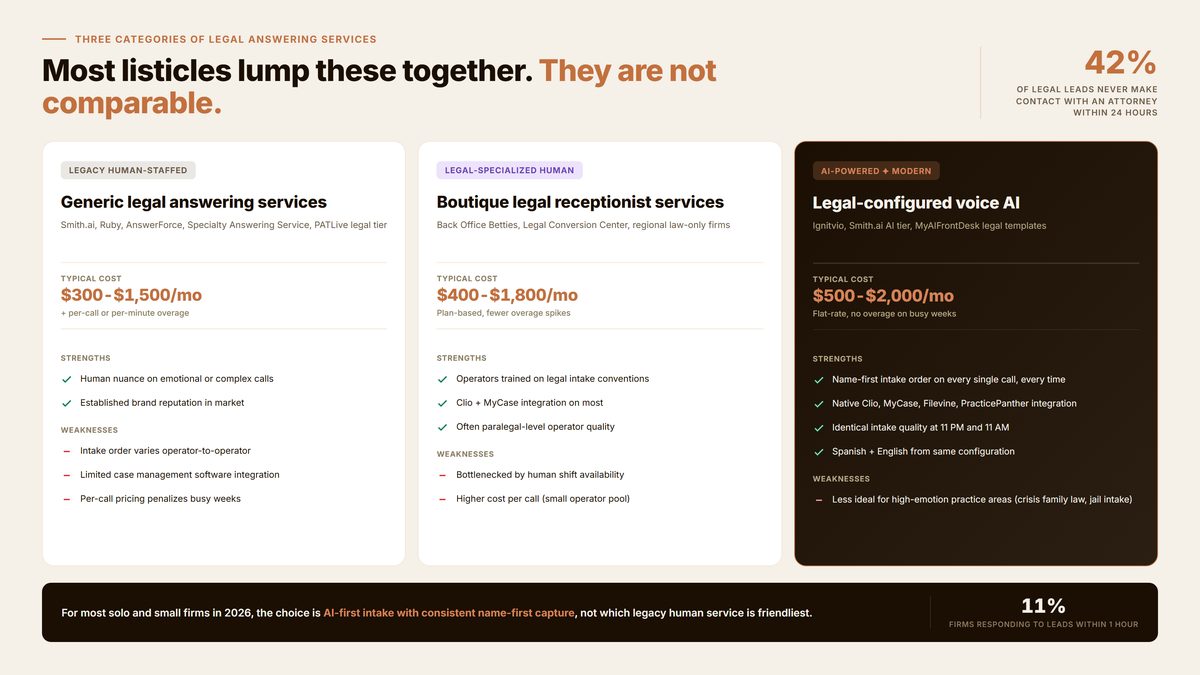
The answering service market for law firms splits into three categories with very different fit profiles. Most “best of” listicles lump them together and produce misleading rankings. They are not comparable.
Legacy human-staffed legal answering services (Smith.ai, Ruby, AnswerForce, Specialty Answering Service, PATLive’s legal tier) employ human operators with general legal intake training. The good ones use proper conflict-check intake order (name-first, then matter description). The bad ones take full intake before any name capture. Quality varies more than the marketing implies, and per-call or per-minute pricing makes busy weeks unpredictable.
Typical cost for a small firm: $300-$1,500/month base plus per-call overage. Quality strength: human nuance on emotional or complex calls (family, criminal defense, wrongful death). Weakness: limited integration with legal case management software, inconsistent quality across shifts.
Legal-specific virtual receptionist services (Back Office Betties, Legal Conversion Center, a handful of regional firms) train staff specifically on legal workflows and integrate with Clio, MyCase, or other legal-specific tools. Closer fit to actual law firm needs. Limited service availability and longer onboarding than generic services.
Typical cost: $400-$1,800/month. Strength: trained on legal vocabulary and intake conventions, often with paralegal-level operators. Weakness: still bottlenecked by human shift availability, smaller operator pools mean higher cost per call.
AI-powered legal answering services handle the intake with voice AI configured for legal-specific intake patterns. The AI captures names first, runs conflict-check workflows against the firm’s case management system in real time, and books consultations directly into the attorney’s calendar. The current generation of voice models handles natural legal intake conversation without obvious robot-tells. Modern AI answering services configured for legal handle this category significantly better than legacy generic services because the AI never deviates from the name-first intake order.
Typical cost: $500-$2,000/month flat rate. Strength: consistent intake quality across all calls and times, native integration with legal case management software, never deviates from privilege-protective workflow. Weakness: small firms doing very high-emotional-content practice (family law with frequent crisis calls, criminal defense with active jail intake) may still prefer human-handled intake for the most sensitive call types.
How We Evaluated the 8 Services Below
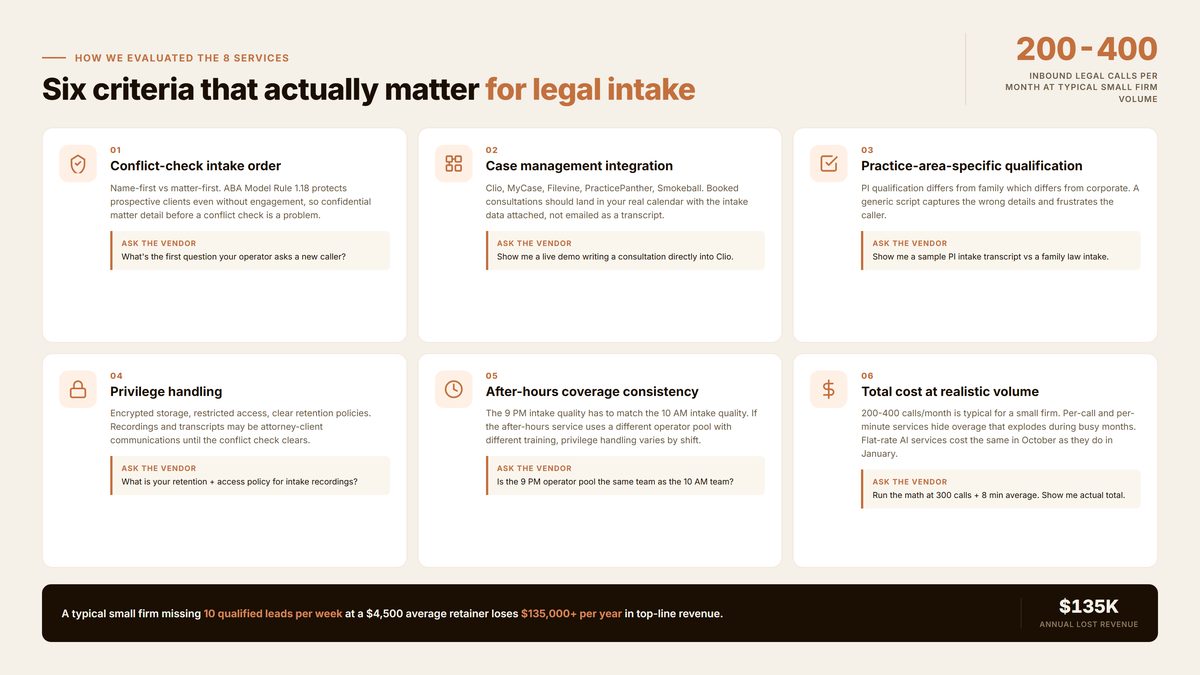
Each service was evaluated against six criteria specific to legal: conflict-check intake order (name-first vs matter-first), case management integration depth (Clio, MyCase, Filevine, PracticePanther, Smokeball), practice-area-specific qualification, attorney-client privilege handling (storage, access, retention), after-hours coverage consistency, and total cost at typical small-firm call volume (200-400 inbound legal calls per month).
We did not attempt to crown a universal #1 because the right pick depends on firm size, practice area, and whether the firm wants AI-first intake with human escalation or human-first intake with AI overflow. Each service below has a “best for” badge identifying the specific firm profile it actually serves best.
The 8 Best Answering Services for Lawyers in 2026
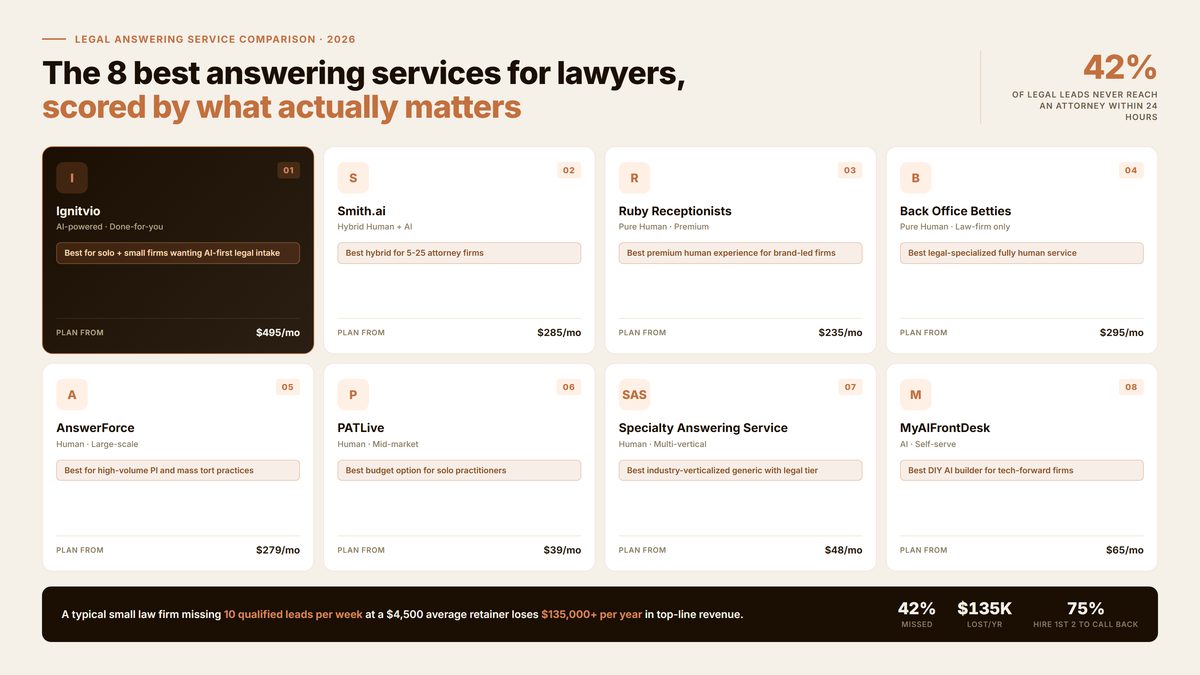
Best Legal Answering Services at a Glance
- 1 Details
Best for AI-First Legal Intake at Solo + Small Firms
Ignitvio
- 2 Details
Best Hybrid Human + AI for Mid-Size Firms
Smith.ai
- 3 Details
Best Premium Human Experience
Ruby Receptionists
- 4 Details
Best Legal-Specialized Human Service
Back Office Betties
- 5 Details
Best for High-Volume PI + Mass Tort
AnswerForce
- 6 Details
Best Budget Option for Solo Practitioners
PATLive
- 7 Details
Best Verticalized Generic with Legal Tier
Specialty Answering Service
- 8 Details
Best DIY AI Builder for Tech-Forward Firms
MyAIFrontDesk

Best for AI-First Legal Intake at Solo + Small Firms
Ignitvio
Type
AI-powered, done-for-you, legal-configured
Pricing
Flat-rate monthly, priced by module
Best for
Solo + small firms (2-5 attorneys)
Why We Picked It
Ignitvio is configured for legal-specific intake workflows during onboarding. The AI captures the caller’s full name, the other party’s name, and the practice area before any matter detail is described, so the firm’s conflict-check workflow can run before privileged information enters the conversation. Booked consultations push directly into Clio, MyCase, PracticePanther, or Filevine.
Pros
- Native Clio, MyCase, PracticePanther, Filevine integration
- Consistent name-first intake order on every call (humans deviate, AI does not)
- Flat-rate pricing that does not penalize busy months
- True 24/7 coverage with same intake quality at 11 PM as 11 AM
- Spanish + English intake from the same configuration
Cons
- Smaller brand than 20+ year legacy legal services
- No human escalation path for the most emotional intake calls (high-conflict family, fresh criminal jail)
- AI-first approach is uncomfortable for firms whose differentiation is 'you'll always reach a human'

Best Hybrid Human + AI for Mid-Size Firms
Smith.ai
Type
Human + AI hybrid, legal-specialized tier
Pricing
$285-$1,500/mo, per-call pricing
Best for
5-25 attorney firms
Why We Picked It
Smith.ai built its legal tier around hybrid handling: AI screens callers and handles basic FAQ, human agents handle the actual intake. Clio integration is mature. The brand has the most established reputation in the modern legal answering service market.
Pros
- Strong human call quality
- Deep Clio, HubSpot, Salesforce integration
- Established brand with extensive legal references
- Both phone and chat handling included
Cons
- Per-call pricing escalates fast on high-volume firms
- Intake order varies by operator (some name-first, some let caller talk)
- Hybrid handoff between AI and human creates conversational seams some callers notice

Best Premium Human Experience
Ruby Receptionists
Type
Pure human, premium positioning
Pricing
$235-$1,505/mo, per-minute
Best for
Boutique firms where call quality is brand
Why We Picked It
Ruby has built a 20+ year reputation on consistently warm, US-based human call handling. For boutique firms where the answering experience is part of the brand, Ruby is hard to beat on call quality alone. Legal-specific training is decent but not as deep as legal-specialized services.
Pros
- Highest consistent human call quality in the category
- Strong 20+ year brand reputation
- Simple to set up, no script writing required
- No AI confusion for callers who dislike speaking with AI
Cons
- Most expensive option per call
- Generalist intake training means legal-specific conflict-check workflow depends on script customization
- Per-minute pricing makes high-volume months unpredictable
Best Legal-Specialized Human Service
Back Office Betties
Type
Pure human, law-firm-only specialization
Pricing
$295-$1,495/mo, plan-based
Best for
Small + mid-size firms wanting fully human legal intake
Why We Picked It
Back Office Betties works exclusively with law firms, which shows in their intake quality. The operators are trained on legal vocabulary, common intake patterns, and basic conflict-check sequencing. The trade-off is a smaller operator pool than the larger generic services.
Pros
- Genuinely law-firm-specific operator training
- Strong Clio, MyCase, Filevine, PracticePanther integration
- US-based operators with consistent quality across the team
Cons
- Higher cost per call than generic services because operators are specialized
- Limited after-hours coverage on lower-tier plans
- Smaller brand than Ruby or Smith.ai

Best for High-Volume PI + Mass Tort
AnswerForce
Type
Human, large-scale operations with legal vertical training
Pricing
$279-$1,099/mo, per-minute
Best for
PI firms, mass tort, high-volume settlement practices
Why We Picked It
AnswerForce operates at much larger scale than the boutique legal services. The trade-off is less personalized service in exchange for high uptime and cost efficiency at scale.
Pros
- Genuine 24/7 coverage including weekends + holidays at flat rate on higher plans
- Cost-effective for firms with 300+ monthly calls
- Mature legal intake scripting for PI specifically
Cons
- Operator quality varies more than premium services
- Integration list is shorter than legal-specialized services
- Vertical specialization beyond PI is limited
Best Budget Option for Solo Practitioners
PATLive
Type
Human, mid-market
Pricing
$39-$649/mo
Best for
Solo attorneys with 30-80 calls/month
Why We Picked It
PATLive targets the very low end of the small business market with a $39 starter tier. For solo attorneys just starting out who need basic message taking and overflow coverage, this is genuinely the most affordable option.
Pros
- Lowest entry-level pricing in the category
- Simple month-to-month commitment
- Decent call quality for the price point
Cons
- No legal-specific training (operators read your custom script)
- Per-minute pricing escalates fast above the starter tier
- Minimal integration with legal case management software
Best Verticalized Generic with Legal Tier
Specialty Answering Service
Type
Human, multi-vertical with legal tier
Pricing
$48-$1,219/mo, per-minute
Best for
Firms wanting consistent generic-but-trained answering
Why We Picked It
Specialty Answering Service has a long-tenured legal tier with operators trained on basic intake workflows. The platform is dated but the underlying service is reliable.
Pros
- Long industry track record (decades of legal call handling)
- Extensive call type customization options
- US-based operators on premium tiers
Cons
- Limited integration with modern legal case management tools
- Per-minute pricing model penalizes busy months
- Dated platform UX
Best DIY AI Builder for Tech-Forward Firms
MyAIFrontDesk
Type
AI-powered, self-serve
Pricing
$65-$697/mo, minute-based
Best for
Technology-forward solo or small firms
Why We Picked It
MyAIFrontDesk gives you the tools to build and configure your own AI receptionist with templates and a no-code interface. For firms that have a tech-savvy attorney willing to invest the configuration time, the flexibility is real. For firms that just want intake handled correctly, the DIY burden is the cost.
Pros
- Most flexible configuration in the AI category
- No-code editor for non-developers
- Large template library including legal starter templates
Cons
- DIY setup means you are responsible for the conflict-check intake order
- No professional services or onboarding on lower tiers
- Legal-specific intelligence depends entirely on how well you configure it yourself
The honest verdict
For solo and small law firms in 2026, the choice usually comes down to AI-first vs human-first intake. AI-first wins on consistency (the conflict-check intake order is identical on every single call), cost efficiency (flat-rate instead of per-call), and after-hours coverage (no shift quality variance). Human-first wins on the most emotional calls (high-conflict family law, criminal defense jail intake, wrongful death) where caller nuance matters more than intake speed.
For high-volume mid-size firms, the hybrid model (Smith.ai) often hits the sweet spot, with AI handling the FAQ and qualification screens and humans handling the actual intake conversation.
For practices where the answering experience is part of the brand (boutique probate, white-collar criminal defense, high-net-worth divorce), Ruby’s premium human experience remains the gold standard.
For solo attorneys at the very low end of the market, PATLive’s $39 entry tier is the no-risk way to test whether dedicated answering coverage drives a measurable ROI before committing to anything more expensive.
Without Ignitvio vs. With Ignitvio
- Intake order varies by operator: some go name-first, some let caller describe matter first
- No conflict-check integration with Clio / MyCase / Filevine / PracticePanther
- After-hours coverage uses a different operator pool with inconsistent legal training
- Per-call pricing escalates 30-50% during the months you actually need coverage most
- Spanish-speaking potential clients hit a language gate or get routed to a different operator
- Setup takes 3-6 weeks of script writing and operator training
- Name-first intake order on every single call, every time, no operator variance
- Native Clio / MyCase / PracticePanther integration, conflict check workflow triggered automatically
- True 24/7 coverage with identical intake quality at 11 PM Saturday as 11 AM Tuesday
- Flat-rate pricing: peak months cost the same as slow months
- Spanish + English intake from the same configuration, no language gate
- Done-for-you setup operational in under a week
Illustrative comparison of the two service models, not a measured client result.
Stop Losing Qualified Leads to the Firm That Picks Up Faster
See how many qualified legal leads your firm is losing right now
We'll mystery-shop your firm across business hours, evenings, weekends, and emergency scenarios with both English and Spanish callers, then show you exactly how many leads are slipping and what they're worth. Free. No pitch.
Get Your Free Revenue Audit
Jake Melendy
Founder, Ignitvio
Jake Melendy is the founder of Ignitvio. He spent 12 years in enterprise sales and sales leadership, including at Oracle, before building Ignitvio, which runs done-for-you outbound appointment setting for commercial contractors and B2B service companies. He writes about pipeline, trigger-based prospecting, and lead response.