Law Firm Answering Service: 24/7 Client Intake

- 79% of callers who reach voicemail at a law firm hang up and call another firm — every unanswered call is a client your competitor signs.
- The average law firm misses over 50% of incoming calls, and only 42% of firms respond to new leads within 24 hours.
- A single personal injury case can be worth $10,000 to $100,000+ in fees — one missed intake call per week could cost a firm $500,000+ per year.
- AI-powered law firm answering services handle intake screening, appointment booking, and after-hours calls without adding headcount or billable-hour interruptions.
What Legal Clients Expect When They Call

People looking for a lawyer aren’t comparison shopping for fun. They’re in crisis. A car accident, a divorce filing, a wrongful termination, a criminal charge — these are the moments that drive someone to pick up the phone and call a law firm. The emotional stakes are as high as they get, and the caller’s patience is measured in seconds, not minutes.
According to the Clio Legal Trends Report, only 42% of law firms respond to a new client inquiry within 24 hours. That’s a staggering number when you consider what the American Bar Association found on the other side: 85% of potential clients expect a callback within 24 hours. That gap between what clients expect and what firms actually deliver? That’s where cases are won and lost — not in the courtroom, but at the front desk.
of callers who reach voicemail at a law firm hang up and call another attorney
Source: LexisNexisA family law practice in Houston learned this the hard way. They tracked their intake calls over 60 days and found that 34% of first-time callers who reached voicemail never called back. Those weren’t tire-kickers. Those were people with active legal needs — custody disputes, divorce filings, protective orders — who simply called the next firm on Google until someone picked up.
The Martindale-Nolo survey found that 74% of potential clients visit a law firm’s website before calling. They’ve already done their research. Already read reviews and compared practice areas. By the time they dial your number, they’re ready to hire. The phone call is the final step in their decision process — and if no one answers, the decision defaults to whoever picks up next.
This isn’t just a small-firm problem either. Mid-size litigation practices with 10 to 20 attorneys face the same issue because their intake staff is sized for average volume, not peak volume. Monday mornings, lunch hours, and the 4
to 6 PM window after courts close all create call surges that overwhelm a two-person reception team. And the calls that spill over during those windows are disproportionately high-value: people calling after consulting with friends or family over the weekend, people calling right after receiving legal papers, people calling on their lunch break because it’s the only time they can talk privately.The Cost of Missed Intake Calls for Law Firms

The financial math at a law firm is different from almost any other business because the value of a single client can be enormous. A personal injury firm in Atlanta that misses one viable case per week isn’t losing a $200 service call. They’re potentially losing $15,000 to $50,000 in contingency fees per missed intake. Scale that across a year and it becomes impossible to ignore.
The Clio Legal Trends Report found that the average law firm misses more than 50% of incoming calls. For a firm getting 30 calls a day, that’s 15 potential clients per day who heard a voicemail greeting instead of a human voice. Even if only 20% of those callers had viable cases, that’s three lost clients per day — fifteen per week.
The revenue impact varies by practice area, but the numbers are consistently large:
- Personal injury: Average case value of $10,000 to $100,000+ in fees. One missed viable case per week represents $520,000 to $5.2 million in annual lost revenue.
- Family law: Average retainer of $3,500 to $7,500. Missing two intake calls per day that would have converted adds up to $1.8 to $3.9 million per year.
- Criminal defense: Average case fee of $2,500 to $15,000. Defendants facing charges are the most time-sensitive callers — they will hire the first attorney who answers.
- Estate planning: Lower individual case value ($1,500 to $5,000) but high lifetime value through referrals and repeat business for trust amendments, power of attorney updates, and estate administration.
Beyond direct revenue, missed calls damage a law firm’s reputation in ways that compound over time. A potential client who can’t reach your firm doesn’t just hire someone else — they tell their story. “I called three lawyers and only one actually answered” is one of the most common narratives in legal consumer surveys. That word-of-mouth effect means each missed call costs you not just the immediate case but the referral network that client would’ve generated.
There’s also a competitive intelligence angle that most firms overlook. FindLaw research shows that 67% of people looking for a lawyer use a search engine. If you’re spending $5,000 to $15,000 a month on Google Ads or SEO to drive phone calls, every unanswered call represents paid traffic that you acquired and then wasted. You paid to get that phone to ring and then let it go to voicemail. That’s not a staffing problem. You’ve basically lit that ad spend on fire.
Why Traditional Receptionist Models Fail Law Firms
The default solution for most law firms is straightforward: hire a receptionist (or two) and have them answer the phones. The model’s worked for decades and there’s a certain logic to it — a warm human voice, someone who knows the attorneys by name, someone who can handle the nuance of legal intake. But the model has structural weaknesses that no amount of hiring can fix.
First problem: coverage. A full-time receptionist works 40 hours a week. Your phone rings 168 hours a week. That leaves 128 hours — evenings, weekends, holidays — where calls go to voicemail. According to Clio’s data, over 30% of client calls to law firms come in outside business hours. For criminal defense and personal injury firms, the after-hours percentage is even higher because arrests and accidents don’t follow a 9-to-5 schedule.
Second problem: capacity. Even during business hours, a single receptionist can handle one call at a time. If your firm gets 25 calls a day and the average intake call takes 6 to 8 minutes, that’s 150 to 200 minutes of phone time — roughly three hours. Layer on call transfers, voicemail retrieval, appointment scheduling, and greeting walk-in clients, and one person simply can’t keep up during peak windows. The result’s the same as having no receptionist at all: calls go to voicemail, and callers go to your competitors.
Third problem: cost. A full-time legal receptionist costs $35,000 to $50,000 a year in salary alone, plus benefits, training, PTO coverage, and management overhead. Two receptionists for staggered coverage doubles that. And even with two people, you’ve still got zero coverage after 6 PM, on weekends, and on holidays. To get true 24/7 phone coverage with human staff, you’d need a minimum of four full-time employees working shifts — a cost that only the largest firms can justify.
A personal injury firm in Phoenix tried the traditional model with two receptionists and discovered that during their Monday morning surge (8 AM to 10 AM), they were still missing 40% of inbound calls. Both receptionists were on active intake calls while three more lines rang through to voicemail. Fully staffed. Still hemorrhaging leads.
How many client calls is your firm missing?
We’ll mystery-shop your law firm — call after hours, submit a web inquiry, test your hold times — and show you exactly where potential clients are falling through. Free. Results in 48 hours.
How Law Firm Answering Services Work
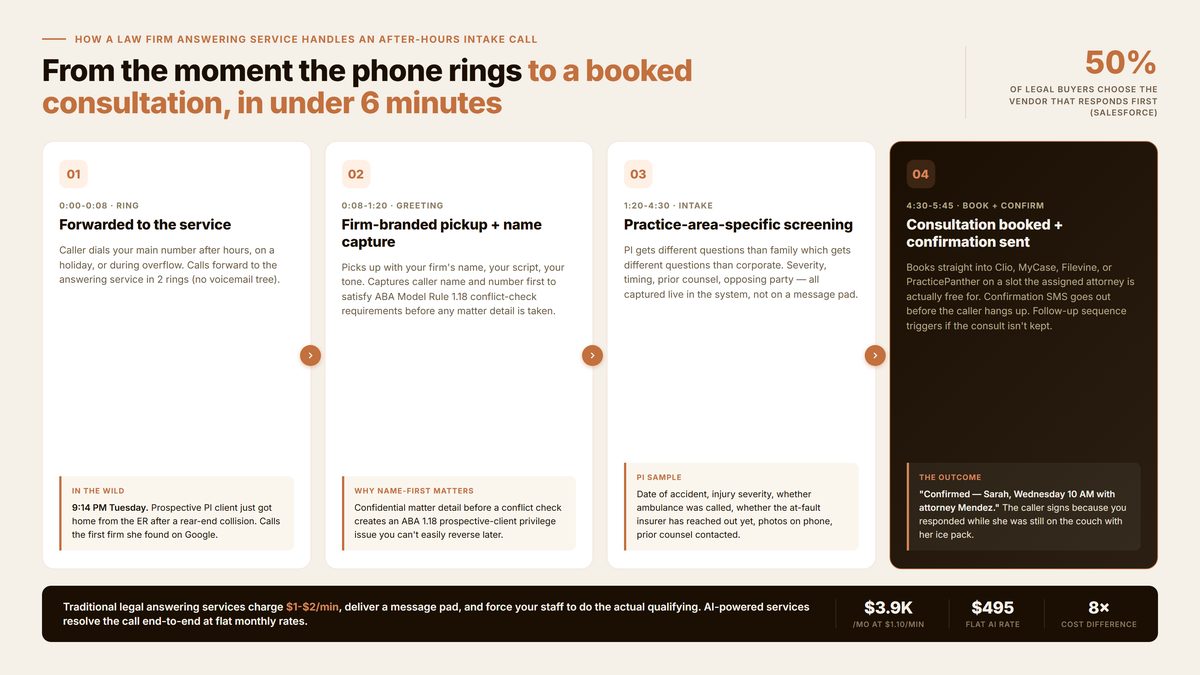
A law firm answering service fills the gaps that in-house reception can’t cover. The basic model is simple: calls to your firm get forwarded to the service during overflow, after hours, or all the time, and trained operators or AI systems handle the initial intake, qualify the caller, and route the information to the appropriate attorney.
But the range of what qualifies as a “law firm answering service” is enormous. At one end, you’ve got basic call centers that answer with your firm’s name, take a message, and email it to you. At the other end, you’ve got AI answering services that conduct full intake screenings, ask qualifying questions specific to your practice area, book consultations directly on your calendar, and send instant follow-up texts to the caller.
The category’s evolved fast. Traditional legal answering services charge $1 to $2 per minute, which means a 6-minute intake call costs $6 to $12. If your firm handles 30 calls a day through the service, that’s $180 to $360 per day — $3,960 to $7,920 per month. And for that cost, you still get a message pad: the operator takes down the caller’s name, number, and issue, and your team still has to call back, qualify the lead, and book the appointment.
AI-powered answering services change the economics completely. Instead of per-minute billing, most operate on flat monthly rates. Instead of taking messages, they resolve requests in real time. A potential client calling at 9 PM on a Tuesday about a car accident can be asked intake questions (when did the accident happen, were there injuries, has the other driver’s insurance contacted you), given a consultation time, and sent a confirmation text — all before they hang up.
The Salesforce State of the Connected Customer report found that 50% of buyers choose the vendor that responds first. In legal services, where the caller’s often speaking to multiple firms in the same afternoon, being first to respond isn’t a nice-to-have. It’s the single strongest predictor of whether you sign the client.
The best legal answering services also handle the follow-up layer that most firms neglect entirely. After the initial call, the system sends a confirmation text, follows up if the consultation isn’t booked, and re-engages leads who went cold. That automated follow-up sequence is where a ton of signed cases actually come from — not the first call, but the persistent, professional follow-up that most firms are too busy to do manually.
What to Look for in the Best Legal Answering Service
Not every answering service understands legal intake. The difference between a generic call center and a purpose-built legal answering service is the difference between “someone called about a car accident” and a fully qualified intake with case type, statute of limitations awareness, conflict check data, and a booked consultation.
Here’s what separates the best attorney answering service from a basic message-taking operation:
-
- Legal intake scripting. The service should ask practice-area-specific qualifying questions. A personal injury intake is different from a family law intake, which is different from a criminal defense intake. Generic “how can I help you?” scripts waste the caller’s time and produce useless messages.
-
- Conflict checking capability. Before booking a consultation, the service needs to capture enough information (opposing party names, case details) to flag potential conflicts. A firm that books a consultation and then has to decline representation due to a conflict wastes everyone’s time and damages its reputation.
-
- Real-time calendar integration. The answering service should book consultations directly on your attorneys’ calendars — not create a list of callbacks for your paralegal to process the next morning. Every hour between the initial call and the booked consultation is an hour the caller might sign with someone else.
-
- After-hours coverage with escalation paths. Criminal defense attorneys need to be reachable for bond hearings. Personal injury firms need to respond to accident calls before the other driver’s insurance adjuster does. The service needs customizable escalation rules: which call types page which attorney, what counts as an emergency versus a routine intake, and what happens when the on-call attorney doesn’t respond.
-
- Bilingual intake. According to U.S. Census data, over 41 million people in the United States speak Spanish at home. For firms in markets like Miami, Houston, Phoenix, or Los Angeles, Spanish-language intake isn’t optional — it’s a competitive necessity.
-
- Transparent reporting and analytics. You need to see call volume by hour, conversion rates from call to consultation, response times, and which practice areas are generating the most intake calls. An answering service that can’t provide this data is a black box.
One pattern we see across every legal market: firms evaluate answering services based on cost per minute rather than cost per signed case. The cheapest service that takes a message and emails it to you at $0.90 per minute looks economical — until you realize that 60% of those messages never convert because the callback happened 18 hours later. The more expensive service that books consultations in real time and follows up automatically may cost twice as much per month but deliver four times the signed cases. Evaluate on outcomes, not on per-minute rates.
Comparing Your Options: Traditional vs. AI Law Firm Answering Services
The legal answering service market breaks into three tiers, and understanding the trade-offs helps you pick the right fit for your firm’s size, practice areas, and growth goals.
Basic answering services ($200 to $500/month) answer calls with your firm’s greeting, take a message, and email or text it to you. Coverage, but no resolution. Your staff still does all the intake work. Best for solo practitioners who just need after-hours voicemail replacement.
Specialized legal answering services ($500 to $1,500/month, plus per-minute overages) employ operators trained in legal terminology and basic intake procedures. They can ask screening questions and categorize calls by practice area. Better than basic services, but still fundamentally a message-taking operation — the operator can’t book appointments, check conflicts, or answer questions about your firm’s specific capabilities.
AI-powered legal answering services ($500 to $1,500/month, flat rate) use voice AI technology to conduct full intake conversations, book consultations, send follow-up texts, and integrate with your practice management software. They run 24/7 with consistent quality, never call in sick, and handle unlimited simultaneous calls. The technology’s reached the point where callers often can’t tell they’re speaking with an AI.
According to a Harvard Business Review audit of 2,241 companies, the average lead response time among companies that responded was 42 hours. For law firms using AI intake, the response time is zero — the call gets answered and the intake begins on the first ring. In a market where the first firm to respond signs the client, that difference alone justifies the investment.
The right choice depends on your volume and economics. If your firm handles fewer than 10 intake calls a week, a basic or specialized service might work fine. If you handle 10 or more per week and each signed case is worth $3,000 or more in fees, the math overwhelmingly favors an AI system that converts calls to consultations in real time rather than creating a callback queue. To see how specific vendors stack up, read our head-to-head review of the best answering services for lawyers.
Putting It All Together

Here’s the full picture. Your law firm is losing clients and revenue to three compounding problems: peak-hour call overflow that your receptionist can’t absorb, after-hours calls that go to voicemail while potential clients call other firms, and a follow-up process that depends on someone remembering to call back the next morning. Each problem alone costs your firm signed cases. Together, they create a structural leak that no amount of attorney talent can fix.
An AI law firm answering service tackles all three at once. It answers overflow calls during business hours so your receptionist isn’t choosing between the phone and the client standing at the front desk. It conducts full intake screenings after hours so a potential client calling at 8 PM Tuesday gets the same professional experience as one calling at 10 AM Wednesday. And it follows up automatically with every caller who doesn’t book a consultation on the first contact.
The difference between a firm relying on voicemail and callbacks versus one using automated intake isn’t subtle:
- 50%+ of calls go unanswered or to voicemail
- After-hours callers wait until the next business day
- 79% of voicemail callers hang up and call another firm
- Intake staff spends hours on manual callbacks and scheduling
- No follow-up system for leads who don't book on first call
- 100% of calls answered within seconds, 24/7/365
- Full intake screening conducted in real time, even at midnight
- Consultations booked directly on attorney calendars
- Automatic follow-up texts sent to every caller who doesn't book
- Captures cases that would otherwise have gone to the firm that picked up
The economics of legal services drive the ROI: because individual case values are so high, capturing even two or three additional cases per month that would’ve been lost to voicemail delivers massive ROI. A family law firm booking three additional retainers per month at $5,000 each recovers $15,000 — from calls that previously rang through to voicemail.
How Ignitvio Works for Law Firms
Ignitvio is a done-for-you AI answering and client intake platform built for law firms that can’t afford to lose cases to unanswered calls. We deploy a complete system that handles inbound calls, after-hours intake, consultation booking, and automated follow-up — without requiring any action from your reception staff.
Law firms face a unique version of the missed-call problem: the value per client is exceptionally high, and the competition for that client is fierce. A potential client who calls three firms and gets one voicemail, one hold queue, and one instant intake screening will hire the firm that answered.
Here’s what the system does for a law firm:
- Voice AI answers every call — during business hours when your receptionist is on another line, and after hours when no one is in the office. It conducts practice-area-specific intake, asks qualifying questions, and books consultations directly on your calendar.
- Missed Call Text Back sends an instant SMS to any caller whose call isn’t answered within your threshold. The text opens a conversation where the potential client can describe their legal need, and the AI qualifies and schedules them via text.
- Automated follow-up sequences re-engage leads who don’t book during the initial call. If a potential client calls about a divorce consultation but doesn’t schedule, the system follows up at smart intervals until they book or opt out.
- Review automation sends a review request to every client after their case concludes, building the Google review profile that drives new client acquisition.
The entire system is deployed and managed for you. No software to learn. No staff training required. No per-minute charges that spike during your busiest months. You get a flat monthly rate and a dedicated team that configures the system to match your practice areas, intake procedures, and scheduling rules.
Setup takes less than a week. We configure your intake scripts by practice area (personal injury screening is different from estate planning screening), set escalation rules for urgent matters, and connect directly to your calendar and practice management system. We test with simulated calls across every scenario your firm handles, adjust until the intake matches your standards, and monitor performance weekly after launch.
The firms that see the fastest results are the ones that already know they’re losing cases to unanswered calls. If you’ve ever checked your missed call log on a Monday morning and wondered how many of those callers hired someone else over the weekend — this is the system that closes that gap for good.
See How AI Answering Would Work for Your Firm

Jake Melendy
Founder, Ignitvio
Jake Melendy is the founder of Ignitvio. He spent 12 years in enterprise sales and sales leadership, including at Oracle, before building Ignitvio, which runs done-for-you outbound appointment setting for commercial contractors and B2B service companies. He writes about pipeline, trigger-based prospecting, and lead response.