Best Rated AI Virtual Receptionist Voice in 2026: 8 Compared Across G2 and Trustpilot
- Most “best rated AI virtual receptionist voice” listicles do not actually cite the ratings. Of the 3 articles currently ranking on page 1 of Google for this exact query, zero include G2, Capterra, or Trustpilot star averages or review counts for the platforms they review. This post fixes that.
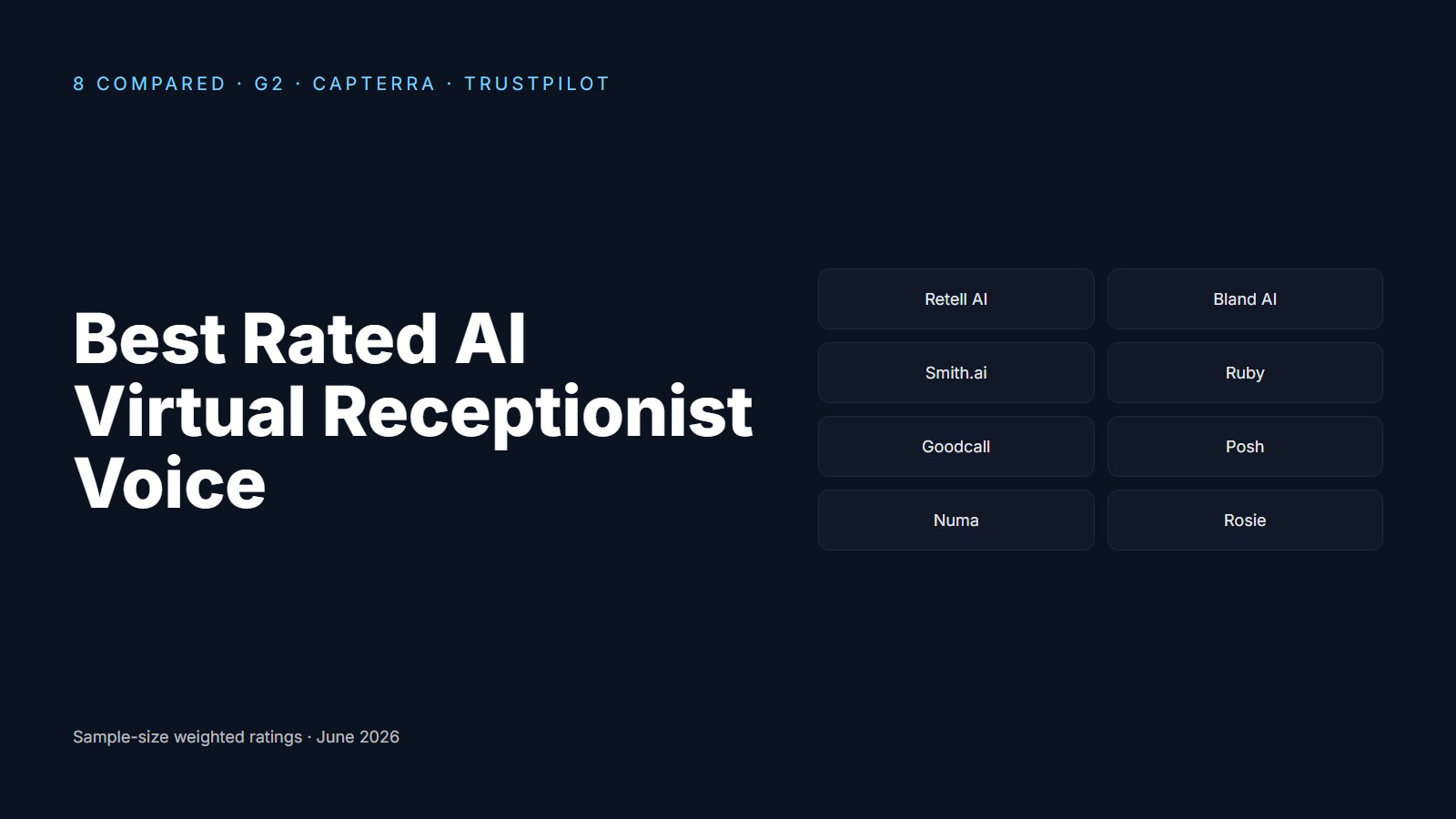
- The 8 platforms compared below have wildly different review profiles. Retell AI sits on 1,400-plus G2 reviews at 4.8 stars. Ruby has 750-plus Trustpilot reviews at 4.1 stars. Bland AI has 3 G2 reviews and a 5.0 average. The aggregate rating you actually want is sample-size-weighted, not raw star count.
- Voice quality is the one thing a spec sheet cannot fake. Latency, naturalness, interruption handling, and recovery from off-script questions are the four components that decide whether a real caller hangs up or books. We list a 5-minute DIY voice test in the last section so you can hear the differences yourself.
- We excluded ourselves (Ignitvio) from the rated comparison below. Our G2, Capterra, and Trustpilot footprint is still building, and putting ourselves in the rated rankings next to platforms with 50-plus verified reviews would compromise the credibility of the rating-aggregation method that makes this post useful. Our own perspective sits in the final section.
Why “Best Rated” Means Nothing Without a Source
Search “best rated AI virtual receptionist voice” on Google in 2026 and you will get a top 10 SERP made of three article-style listicles, a handful of vendor product pages, and several Reddit threads. We read the top 3 articles before writing this one. None of them cite the actual ratings of the platforms they review.
That is the standard pattern in this category. A blog post claims a platform is “best rated” or “top rated,” then leads with feature checklists, screenshots, and pricing tables that have nothing to do with rating data. The reader has no way to verify the claim. The reader has to trust the author.
The honest version of “best rated” requires four things the typical listicle skips. First, naming the rating sources the post is aggregating from. Second, showing the actual star average and review count from each source, not just one. Third, weighting the aggregate by sample size so a 5.0 from 3 reviewers does not outrank a 4.6 from 1,000 reviewers. Fourth, separating recent reviews from old ones, because voice AI in particular has changed fast enough that a 2023 review is closer to ancient history than to a current product evaluation.
The five sources that actually matter for AI receptionist platforms are G2 for B2B software credibility, Capterra for small-business buyer perspective, Trustpilot for consumer-facing complaint resolution patterns, Product Hunt for early-adopter signal, and Reddit subreddit threads for unfiltered operator commentary. No single source tells the full story. A platform highly rated on Product Hunt but missing from G2 has early-adopter momentum without enterprise validation. A platform with strong Trustpilot but weak G2 likely targets very small businesses. A platform with all three has real product-market fit.
Of G2 reviews submitted since ChatGPT launched have been flagged as likely AI-generated, per a 2024 study by Originality.AI. That is one reason cross-source aggregation matters: a single platform with inflated G2 numbers but weak Trustpilot and zero Product Hunt traction looks suspicious in a way that single-source rankings will miss.
Source: Originality.AI studyWhat Voice Quality Actually Measures
Voice is the dimension a comparison table cannot capture. A platform can score perfectly on every spreadsheet criterion and still sound robotic enough that callers hang up before the second question. Four components decide whether a voice passes the credibility bar with a real caller.
Latency, measured in milliseconds between when the caller stops speaking and when the AI starts responding. Anything over 800 milliseconds reads as awkward. Anything under 400 milliseconds reads as natural. The good platforms in 2026 sit at 300 to 500 ms. The weaker ones sit at 800 to 1,200 ms and the listener can feel it, even if they cannot articulate why.
Naturalness, which covers prosody, inflection, and the pacing of pauses inside a sentence. The technical term is mean opinion score (MOS), a 1 to 5 scale that human raters apply to voice samples. The current MOS ceiling for production AI voices is around 4.5, which is close enough to human that most callers will not consciously notice. Below 4.0 the listener starts to feel something is off without being able to name it.
Interruption handling, meaning what happens when the caller starts talking before the AI finishes a sentence. The bad behavior is the AI keeps talking through the interruption, or stops mid-word and resets the whole turn. The good behavior is the AI yields the floor, listens to the new input, and resumes the conversation from the right context. ContactBabel research on contact center expectations puts interruption handling in the top three priorities buyers care about, ahead of even voice quality.
Recovery from off-script questions, which is where most demo videos quietly avoid showing the platform. A caller asking “wait, do you guys do leak detection or just pipe replacement?” outside the listed services is the moment the AI either degrades to “let me take a message” or actually answers based on the context the business gave it. The platforms that handle this well sound like a competent receptionist on day three of training. The platforms that handle it badly sound like an IVR phone tree from 2016.
You cannot read your way to a verdict on these four components. You have to listen. The fastest path is the DIY voice test in the last section of this post, which takes about 5 minutes per platform.
Our 5-Criteria Evaluation Framework
The 8 platforms below are scored across five dimensions. We weighted them based on what a service-business owner actually cares about when buying an AI receptionist, not what a feature comparison spreadsheet would weight.
Aggregate rating (across G2, Capterra, Trustpilot, and Product Hunt)
We pulled current star averages and review counts from each platform’s listings on G2, Capterra, Trustpilot, and Product Hunt. Where a platform is listed on multiple sources, we report each one rather than collapse them into a single misleading composite. A weighted aggregate that combines a 5.0 from 3 reviewers with a 4.2 from 750 reviewers tells you almost nothing useful.
Voice quality benchmark
Where the platform publishes latency numbers we report them. Where they do not, we note that, because opaque latency claims usually mean the number is bad. We also note which platforms allow you to listen to a public demo of their voice and which require you to schedule a sales call to hear anything.
Native CRM and calendar integrations
Count of named platforms each service integrates with directly, not via Zapier middleware. ServiceTitan, Jobber, Housecall Pro, Salesforce, HubSpot, Clio, athenahealth, Google Calendar, Microsoft 365, Calendly. The number of named integrations is a proxy for whether the platform takes any specific vertical seriously.
Pricing transparency
Whether published pricing exists on the public website, or whether the page sends you to a “contact sales” form. Published pricing scores higher because it lets the buyer make a decision without burning calendar time on a discovery call. “Contact sales” is the default for enterprise-positioned platforms and usually adds 30 to 50 percent to the eventual price quoted.
Real customer review density
The total volume of reviews across all sources, regardless of star rating. A platform with 2,000 total reviews at 4.4 stars is more credible than a platform with 12 reviews at 4.9 stars. Sample size beats star average for evaluation purposes.
A Note On Bias Before You Read Further
Ignitvio is the company behind this post. We build an AI receptionist for service businesses, and we appear in your search results for the same category these 8 platforms compete in. We excluded ourselves from the rated rankings below for one reason: our G2, Capterra, and Trustpilot rating profile is still building, and putting ourselves into a rating-aggregation comparison next to platforms with 50 to 1,400 verified reviews would compromise the credibility of the method that makes this post useful in the first place.
This is the same reason Wirecutter does not rank its parent company’s products, and the same reason editorial review sites disclose their conflicts up front instead of pretending they do not have any.
If you already know your business needs a service-vertical platform built around ServiceTitan, Jobber, Housecall Pro, Clio, or athenahealth integrations rather than a horizontal voice AI builder, you can skip the comparison below. The free Ignitvio audit takes 30 minutes and tells you what your current call handling is costing in missed revenue and what a vertical-specific platform would actually book on your call mix.
Skip the platform shopping. Audit your real call data with Ignitvio in 30 minutes.
Free written analysis with your call volume and revenue leak numbers.
Get Your Free AuditThe rest of this post is the editorial comparison for readers who want to evaluate horizontal platforms first. Our own positioning sits in the final section.
Best Rated AI Virtual Receptionist Voice at a Glance
Best Rated AI Virtual Receptionist Voice in 2026
- 1 Details
Best for Most Reviews + Highest G2
Retell AI
- 2 Details
Best No-Code Builder
Synthflow
- 3 Details
Best Human + AI Hybrid
Smith.ai
- 4 Details
Best Established Human Service
Ruby Receptionists
- 5 Details
Best for Developer Flexibility
Vapi
- 6 Details
Best for Very Small Business
Goodcall
- 7 Details
Best Interruption Handling (small sample)
Bland AI
- 8 Details
Best Newer Entrant (2024 launch)
Allo
The 8 Best Rated AI Virtual Receptionist Voices in 2026
Best for Most Reviews + Highest G2
Retell AI
Type
Voice AI developer platform with prebuilt receptionist agents
Pricing
$0.07 to $0.31 per minute, published
Best for
Teams that want the highest-rated voice with strong technical flexibility
Why We Picked It
Retell AI holds the largest verified review base of any platform in this category. The 4.8 average on G2 across 1,400-plus reviews is not just high, it is statistically robust in a way that a 5.0 from 3 reviewers is not. Reviewers consistently call out voice quality and ease of integration, with the most common complaint being per-minute pricing that adds up for high-volume operators.
Pros
- G2 rating of 4.8 stars across 1,414 to 1,755 reviews, the largest sample in this category
- Published latency in the 300 to 500 ms range that competitors do not match in public demos
- Open API with direct integrations to common CRMs and calendar platforms
- Listed on Trustpilot and Product Hunt in addition to G2, with positive signal on all three
Cons
- Developer-flavored interface, less appealing to a non-technical owner
- Per-minute pricing penalizes high-volume call months unless you negotiate a flat rate
- Voice library is solid but smaller than Vapi or Synthflow if you want unusual accents
Best No-Code Builder
Synthflow
Type
No-code AI voice agent builder
Pricing
Plans from $29 per month, published
Best for
Non-technical operators who want to build their own agent without engineering help
Why We Picked It
Synthflow is the platform that closes the gap between developer-flavored voice AI and a typical operator who wants to build something themselves. The 4.5 G2 rating across 999 reviews is a strong second-place signal, and the consistent praise around ease of setup and integration speed is the kind of pattern you only see from a product that actually works as advertised. The cost complaint is real and worth weighing.
Pros
- G2 rating of 4.5 stars across roughly 999 reviews, the second-largest sample
- Drag-and-drop flow builder that genuinely works without writing code
- Strong Capterra and Trustpilot listings reinforcing the G2 signal
- Ranked number 4 in AI agents worldwide on G2 with multiple G2 award badges
Cons
- Top G2 complaint is cost, with 145 mentions citing the price as high relative to alternatives
- Some users report a learning curve on the more advanced flow features
- Voice library quality is good but not best-in-class on prosody benchmarks
Best Human + AI Hybrid
Smith.ai
Type
Human virtual receptionist service with AI tier
Pricing
From $325 per month for human service, AI tier pricing on request
Best for
Firms that want a human safety net behind the AI for complex or sensitive calls
Why We Picked It
Smith.ai is the answer for buyers who do not fully trust an unsupervised AI to handle every call. The hybrid model layers human escalation behind the AI tier, which means a call that goes off-script can be handed off without the caller getting frustrated. The G2 and Trustpilot ratings are strong on both the legacy human service and the newer AI tier, which is unusual in this category.
Pros
- Smith.ai Virtual Receptionists at 4.6 stars on G2 across 73 reviews, AI tier rated 4.7 stars
- Trustpilot rating of 4.4 stars across 334 reviews, the second-largest Trustpilot footprint
- Established 8-plus year track record in the legal and professional services market
- Hybrid model lets the AI handle volume and escalate complex calls to trained human staff
Cons
- Pricing is significantly higher than pure-AI alternatives because of the human staffing component
- AI tier pricing is not published, requiring a sales conversation to evaluate
- Per-minute structure on the legacy human plans punishes busy weeks with overage fees
Best Established Human Service
Ruby Receptionists
Type
Human-staffed virtual receptionist service
Pricing
Plans from $325 per month, per-minute thereafter
Best for
Established firms that prefer a fully human voice and have budget for premium service
Why We Picked It
Ruby Receptionists is the established legacy answer in a category where most platforms launched in 2022 or later. The Trustpilot signal across 750-plus reviews is the broadest customer-facing sentiment data in this comparison. The G2 score of 3.7 is the weakest in this list and deserves the second look, though the small G2 sample size means the Trustpilot data is more reliable for sentiment assessment.
Pros
- Trustpilot rating of 4.1 stars across 750-plus reviews, the largest Trustpilot footprint in this category
- 20-plus years of brand recognition in the professional services market
- Consistently praised for receptionist professionalism and customer service quality
- Established partnerships with Clio, MyCase, and other legal practice management software
Cons
- G2 rating of 3.7 stars across only 10-plus reviews, the lowest G2 score of any platform in this list
- Capterra rating of 4.1 stars but only 5-plus reviews, a small sample for a 20-year-old brand
- Pricing is consistently called out as expensive, especially as call volume grows
- Fully human staffing means the service cannot match AI on coverage hours or simultaneous calls
Best for Developer Flexibility
Vapi
Type
Developer-first voice AI orchestration platform
Pricing
Base $0.05 per minute orchestration, true all-in $0.07 to $0.25 per minute
Best for
Technical teams that want to plug their own LLM, TTS, and STT providers into a custom flow
Why We Picked It
Vapi is the platform for teams that want maximum control and are willing to assemble their own stack. The G2 rating is solid at 4.4, and the bring-your-own-API model is a real differentiator if you already have preferred LLM and voice providers. The pricing reality is more expensive than the headline suggests once you add up the third-party costs, and the setup curve is real.
Pros
- G2 rating around 4.4 stars based on aggregated review data
- Bring-your-own-API model lets you use OpenAI, Anthropic, ElevenLabs, Deepgram, and others
- Cheapest published base rate at $0.05 per minute for orchestration
- Strong Reddit and Product Hunt presence in the developer community
Cons
- Dashboard requires developer knowledge to navigate, with no clear basic mode for non-engineers
- Published $0.05 rate is orchestration only, real all-in costs run $0.07 to $0.25 per minute once third-party LLM and voice provider fees are added
- Smaller G2 review base than Retell or Synthflow
- Setup time to production-ready is the longest of any platform on this list, multiple days minimum
Best for Very Small Business
Goodcall
Type
AI phone assistant for solo operators and very small teams
Pricing
Free tier available, paid plans from around $19 per month
Best for
Solo operators or 1 to 3 person teams that want a working AI phone line without enterprise complexity
Why We Picked It
Goodcall targets the operator who wants something that works without becoming a project. The free tier lowers the evaluation cost to zero, and the simplicity is genuine. The data gap on G2 is the main caveat, with the inactive profile making cross-source aggregation harder than for the platforms with current G2 data.
Pros
- Capterra listing with detailed product information and verified reviews
- Free tier lets you evaluate before paying anything
- Genuinely simple setup designed for non-technical operators
- CRM and calendar integration adequate for typical small-business needs
Cons
- G2 profile has not been actively maintained in over a year, limiting cross-source signal
- Capterra review count is not robust enough to be statistically meaningful
- Voice quality is functional rather than best-in-class on naturalness benchmarks
- Feature ceiling becomes apparent above a few hundred calls per month
Best Interruption Handling (small sample)
Bland AI
Type
Developer voice AI platform with conversation pathway editor
Pricing
Per-minute pricing on request, not publicly listed
Best for
Technical teams building complex conversation flows with predictable branching logic
Why We Picked It
Bland AI gets cited often in the developer community for handling interruptions and webhook triggers better than competitors. The 5.0 G2 average sounds impressive but is built on only 3 reviews, which is not enough sample to be confident. The platform is technically capable, the rating data is genuinely thin, and the lack of published pricing is the kind of friction that loses non-technical evaluators before they get to a demo.
Pros
- G2 rating of 5.0 stars across 3 reviews, though sample size limits the signal
- Pathways feature is genuinely strong at building branching conversation logic
- Webhook flexibility lets you trigger external actions mid-call
- Voice quality and interruption handling consistently praised in Reddit threads and Product Hunt comments
Cons
- G2 sample of 3 reviews is too small to support the 5.0 average as a reliable signal
- Pricing is not published, requiring a sales conversation for any real cost comparison
- Technical setup is required before you can run a production call
- Mixed feedback on community forums about pricing opacity
Best Newer Entrant (2024 launch)
Allo
Type
AI-enabled mobile-first business phone system
Pricing
Plans from approximately $35 per month, published
Best for
Mobile-first solo operators and small teams who want an AI receptionist built into their phone system
Why We Picked It
Allo is the youngest established platform on this list, having launched in 2024. The voice quality is genuinely strong and the customer service signal in reviews is unusually positive. The trade-off is the shorter operating history and the smaller cross-source review base, which is the price of being early.
Pros
- Realistic, human-like voices consistently praised on G2
- Customer service team called out by name in reviews for responsiveness
- Published pricing on the public website
- Capterra listing with verified provider data and moderated reviews
Cons
- Launched in 2024, the smallest review base of the established platforms on this list
- No native messaging integration with WhatsApp or Instagram
- Some users report dropped calls and number outages in certain regions
- Feature set is more phone-system-first than receptionist-first compared to specialist alternatives
Why Aggregate Rating Is the Wrong Lens for Service Businesses
The 8 platforms above are rated highly because they have built up volume on G2 and Trustpilot. That signal is real but it is incomplete. Aggregate star count tells you “these platforms have a lot of generally satisfied users across every industry.” It does not tell you whether the platform actually knows what to do with a no-cool call from a homeowner in July, or whether it can read availability out of ServiceTitan in real time, or whether the AI knows the difference between a dental emergency and a routine cleaning request.
That gap is the reason this post separates “best rated” from “best fit.” Below is the honest, situation-specific verdict for the readers who came here trying to pick a platform, not just compile a list.
Service business of any size on a vertical CRM (ServiceTitan, Jobber, Housecall Pro, Clio, athenahealth, etc.). Ignitvio. The horizontal platforms above all integrate via API or Zapier middleware. A platform built around your CRM reads live availability, books into the same calendar your dispatcher uses, and knows the intake script for the specific industry (no-heat vs no-cool, repair vs replacement, emergency vs routine). Aggregate review count does not capture vertical fit. Vertical fit captures conversion.
Firm where some calls genuinely require a live human on the line (corporate legal intake, medical triage with PHI exposure, high-touch B2B sales). Smith.ai hybrid tier. This is the one situation where a human-in-the-loop service still earns its premium. The AI tier handles volume, trained humans handle the complex calls, and the hybrid model is what makes Smith.ai different from every other entry above. Ignitvio is pure AI by design and we recommend Smith.ai for buyers who specifically need that safety net.
Developer team that wants to build something custom from scratch. This is not a service-business purchase. If you have the engineering hours to wire up your own LLM, TTS, STT, and webhook layer, the orchestration platforms above are tools, not products. A service business owner who is buying a platform rather than building one will be better served by something configured for the vertical.
If your business does not fit the human-hybrid carveout above, the honest answer is that we built Ignitvio because no horizontal platform was solving for service-vertical specificity. The way to evaluate whether that matters more than aggregate review count is to compare on your real call data, which is what the audit at the bottom of this post does.
Compare vertical-specific vs. horizontal on your real call data
30-minute audit with written analysis. We show you what each platform would actually book on your call mix.
Get Your Free AuditHow to Test a Voice Yourself in 5 Minutes
The fastest way to actually evaluate any AI receptionist voice is the 3-call test. It takes about 5 minutes total per platform and tells you more than any review aggregation can.
Call 1, the weather check. Call the platform’s demo number or your trial setup, and ask “what is the weather like in Dallas today?” This is an off-script question every platform should be able to handle by checking real-time data or honestly saying it cannot. The response tells you how the platform handles questions outside the configured intent list.
Call 2, the appointment booking. Ask to book the earliest available appointment for a specific service the configured business offers. The good behavior is the platform checks the calendar, offers two or three concrete time slots, captures your contact information, and confirms the booking with details. The bad behavior is the platform offers to “have someone call you back to schedule,” which means the booking is not happening in real time.
Call 3, the interruption. Start asking a question, then interrupt the platform’s response 2 seconds in with a different question. The good behavior is the platform yields the floor, listens to the new question, and answers it without restarting from the beginning. The bad behavior is the platform talks through your interruption or stops mid-word and resets the whole turn.
Run this test on any 2 or 3 platforms from the list above and you will have a clearer verdict than any review aggregation. The reason none of the article-style listicles on the SERP suggest this test is that it embarrasses the weaker platforms in a way feature checklists cannot.
- Coverage: 9 to 5 plus voicemail after hours
- Pickup time: 3 to 5 rings or rollover to voicemail
- Booking completion: caller leaves message, you call back, often voicemail tag
- Cost per call: $2 to $8 with a human service plus per-minute overage
- Quality consistency: varies by operator, varies by shift
- Coverage: 24/7 same voice and intake quality, including evenings and weekends
- Pickup time: under 2 seconds on every call
- Booking completion: booked on the call into your real calendar
- Cost per call: flat-rate, peak weeks cost the same as slow weeks
- Quality consistency: same script and tone on call 1 and call 10,000
How Ignitvio Compares On the Things That Actually Matter
We build Ignitvio, an AI receptionist purpose-built for service businesses: HVAC, plumbing, roofing, dental, medical, law firms, property management, contractors, and similar verticals. The 8 platforms above are horizontal voice AI products. The difference matters more than aggregate G2 review count suggests, and here is the concrete version of why.
Native vertical integrations, not Zapier middleware. Ignitvio is built around ServiceTitan, Jobber, Housecall Pro, Clio, athenahealth, and the rest of the software service businesses actually use. We read live availability, write confirmed bookings into the same calendar your dispatch team works from, and update on cancellations. The horizontal platforms above mostly integrate via API wrappers or Zapier, which means appointments arrive as unconfirmed pending items requiring manual approval, or sync hours later instead of in real time. For a business where call-time matters, that gap is the difference between a booked job and a callback that hits voicemail, especially for the after-hours calls that arrive nights and weekends.
Pre-built intake for the specific call patterns of each vertical. A no-cool emergency call to an HVAC company gets different intake than a chipped molar call to a dental office. Our intake flows are built for those specific question patterns out of the box: emergency triage logic for trades, insurance pre-verification for medical, conflict-of-interest checks for legal, work order context for property management. Horizontal platforms ship with generic templates that the operator has to configure from scratch.
Predictable monthly cost, not per-minute surprises. Pricing is structured around the modules and features each business actually uses, with flat-rate billing. No per-minute fees, no overage when call volume spikes during peak weeks. A heat wave or a storm week does not turn into a variable bill. The free audit below shows you exactly which modules and features fit your business, and what that comes out to monthly.
Service-business owner UX, not developer dashboard. A service business owner should not need to wire up an LLM, a TTS provider, and a webhook handler to get an AI receptionist live. Ignitvio is configured around what HVAC and roofing and dental owners actually need to set, in the language they actually use. The horizontal platforms above are powerful but most assume an engineering team is doing the setup.
Honest weakness disclosure. We are newer than most platforms on the list above. Our G2, Capterra, and Trustpilot review profile is still building. We are betting on service-vertical specificity over horizontal flexibility, which means we are not the right answer for engineering teams building custom flows from scratch, and we are not Smith.ai for buyers who specifically need a live human safety net. For everyone else in a service business, we are betting that vertical depth beats aggregate review count on the metric that actually matters: whether the call books a job.
The audit below compares Ignitvio against the platforms above on your actual call data. It takes about 30 minutes and produces a written analysis with your call volume, your current revenue leak, and what a vertical-specific platform would book on your real call mix. No sales pressure, just numbers.
See what vertical-specific AI receptionist looks like on your real call data
30-minute audit, written analysis, no sales pressure.
Get Your Free AuditFrequently Asked Questions
What does "best rated" actually mean for AI virtual receptionists in 2026?
Is voice quality really that different between AI receptionist platforms?
How important is G2 versus Capterra versus Trustpilot for evaluating an AI receptionist?
What is a fair price for an AI virtual receptionist in 2026?
Why did you exclude Ignitvio from the rated rankings?

Jake Melendy
Founder, Ignitvio
Jake Melendy is the founder of Ignitvio. He spent 12 years in enterprise sales and sales leadership, including at Oracle, before building Ignitvio, which runs done-for-you outbound appointment setting for commercial contractors and B2B service companies. He writes about pipeline, trigger-based prospecting, and lead response.