Spanish-Speaking Answering Service: How to Win the 42M Bilingual Caller Market

- Roughly 42 million US adults speak Spanish at home. About 16 million of them have limited English proficiency. For most service businesses that means a chunk of their local market is being filtered out at “Hello, thanks for calling.”
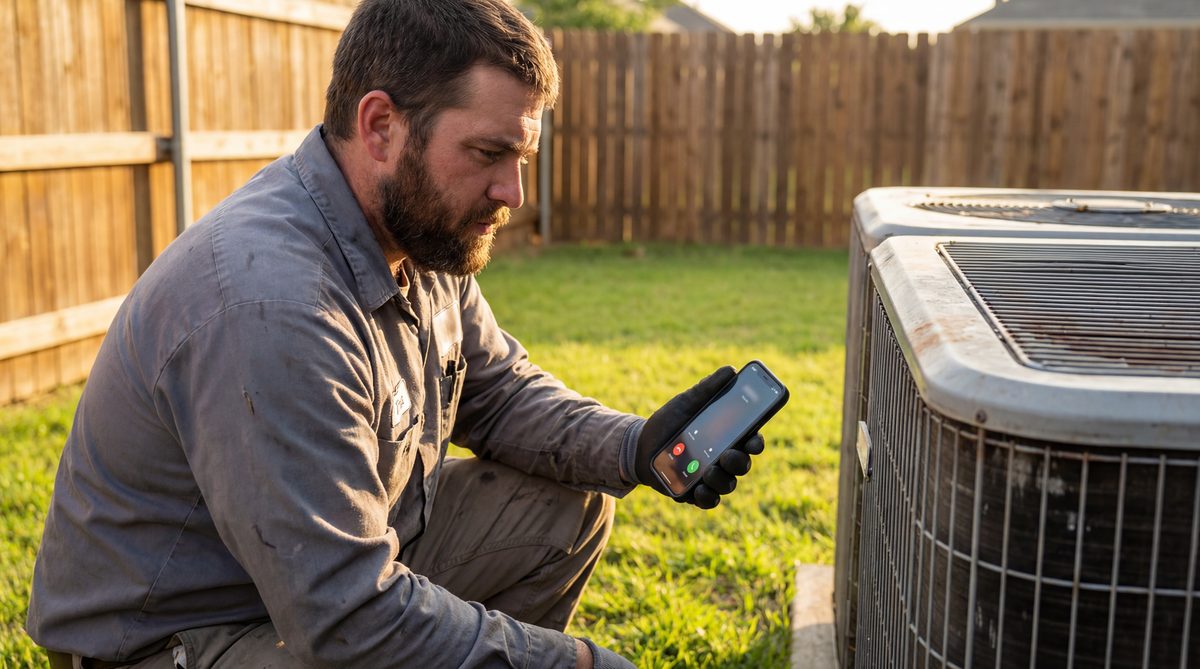
- The cost is invisible because the lost call never shows up in CRM data. Spanish-dominant callers who hit an English-only greeting hang up within 10 to 15 seconds and try the next listing.
- Hispanic-owned small businesses are the fastest-growing segment of US small business by a wide margin. Many of them prefer to do their own vendor work in Spanish, even when they speak English fluently.
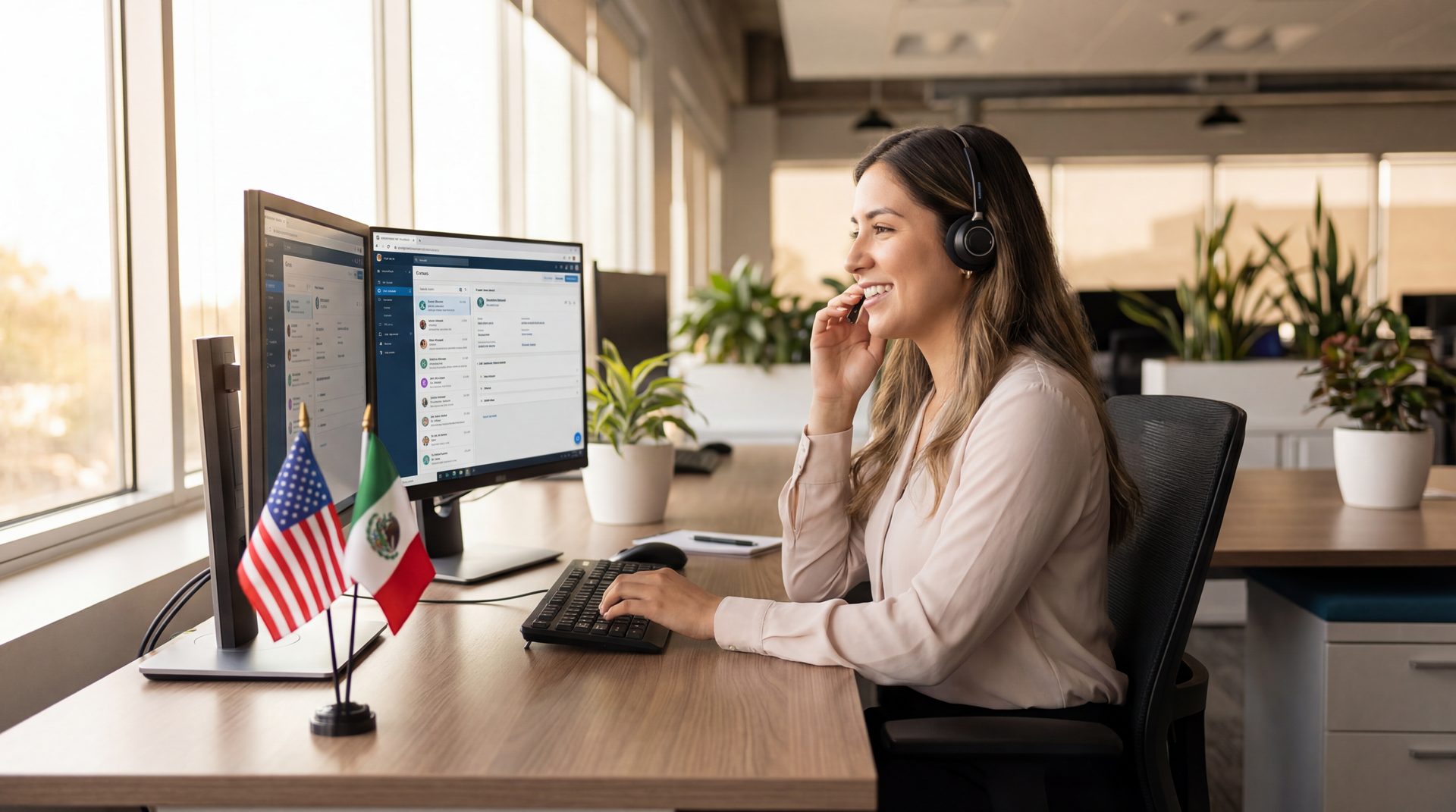
- A real Spanish-speaking answering service handles the call end-to-end in Spanish, not a transfer-after-30-seconds workflow. Modern AI voice handles Spanish natively at the same per-call cost as English.
The Customers Most Service Businesses Filter Out at “Hello”

Open a typical service business’s voicemail log for a week and you’ll see a pattern that almost nobody talks about. There’s a cluster of calls that end within 10 to 15 seconds of pickup. Some are dropped connections. Most are not. They’re Spanish-dominant callers who heard an English-only greeting, realized they wouldn’t get help, and hung up before saying a word.
The opportunity is much larger than most business owners realize. US Census data shows roughly 42 million people in the US speak Spanish at home, making it by far the largest non-English language in the country. Pew Research’s Hispanic studies estimate that about 16 million of those adults have limited English proficiency, meaning they actively struggle with English-only phone interactions even when they manage written English.
That market does not divide neatly along income lines or industry lines. Spanish-dominant US adults are homeowners with HVAC units that fail, parents with pets that get sick, business owners that need legal help, families that need plumbers and roofers and dentists. They have the same buying power and the same buying frequency as English-dominant customers. The difference is that they call the second contractor on the search results when the first one cannot serve them in Spanish.
US adults who speak Spanish at home. Roughly 16 million have limited English proficiency and will hang up on an English-only greeting within seconds.
Source: US Census Bureau, Languages We Speak in the United StatesThe cost compounds in geographic markets with large Hispanic populations. Census state data shows that in Texas, California, New Mexico, Arizona, Florida, Nevada, and Colorado, the Hispanic share of the population runs from 22 percent to 50 percent. A service business in Dallas, Houston, Phoenix, Miami, Los Angeles, or Las Vegas that does not handle Spanish calls is effectively cutting its addressable market by 30 to 50 percent at the phone gate before any qualification ever happens.
Why the Lost Call Never Shows Up in Your CRM
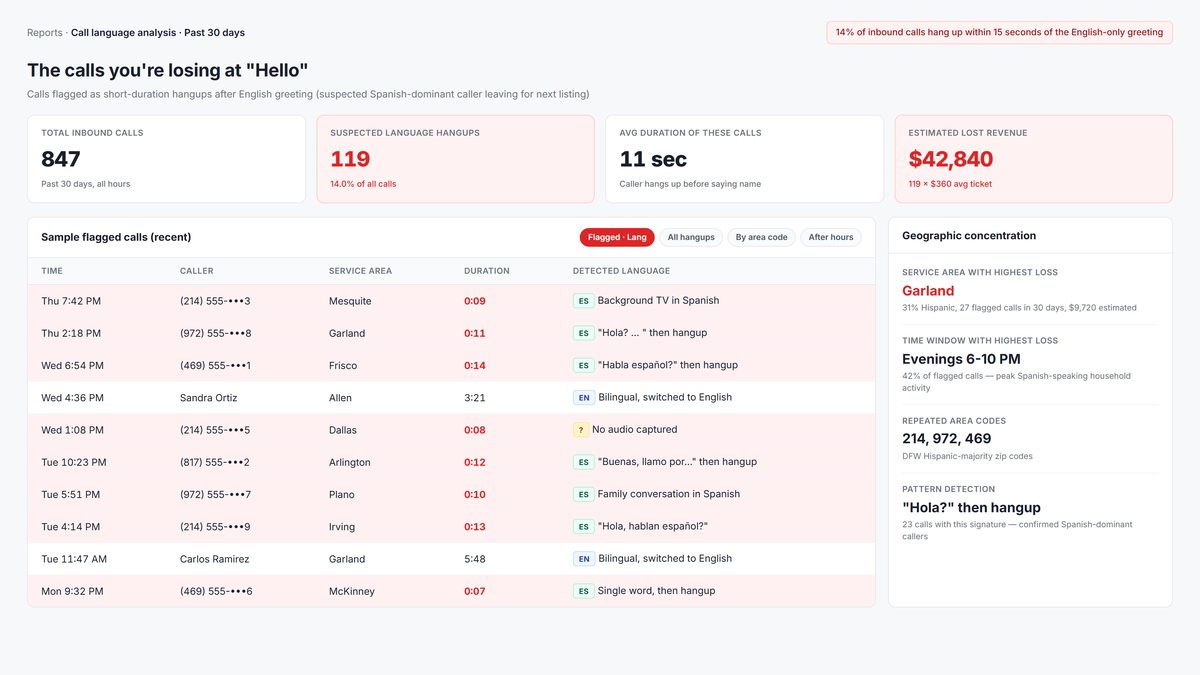
The reason most owners underestimate the size of the problem is that the lost Spanish-speaking call is structurally invisible. It does not appear as a missed lead in HubSpot or Service Titan. The CRM never sees the call because the caller never said their name, never left a message, and never returned. The data trail is a 12-second entry in a phone log that gets reviewed by nobody.
This is fundamentally different from how English-only missed calls show up. Drift’s lead response data tracks the cost of slow-response English calls and even there the average business is shocked when they see the dollar amount. The Spanish-dominant version of that same problem is much harder to surface because the dropped call leaves no breadcrumbs. The owner sees zero in their lead tracker and concludes there is no Spanish-speaking demand. The reality is that demand exists, it called, and it routed instantly to the next listing.
There is also a second-order loss most owners never connect. SBA economic data shows Hispanic-owned businesses are the fastest-growing segment of US small business, expanding at roughly 3 times the national rate. Many of those owners speak English fluently, but per Pew Research on Latino language preferences, a large share of them still prefer to handle their own vendor work in Spanish when given the option. So the business-to-business segment of the lost market is also larger than most owners model. The HVAC company that cannot take a Spanish-speaking call is losing residential customers AND commercial accounts owned by Spanish-preferring operators.
The accumulated effect is a quiet ceiling on growth. A business that never opens up Spanish coverage assumes its market share is what it is. A business that opens Spanish coverage usually sees revenue jump 15 to 30 percent within a few months in markets with meaningful Hispanic population density, often without any additional marketing spend.
What Spanish-Speaking Customers Actually Need on the Call

Most generic advice on “adding Spanish to your phone tree” misses what Spanish-dominant callers actually want. There are four specific things that separate a good Spanish-speaking answering setup from the typical “press 2 for Spanish, hold for 10 minutes” experience that pushes those callers to a competitor anyway.
Someone who actually handles the call in Spanish
Not “we have someone who can call you back.” Not “let me transfer you to our Spanish line.” The first voice the caller hears needs to be capable of conducting the whole conversation in Spanish without escalation. Per Pew Research on Latino consumer behavior, the moment a customer hears “let me transfer you” they assume the service they actually want does not exist at this business and they start looking elsewhere.
Natural conversational Spanish, not phrasebook Spanish
Spanish in the US is not a single uniform dialect. Mexican Spanish, Caribbean Spanish (Cuban, Puerto Rican, Dominican), and Central and South American Spanish all have distinct vocabulary, pronunciation, and conversational rhythm. A service that uses textbook Castilian Spanish or stilted machine-translated phrases lands as clearly non-native to most US Hispanic callers and undermines trust on the call. Modern AI voice models trained on US Hispanic Spanish handle this naturally because the models were trained on real US Spanish speech, not academic Spanish.
The same booking flow English-speaking customers get
A Spanish-speaking caller needs to book the appointment on the call, not get queued for a Spanish-fluent dispatcher to call them back. Same calendar, same triage logic, same dispatch fee quoting, same emergency routing. Anything less reinforces the perception that the business does not actually serve Spanish-speaking customers, it just tolerates them.
A confirmation in Spanish after the call
A 30-second text in Spanish confirming the appointment time, the dispatch fee, and what to expect when the tech arrives. The same SMS workflow that English-speaking customers get, in Spanish. BrightLocal local consumer research consistently shows that confirmation messaging is what cements the customer relationship after the call ends. Skipping it for Spanish-speaking customers signals they’re a second-class customer segment even when the phone conversation was perfect.
How many Spanish-speaking calls is your business missing right now in your service area?
We’ll mystery-shop your business with both English and Spanish calls during business hours, evenings, weekends, and emergency scenarios, then show you exactly how many calls you’re filtering out at the language gate. Free. Results in 48 hours.
The Three Myths That Keep Most Owners From Adding Spanish Coverage

Most service business owners have considered adding Spanish coverage at some point and stopped at one of three myths. None of them hold up against the current state of the market.
Myth 1: “We do not have enough Spanish-speaking customers to justify it”
Almost every owner who says this is reasoning from the customers they DO have, not the customers they’re losing. The data trail is broken (per the previous section), so the lost-call rate from Spanish-dominant callers is invisible in standard reporting. The actual test is to look at the demographic data for your service zip codes via Census ACS data. If your service area has even 8 to 10 percent Spanish-dominant adults, you are leaving real revenue on the table. Most US metro markets are well past that threshold.
Myth 2: “Hiring a bilingual employee solves it”
It solves a single-shift coverage window. It does not solve evenings, weekends, holidays, vacations, sick days, or any moment that bilingual employee is on another call. Per Bureau of Labor Statistics CSR data, the average customer service representative covers roughly 40 hours per week. That leaves 128 hours per week of business and after-business time without Spanish coverage. The lost Spanish calls happen in those 128 hours, not the 40.
Myth 3: “AI Spanish voice models still sound robotic”
This was true in 2022. By late 2024 the major voice AI providers (the same models that power the English voice services like Smith.ai’s AI tier and modern AI receptionist platforms) had crossed a quality threshold where typical Hispanic callers cannot reliably tell they are speaking with AI rather than a human. The models handle natural Spanish conversation, recognize regional vocabulary differences, and maintain context across multi-turn exchanges. The technology that was a clear weakness three years ago is now a clear strength because AI cost scales nearly linearly with English while human Spanish-fluent operator coverage costs 30 to 50 percent more per hour than English-only coverage (a wage premium driven by the labor scarcity of fluent bilingual operators).
How Modern Spanish-Speaking Answering Services Actually Work
There are three categories of Spanish-speaking answering services in the market right now, and the gap between them in 2026 is wider than most owners realize.
Traditional bilingual call centers (Specialty Answering Service, AnswerNet, and the bilingual tiers of services like Ruby and AnswerConnect) staff Spanish-fluent human operators alongside English operators. Pricing typically runs at a 20 to 40 percent premium over the English-only equivalent because bilingual operators command higher wages and the supply pool is smaller. Coverage gaps appear during off-hours and weekends when bilingual operator availability shrinks. The call quality is typically good when a fluent operator is available and degrades to “press 2 for Spanish, hold music” when none is.
Translation-routed services present a Spanish menu, then route to an English-speaking operator with a live translator on the line. This sounds reasonable in theory but the caller experience is poor. Three-way calls with translation have 2x to 3x the duration of native-language calls, lose conversational nuance, and create awkward pauses that signal to the caller that they’re a complicated case. Harvard Business Review’s coverage of multilingual customer service makes the same case: support delivered in the caller’s own language beats translation-routed support on customer experience.
AI-powered native Spanish answering services handle the whole call in Spanish using voice AI trained on US Hispanic Spanish. The AI picks up, asks intake questions in Spanish, books the appointment, sends a confirmation SMS in Spanish, and pushes the lead into the CRM the same way English calls work. Modern AI answering services built on the current generation of voice models handle Spanish at the same per-call cost as English with no operator availability gap. The configuration is done once during onboarding and runs 24/7 without staffing constraints.
For most small and mid-sized service businesses adding Spanish coverage in 2026, the AI-powered native option is dramatically better on coverage, cost, and call quality than the traditional bilingual call center model. The exceptions are highly emotional or escalated calls where a human Spanish-fluent operator may handle nuance better, which is a small fraction of typical service business call volume.
What to Look for When Evaluating a Spanish Answering Setup

If you are shopping for Spanish coverage in 2026, focus on these five capabilities. These are the ones that actually matter for whether the service captures the calls you’re currently losing.
Native Spanish voice quality, not a Spanish menu in front of an English agent
Test the experience yourself before you sign anything. Call the service’s demo number in Spanish, ask a typical service question, and see whether the conversation feels natural or feels translated. If you hear “let me transfer you” or hold music at any point, the service is not actually handling Spanish, it is queuing it.
Same CRM and dispatch software push as English calls
The Spanish caller’s lead needs to land in your CRM the same way an English lead does. Same fields, same routing, same automated follow-up sequences. If Spanish leads land in a separate spreadsheet or get emailed to you manually, you’ve built a parallel inferior pipeline for Spanish-speaking customers and the experience will degrade over time.
24/7 coverage at the same rate as English
Verify there is no Spanish-coverage gap during nights, weekends, and holidays. With AI services this is automatic since the model runs the same way regardless of time. With human-staffed bilingual services it is often the failure point. Ask directly: “What happens when a Spanish-speaking customer calls at 9 PM on Saturday?”
Spanish SMS confirmations and follow-up
Confirmations, reminders, and follow-up nudges need to go out in Spanish, not English. The full lifecycle of the customer interaction needs to match the language they called in. See the broader mechanism in our missed call text back for service businesses post.
A regional-dialect aware voice
Most US Hispanic adults speak some variant of Mexican Spanish (the largest origin group) or Caribbean Spanish. A voice that lands as clearly European or clearly machine-translated triggers immediate friction. The best AI voice services let you specify regional preferences during setup and the underlying models trained on US Hispanic speech sound native to most callers.
How Ignitvio Handles Spanish-Speaking Calls
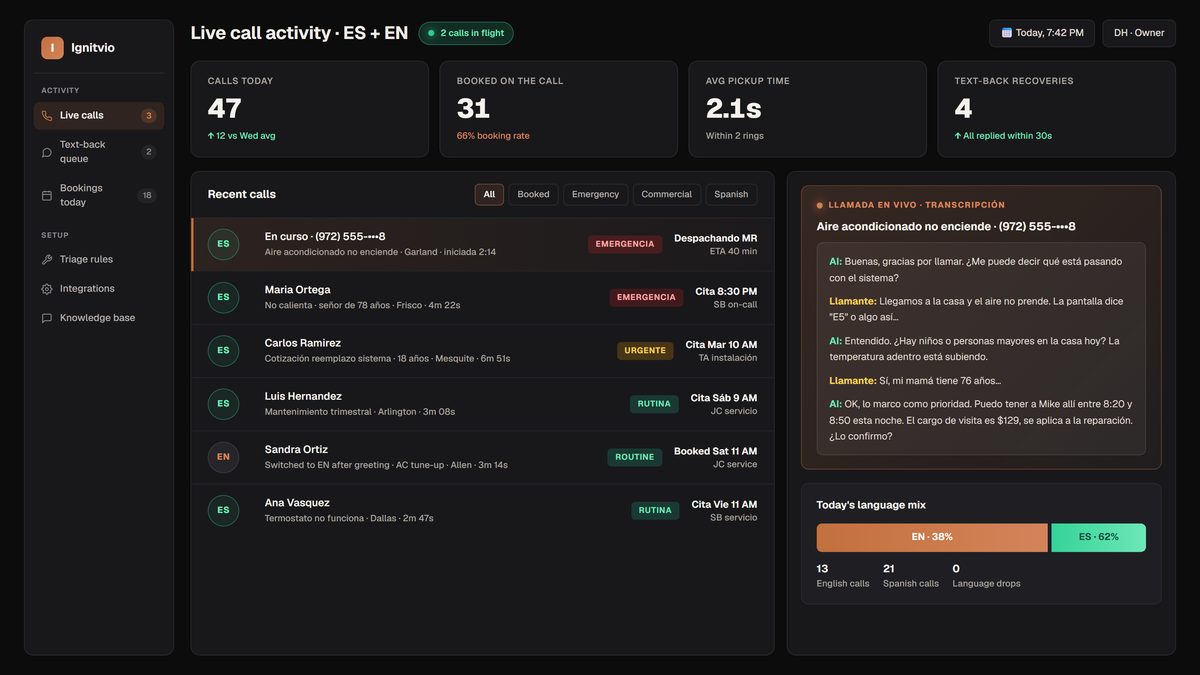
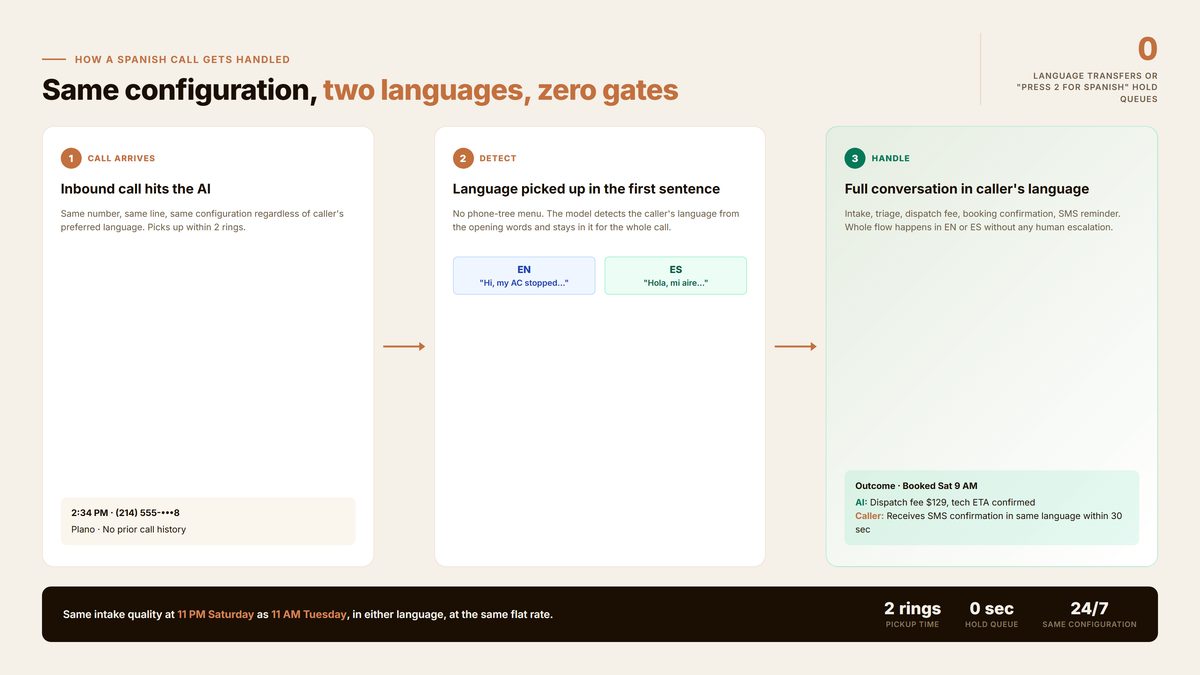
Ignitvio is a done-for-you AI answering system that handles English and Spanish calls natively from the same configuration. There is no separate Spanish tier, no “Spanish overflow” routing, no language gate that filters Spanish-dominant callers into a worse experience. The AI detects the caller’s language preference from the first few words and handles the whole call accordingly.
Here’s what it does for a service business that wants to actually serve Spanish-speaking customers:
- Native Spanish voice handling with regional-dialect tuning. The voice model was trained on US Hispanic Spanish, so the conversational rhythm, vocabulary, and pronunciation land as natural to Mexican, Caribbean, and Central/South American Spanish-speaking callers without any obvious translation feel.
- Language detection within the first sentence so callers do not have to navigate “press 2 for Spanish” menus. The system handles whatever language the caller opens with and stays in that language for the whole call.
- Same booking flow as English calls with native CRM push. Spanish leads land in ServiceTitan, Jobber, Housecall Pro, or Follow Up Boss with the same fields and routing as English leads. No parallel inferior pipeline for Spanish-speaking customers.
- Spanish SMS confirmation sent automatically after the call. Appointment time, dispatch fee, prep instructions, all in Spanish, sent within 30 seconds of the call ending.
- Industry-specific Spanish vocabulary baked into the configuration. HVAC, plumbing, dental, medical, and other vertical-specific Spanish vocabulary is configured during onboarding so the AI can handle technical conversations naturally (calefacción, plomería, presupuesto, garantía, urgencia, etc.) without falling back to generic translation.
- Missed call text back in the caller’s language for any call that drops or hits an edge case the AI cannot handle. Spanish callers get the recovery SMS in Spanish, English callers get it in English.
- Flat-rate pricing identical to English-only coverage. There is no Spanish premium tier, no overage fees for Spanish calls, no language-based pricing tier at all. The same entry plan covers Spanish and English equally.
When a service business adds Spanish coverage, the extra call volume needs no additional marketing. The Spanish-speaking demand was already in the market and already calling, it just was not converting because the gate at “Hello” was filtering it out. Opening that gate captures revenue that was always there.
Without Spanish Coverage vs. With Ignitvio
- Spanish-dominant callers hang up within 10-15 seconds of English greeting
- Lost calls do not show up in CRM, so the cost is invisible
- Demographic share of service area that's Spanish-dominant goes uncaptured
- Hispanic-owned business B2B segment routes to competitors
- Service area Hispanic households assume the business doesn't serve them
- Bilingual employee coverage gaps during 128 of 168 weekly hours
- Spanish calls handled end-to-end in natural US Hispanic Spanish
- Spanish leads land in CRM with the same fields and routing as English
- 24/7 Spanish coverage at the same flat rate as English-only plans
- Spanish SMS confirmations and follow-up nudges sent automatically
- Same industry-specific dispatch logic and emergency triage in Spanish
- Revenue from Spanish-dominant households finally shows up in the pipeline
Illustrative comparison of the two coverage models, not a measured client result.
The setup runs under a week. We configure the voice for your regional dialect preference, your industry-specific Spanish vocabulary, your dispatch fee structure, your emergency triage rules, your CRM, and your standard follow-up cadence in both languages. You tell us how you want each language and call type handled. We build it in. Then it runs.
Stop Filtering Out the Customers Already Calling Your Business
See how many Spanish-speaking calls you're losing right now
We'll mystery-shop your business with both English and Spanish calls across business hours, evenings, weekends, and emergency scenarios, then show you exactly how many calls you're filtering out at the language gate. Free. No pitch.
Get Your Free Revenue Audit
Jake Melendy
Founder, Ignitvio
Jake Melendy is the founder of Ignitvio. He spent 12 years in enterprise sales and sales leadership, including at Oracle, before building Ignitvio, which runs done-for-you outbound appointment setting for commercial contractors and B2B service companies. He writes about pipeline, trigger-based prospecting, and lead response.