Answering Service Pricing: What You'll Actually Pay in 2026

- Answering service pricing breaks into three models: per-minute billing, monthly minute bundles, and flat-rate subscriptions. The model you choose matters more than the advertised rate.
- Per-minute pricing looks cheap on paper ($0.78-$1.35/minute) but spikes during your highest-volume months, the exact months you’re already stretched thin.
- The “right” price depends entirely on capability. Message-taking is worth $100-$200/month. Actual appointment booking, emergency triage, and CRM integration are worth 10x that, if they’re genuinely stopping revenue from leaking out.
- A flat-rate AI answering service that books jobs and handles after-hours calls typically costs less per month than a single week of missed-call revenue for a small service business.
The Three Answering Service Pricing Models (and When Each Makes Sense)

Before comparing quotes, you need to understand that answering service pricing doesn’t describe a single fee structure, it describes three very different models. The one you choose will determine your real monthly cost more than any rate on the sales sheet.
Model 1: Per-Minute Billing
The oldest model in the industry. You pay for every billable minute the operator spends on your calls, typically $0.78-$1.35/minute for live answering, depending on the service tier and your volume. Most services layer on a monthly minimum (50-100 minutes), so you pay even during slow weeks.
Where it breaks: per-minute billing punishes busy businesses. A plumbing shop that gets 40 calls during a pipe-freeze event or a spring rush pays 4-5x their normal bill that month. Your highest-revenue weeks generate your highest answering service invoices. Per-minute overage charges rank among the most frequently flagged billing complaints from small business customers.
Model 2: Monthly Minute Bundles
The most common model. You buy a block of receptionist minutes, typically 100, 200, or 500 per month, at a flat rate. Go over, and you pay per-minute overages ($1.00-$1.50/minute). Stay under, and you usually lose the unused minutes.
Where it works: businesses with predictable, flat call volume. Where it breaks: home service businesses with seasonal patterns. A summer HVAC surge or a winter no-heat wave blows through a 200-minute bundle in a week, then you’re paying overage for the rest of the month. G2’s answering service reviews show that bundle plans average $149-$399/month for small business volume, with per-minute overages routinely pushing the real monthly cost well above the plan rate.
Model 3: Flat-Rate Monthly (No Per-Minute)
The newest model, increasingly standard with AI-powered answering services. You pay one fixed monthly fee regardless of call volume, 50 calls or 500 calls costs the same. No overage fees, no surprise invoices, no “your minutes ran out at 3 PM on the 15th.”
Where it wins: any service business with unpredictable call volume or strong seasonality. What to verify before signing: whether “flat-rate” is truly unlimited or caps total calls at some threshold. Read the fine print carefully.
For most service businesses, answering service plans at any price point cost a fraction of what a single week’s worth of missed calls generates in lost revenue. The real question isn’t whether you can afford an answering service. It’s which pricing model matches your call pattern.
The Hidden Costs in Answering Service Pricing (The Math Most Businesses Miss)
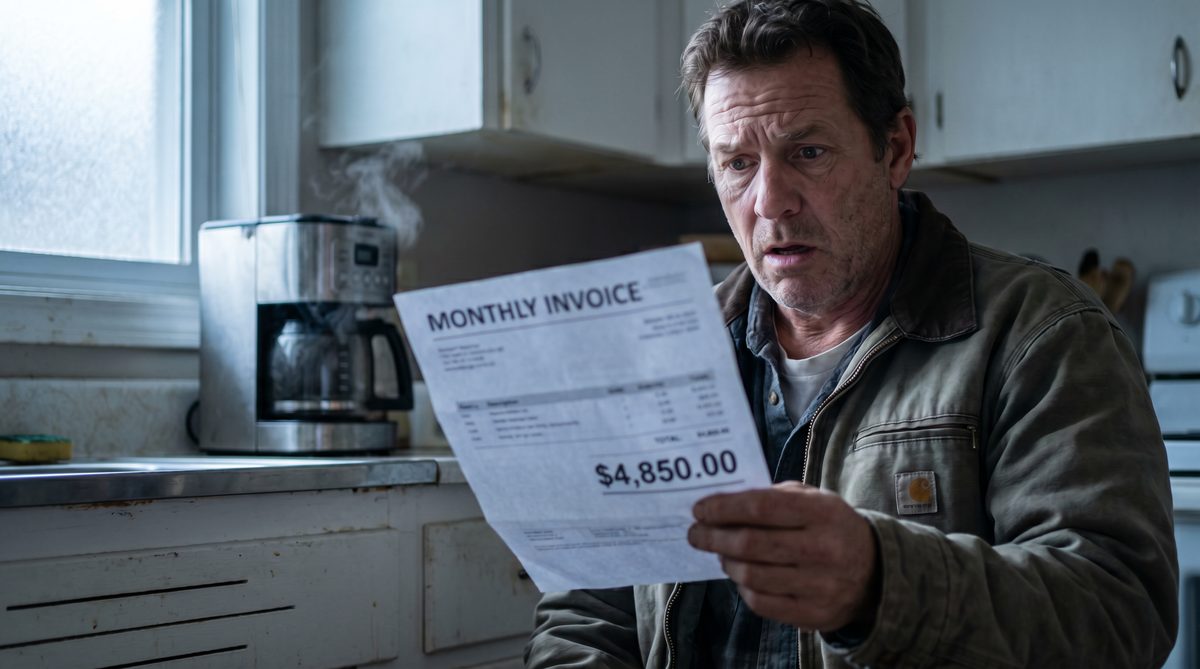
Per-minute pricing is the most common model in the industry and the most misunderstood. Most service business owners evaluate it wrong: they look at the per-minute rate, check the monthly minimum, compare it to a flat-rate plan, and choose the cheapest advertised number. Then the first real invoice arrives.
Here’s the math that actually matters. The average inbound service call runs 3-4 minutes on a live answering service. At $1.00/minute with a 100-minute base plan:
- Slow month (75 calls): Base plan covers it. Total: ~$149-$199/month.
- Normal month (150 calls): 100-minute base + ~200 overage minutes. Total: ~$349-$399/month.
- Peak month (300 calls, storm surge, heat wave, seasonal spike): 100-minute base + ~800 overage minutes. Total: ~$949-$1,149/month.
That “affordable” per-minute plan just charged you over $1,100 in the month you were already paying techs overtime and sourcing emergency parts.
more likely you are to qualify a lead when you follow up within one hour versus waiting 30+ minutes. Message-taking services create a callback queue, and most callers don't wait around for it.
Source: Harvard Business Review, The Short Life of Online Sales LeadsThe second hidden cost: line-item fees that don’t appear in the advertised rate. Traditional live answering services commonly charge $25-$75 one-time setup fees, $0.15-$0.25 per outbound text message, $0.05-$0.10 per minute for bilingual calls, and holiday premium rates during the days your emergency call volume is highest. The industry practice of disaggregating fees makes apples-to-apples comparison deliberately difficult.
The right way to evaluate per-minute pricing: model three scenarios, your slow month, your average month, and your worst peak month. If the gap between slow and peak is more than 3x your call volume, per-minute billing is almost certainly the wrong model for your business.
What Answering Service Pricing Should Actually Include
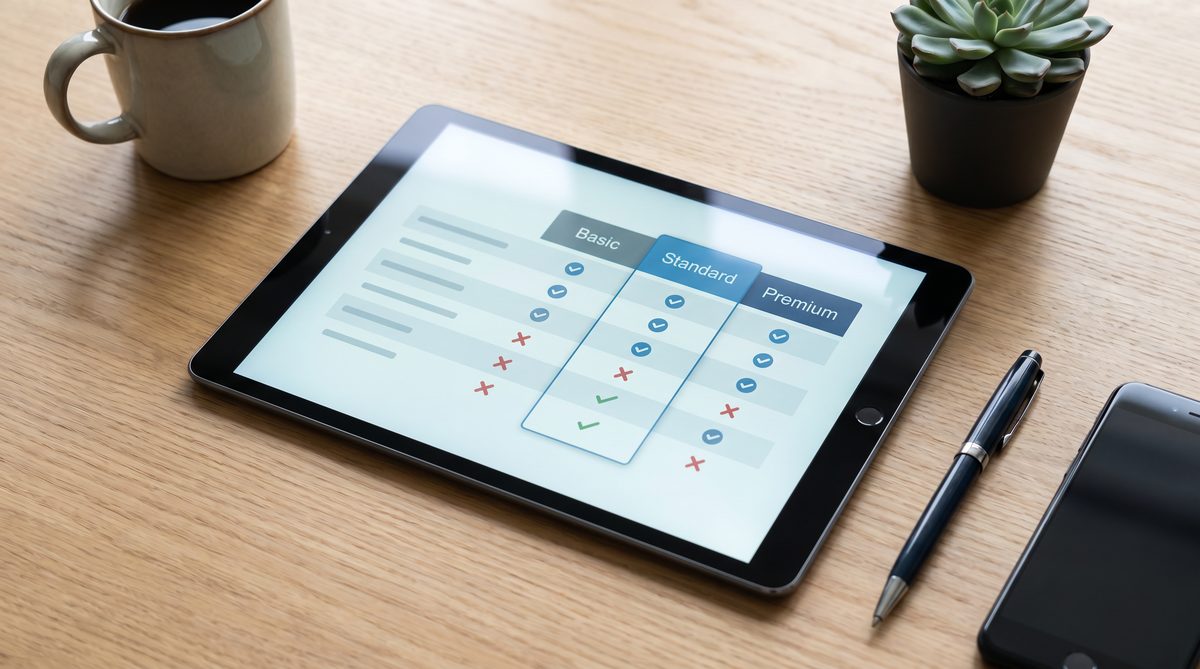
Price comparison between answering services is close to meaningless without understanding what each tier actually delivers. Two plans at $199/month can have completely different value, one takes a message, the other books the appointment, triages the emergency, and pushes the lead to your CRM. Here’s what the price ranges in the market actually correspond to:
$50-$150/month: Message-Taking Only
Entry-level plans from services like MAP Communications, Davinci, and basic virtual receptionist providers. An operator picks up your phone, collects a name, number, and reason for call, and sends you the message. You still call the customer back, which creates a callback queue that most callers bail out of before you reach them. Customers who don’t get a booking on the first call typically move to the next option on their search results.
This tier fits businesses where every call genuinely requires human judgment before any next step, complex medical intake, legal screening with specific eligibility questions. For most service businesses, message-taking is the wrong tool.
$150-$350/month: Message-Taking + Basic Scripting
The most common tier for small business live answering. Operators follow your script, answer basic FAQs (“do you service this zip code,” “what’s your dispatch fee”), and either message-take or transfer. Most general-purpose virtual receptionist services, Ruby ($235-$409/month), AnswerConnect ($149-$325/month), operate here. Better than pure message-taking, but appointment booking and CRM integration are typically minimal or unavailable.
$350-$1,000/month: Booking, Integration, and After-Hours Coverage
Premium live answering or AI-powered services that actually book the appointment on the call, integrate with dispatch software (ServiceTitan, Jobber, Housecall Pro), handle after-hours emergencies with triage logic, and push the lead to your CRM before the caller hangs up. The call ends with a job scheduled, not a note to call back tomorrow.
Understanding the full capability gap between these tiers, not just the price, is the right starting point. See what a virtual receptionist actually does for a full breakdown of what each service level can and can’t handle.
The question every service business needs to answer before comparing answering service pricing: what is a booked appointment worth to you? If your average job ticket is $400 and a booking-on-call converts instead of dying in a callback loop, the math calculates itself fast at any price in this tier.
How AI Answering Services Changed the Pricing Equation
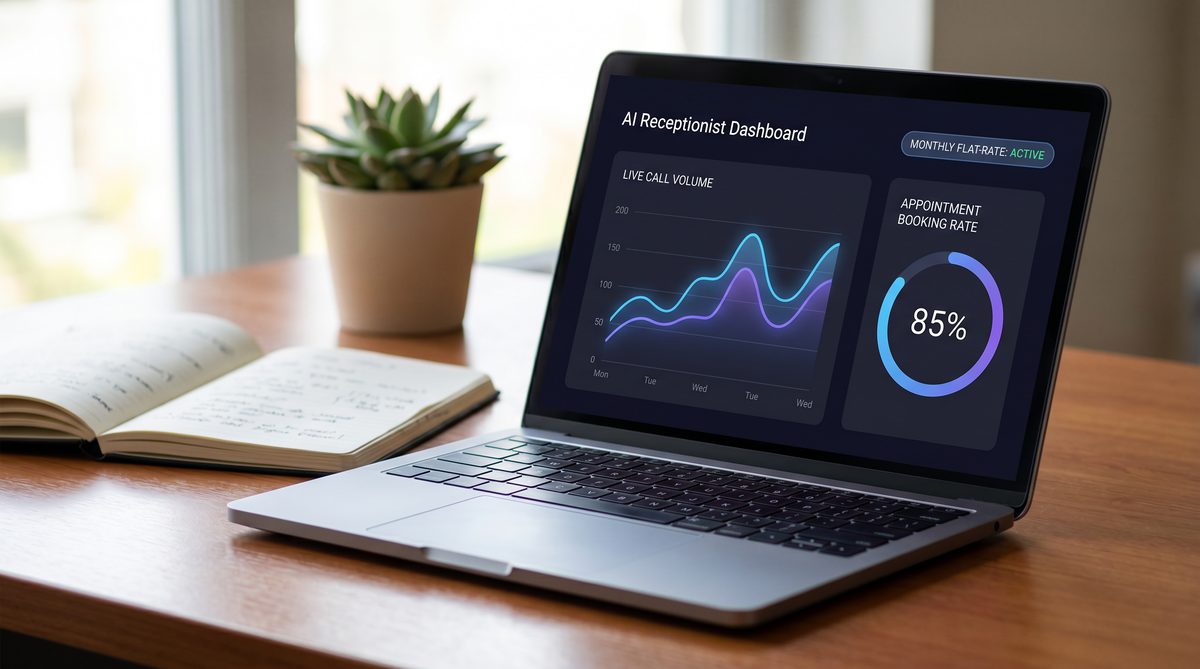
The answering service industry operated on per-minute and monthly-bundle pricing for decades because the cost structure was human-bottlenecked. More calls meant more operator hours, which meant more cost. Flat-rate unlimited pricing wasn’t viable when volume risk was real.
AI changed the underlying math entirely.
An AI answering system doesn’t cost more to run during a July surge than a February slow period. It handles 10 calls simultaneously as easily as it handles 1. The marginal cost of an additional call is effectively zero. That’s why AI-powered answering services can offer genuine flat-rate pricing, no overage fees, no per-minute billing, no peak-season spikes, and still operate profitably.
The second change: AI answering handles more during a single call than a live operator typically can. Per the MIT Lead Response Management Study, the odds of qualifying a lead drop 10x after the first five minutes of initial contact. A business running on message-taking and callback queues doesn’t make contact within those five minutes, it makes contact hours or days later, when the customer has already moved on. An AI answering service completes booking, triage, FAQ resolution, and CRM entry during the live call, before the customer hangs up. That’s the difference between a “lead” and a “booked job.”
For small service businesses comparing answering service pricing in 2026, AI-powered flat-rate plans have become the practical benchmark against which everything else should be evaluated:
- Under 80 calls/month: Live answering services may win on pure cost if volume is genuinely low and calls are simple.
- 80-250 calls/month: AI flat-rate pricing is typically competitive with bundle pricing and substantially outperforms on capability.
- 250+ calls/month or strong seasonality: AI flat-rate wins on both cost and capability, peak months don’t generate billing spikes, and surge capacity is unlimited.
The after-hours answering cost is the clearest example of AI’s pricing advantage. Most live answering services charge 1.5x-2x for evening, weekend, and holiday calls, exactly when a plumber’s emergency pipe call or an HVAC no-heat call comes in. AI plans cover those calls at the same flat rate, which is the only pricing structure that makes economic sense for trades where the most valuable calls come in outside business hours.
How to Calculate ROI Before You Sign Any Answering Service Contract

Before comparing answering service pricing from any vendor, run this three-number calculation. It takes five minutes and will tell you what any service on the market is actually worth to your business.
Step 1: Your Average Call Value
What’s a typical inbound call worth if it converts to a booked job? Take your average job ticket and multiply by your inbound close rate. A plumber with a $350 average ticket and a 65% close rate on inbound calls has an average call value of roughly $228.
Step 2: Your Current Missed Call Volume
How many inbound calls per month aren’t getting answered? Count the calls that hit voicemail during jobs, after hours, and during lunch. Even a conservative estimate of 20-25% for a busy service business adds up fast. For a business receiving 100 calls/month at a 20% miss rate, that’s 20 missed opportunities. At $228 average call value, that’s $4,560 walking to competitors every month.
Step 3: Estimated Capture Rate
What percentage of those missed calls would an answering service actually recover? A message-taking service that generates callback loops recovers roughly 40-50%, because phone tag fails. A service that books on the live call recovers 70-85%. Apply the capture rate to your missed call volume and multiply by your average call value.
The math:
- 100 calls/month × 20% missed = 20 missed calls
- 20 × 75% capture rate = ~15 recovered calls/month
- 15 × $228 average call value = $3,420/month in recovered revenue
- A $500/month answering service generates roughly 6.8x ROI in this model
Run this calculation and it almost always favors any answering service over no answering service, and usually favors a higher-capability service over a cheaper one, because the capture rate difference (40% vs 80%) dwarfs the pricing difference ($199/month vs $499/month). The real comparison isn’t “can I afford this”, it’s “what’s the cost of the missed calls I’m already generating?”
Six Questions to Ask When Comparing Answering Service Quotes

The advertised monthly rate is the least useful number when comparing answering service quotes. These six questions reveal what you’re actually buying.
1. What counts as a billable minute? Some services bill from call connect; others from first operator word. Hold time, transfers, and after-call wrap-up are often billed separately. Get the full billing definition in writing before signing.
2. What does after-hours actually cost? Many services advertise 24/7 coverage but charge 1.5x-2x for calls outside 9-5 Monday-Friday. For any service business where emergencies peak on evenings and weekends, get the true all-in cost per month, not the day-rate.
3. Is appointment booking included, or an add-on? Message-taking and appointment booking are different products. Confirm whether booking requires a separate integration fee, whether it works with your specific dispatch software (ServiceTitan, Jobber, Housecall Pro), and whether the booking hits your calendar in real time.
4. What’s the overage rate, and is there a cap? If you’re on a per-minute or bundle plan, get the exact overage rate and ask explicitly whether there’s a monthly invoice cap. A service with no cap can generate unexpected four-figure bills during a major storm event.
5. Which integrations are included vs. billed separately? CRM push, ServiceTitan, Jobber, HIPAA compliance, bilingual handling, each is either included in the plan, an add-on, or unavailable. Unmapped integrations mean manual data entry or callback loops that defeat the purpose.
6. Is missed call text-back included? Even the best answering setup occasionally misses a call (network drop, AI handoff, brief system lag). A good service automatically SMSes any missed caller within 30 seconds: “Sorry we missed you, what can we help you with?” Smith.ai’s call-handling research shows that instant missed call texts recover a significant share of calls that would otherwise leak to a competitor. If it’s not built in, every call the service misses stays missed. See the full mechanics in our missed call text-back guide.
The Answering Service Pricing Structure That Works for Growing Service Businesses
The typical small service business follows the same path: start with a cheap message-taking plan, watch it fail to convert calls, upgrade to a live answering bundle, get hit with surge-month overage fees, then either abandon answering services entirely or look for something structurally different.
The answering service pricing model that actually works for most service businesses in 2026 is flat-rate AI with full booking capability, for three reasons:
It doesn’t penalize growth. Your best months are your highest-call-volume months. A per-minute or bundle plan charges you more the busier you are. Flat-rate doesn’t.
It converts calls to booked jobs, not messages. The difference between “we took your call” and “we booked your appointment” is the entire economic case for having an answering service. Per InsideSales.com, 50% of buyers choose the vendor that responds first, and “responding first” means booking the job on the live call, not calling back 90 minutes later after you’ve retrieved a message.
It costs less in peak months than per-minute alternatives. A flat-rate AI plan costs less in July, when call volume is highest and per-minute overage fees are biting, than a $1.25/minute live service handling 600 minutes of HVAC emergency calls.
The threshold where flat-rate AI doesn’t win: genuinely low volume (fewer than 20 inbound calls/month) with calls requiring highly complex human judgment on every single one. Most service businesses aren’t in that box.
How Ignitvio Handles Answering Service Pricing
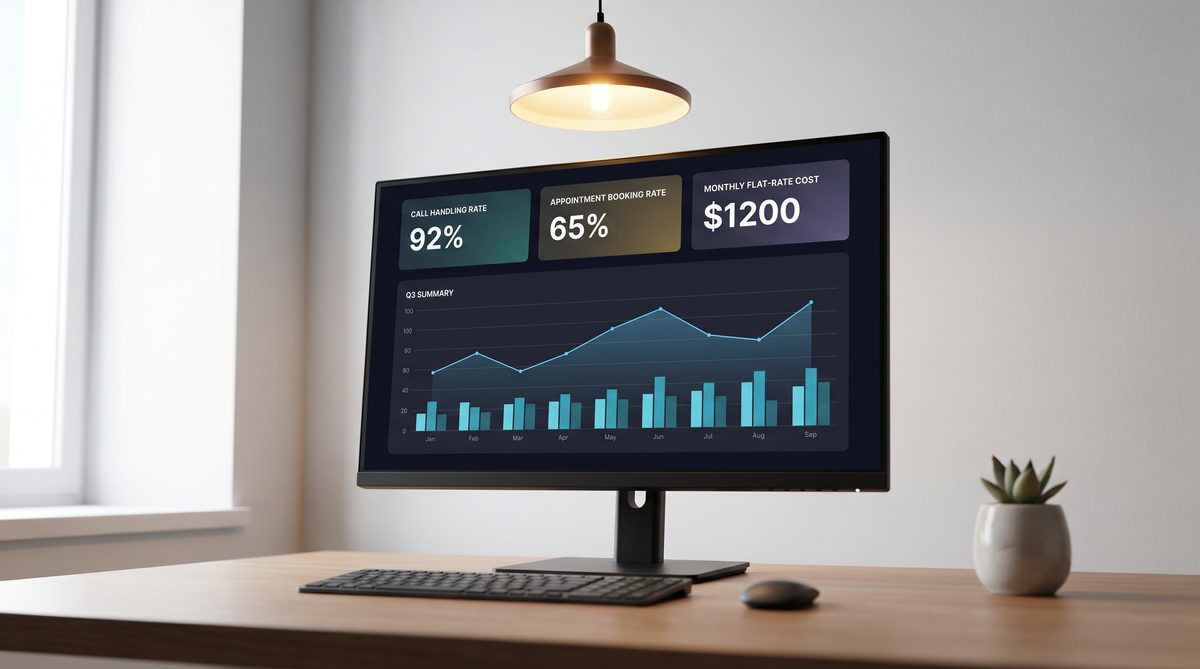
Ignitvio is a flat-rate AI answering system built for service businesses, HVAC, plumbing, electrical, law firms, medical practices, property management, that are losing revenue to missed calls and want a single system that answers, books, triages, and follows up without per-minute billing or seasonal invoice spikes.
Here’s what the pricing covers:
- Voice AI answers every call, 24/7, including evenings, weekends, and holidays. Same flat rate whether you get 40 calls in January or 400 in July. No per-minute billing, no overage tiers.
- Appointment booking on the live call, connects natively to ServiceTitan, Jobber, and Housecall Pro. Jobs are booked during the call. No messages, no callbacks, no phone tag.
- Emergency triage, configurable rules for your industry and business: urgent vs. non-urgent, emergency dispatch vs. schedule-for-morning, on-call paging thresholds. You set the rules once; the AI executes them on every call.
- Missed Call Text Back, any dropped or missed call gets an automatic SMS within 30 seconds. The AI picks up the text conversation and books the job.
- Automated follow-up, quotes that didn’t close get follow-up at 1, 3, 7, 14, and 30 days. You recover the high-ticket jobs that would otherwise vanish into a “think it over” pile.
- Review automation, every completed job generates an automated review request, building your Google ranking over time.
Per-Minute Plans vs. Ignitvio
- Peak-month bills spike unpredictably, busiest months cost the most
- Message-taking only, you still call the customer back
- After-hours calls cost 1.5-2x the standard rate
- No CRM integration, leads arrive by email or text, then get manually entered
- Call surge overflow goes unanswered when operators hit capacity
- Overage fees with no cap, one bad storm week can run $1,000+
- Same flat monthly rate regardless of call volume, zero billing surprises
- Jobs booked on the live call, customer hangs up knowing when you're arriving
- 24/7/365 at flat rate, no after-hours premium on evenings, weekends, or holidays
- Native CRM and dispatch integration, booked jobs hit your schedule before the call ends
- Unlimited concurrent call handling, 10 calls or 200 calls in an hour, same cost
- No overages, no caps, no invoice surprises at end of month
Ignitvio’s pricing structure is on the pricing page; for most small service businesses it costs less than the missed-call revenue lost in a single week.
See what answering service pricing makes sense for your business
We'll review your call volume, average ticket size, and current answering setup, and show you exactly what missed calls are costing you each month. Free. No obligation.
Book a Revenue Audit
Jake Melendy
Founder, Ignitvio
Jake Melendy is the founder of Ignitvio. He spent 12 years in enterprise sales and sales leadership, including at Oracle, before building Ignitvio, which runs done-for-you outbound appointment setting for commercial contractors and B2B service companies. He writes about pipeline, trigger-based prospecting, and lead response.