Answering Service for HVAC Company: The Revenue Math and What to Buy
- The average HVAC company misses 25-35% of inbound calls during business hours and 60%+ after-hours. At a blended $1,200 average ticket across service and replacement work, that’s $40,000-$200,000 per year in lost top-line revenue depending on company size.
- The lost calls cluster around the highest-value moments: no-heat emergencies in winter, no-cool emergencies in summer, system replacement quotes, commercial property requests, and the maintenance contract upsell call from an existing customer.
- An answering service for an HVAC company has to do more than take messages. It has to triage emergencies, quote dispatch fees, book into ServiceTitan or Housecall Pro, route commercial vs residential differently, and handle the seasonal call surge without overage fees.
- The economics changed in 2024-2026. AI-powered HVAC-specific answering services now run flat-rate $400-$1,500/month, replace the function of a $50,000-$70,000/year human dispatcher, and handle the seasonal surge without coverage gaps.
What an HVAC Company Actually Loses to a Missed Call
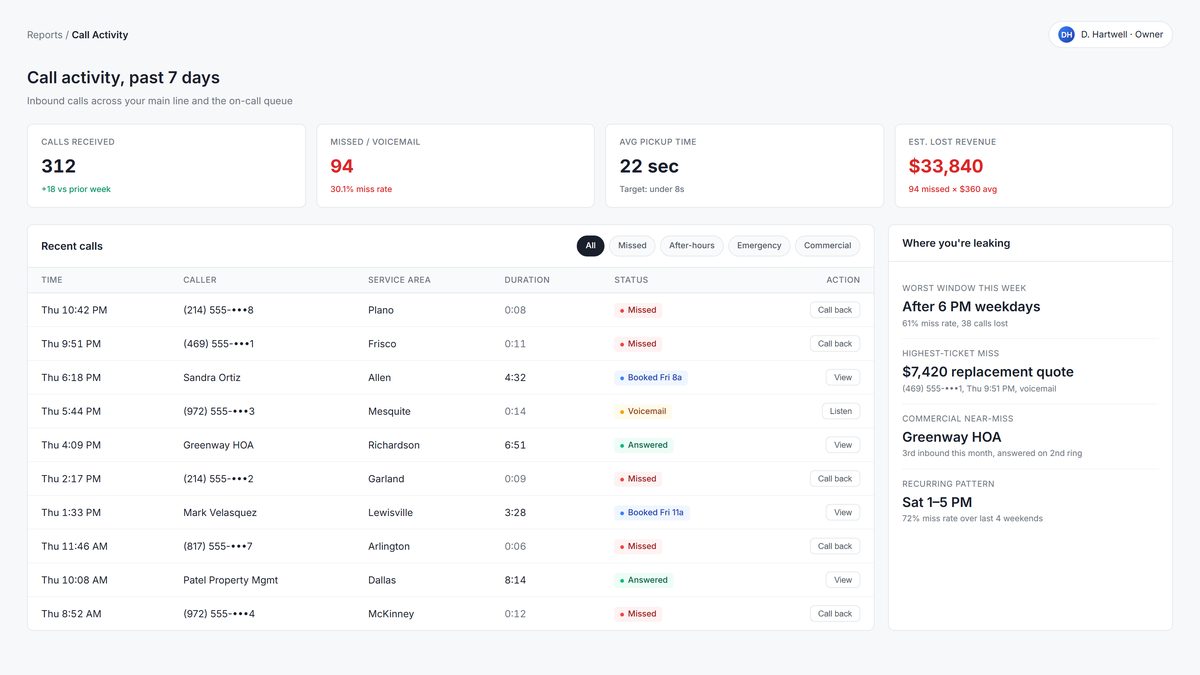
Walk an HVAC company owner through their phone log for any given week and the same pattern shows up. There are clusters of calls during the busiest dispatch windows that ended in 8-15 seconds. There are calls at 6
PM, 11 PM, 2 AM from numbers nobody recognizes. There are calls during the 95-degree Saturday afternoon last June where the office line rolled to voicemail for 4 straight hours because the front desk was already on another line.Each of those is a job that paid a competitor instead.
The math is brutal for HVAC specifically because the ticket sizes are larger than most home services. ServiceTitan industry data puts the average HVAC service call between $300 and $600. Angi’s HVAC cost guides peg the average system replacement at $5,000 to $10,000, with high-efficiency systems pushing $15,000+ once you add labor and ductwork. Mix it across a typical service-and-replacement HVAC company and the blended average ticket sits around $1,200 to $1,500.
A company missing 10 calls per week at a 30% close rate at $1,200 average ticket is losing roughly $3,600 in revenue per week. Annualized, that’s $187,000 in top-line revenue walking to whoever picked up the phone instead. For a company with $1.2M in annual revenue, that’s the equivalent of an entire month of work disappearing because the phone was busy.
Annual top-line revenue HVAC companies lose to missed calls, depending on company size and call volume. Blended $1,200 average ticket across $300 service calls and $7,500 system replacements.
Source: ServiceTitan industry dataThe geographic concentration is also worth understanding. ACCA’s contractor surveys consistently show that the highest-volume call days of the HVAC year fall on roughly 15 to 20 unpredictable days, scattered through the heating and cooling extremes. Three or four of those days produce more inbound calls than the slowest entire month. The companies that staff for the average call volume drown on the peak days. The companies that staff for the peak call volume burn cash on the average days. Neither extreme works without something that scales call coverage independent of human staffing.
The Five Most Expensive Call Types HVAC Companies Lose
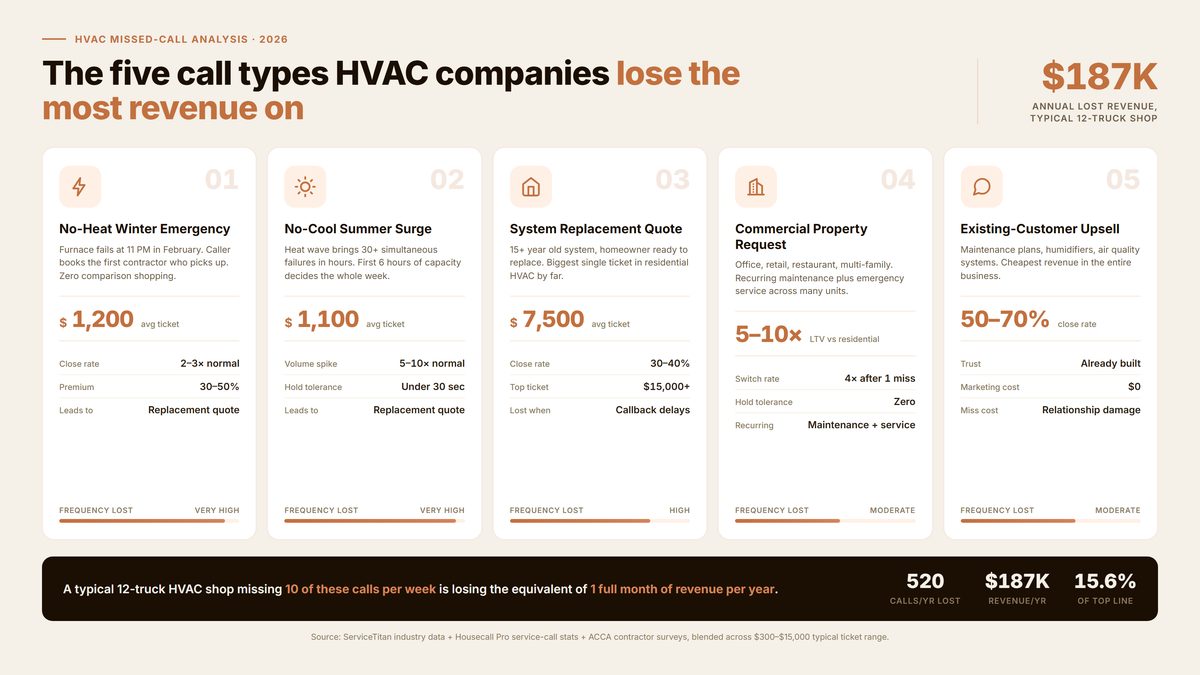
Not every missed call costs the same. Understanding which call types are leaking is the first step to knowing how much revenue an answering service would actually recover.
No-heat emergency calls in winter
The single highest-margin call category in residential HVAC. A homeowner in a 50-degree house at 11 PM in February will book the first contractor that picks up, no comparison shopping, willing to pay a 30-50% emergency premium. Housecall Pro’s industry data shows no-heat emergency calls close at roughly 2-3x the rate of planned service work, and they almost always lead to either a major repair or a same-week system replacement quote when the unit is older than 10 years.
Average ticket: $400 to $1,200 for the emergency dispatch and repair, often followed by a $5,000-$10,000 replacement quote that converts at 30-40%.
No-cool emergency calls in summer
Same pattern as no-heat but with a sharper seasonal peak. A heat wave brings a sudden surge of dozens of simultaneous no-cool calls within hours. The companies that capture the first 6 hours of a heat wave book themselves solid for the rest of the week. The companies whose phones go to voicemail watch the work go to competitors.
Average ticket: similar to no-heat, $400 to $1,200 for the emergency, with the replacement conversion rate even higher because summer cooling failures are more visible to the homeowner than winter heating issues.
System replacement quote calls
The biggest single tickets in the HVAC business. A homeowner whose system just died and needs full replacement, or whose system is 15+ years old and they want a quote on the new high-efficiency option. These calls typically convert to $5,000-$15,000 jobs at a 30-40% close rate when handled properly.
The replacement quote call is also where most HVAC companies leak the most revenue. The call comes in, the owner is “in a meeting” or “on another job,” it gets sent to voicemail, and by the time anyone calls back the homeowner has already had two competitors at the house.
Commercial property requests
Commercial HVAC accounts (office buildings, retail, restaurants, multi-family property management) are worth 5-10x residential accounts in lifetime value because they generate recurring maintenance contracts plus emergency service across multiple units. A commercial property manager calling about a rooftop unit issue has zero tolerance for voicemail because they have tenants complaining.
Per ACCA’s commercial contractor surveys, commercial HVAC accounts that experience a single missed-call event are 4x more likely to switch contractors within 12 months than accounts that don’t.
Maintenance contract upsell calls from existing customers
The cheapest revenue an HVAC company can generate is the call from an existing customer asking about a maintenance plan, a humidifier add-on, an air quality system, or a service contract renewal. These calls convert at 50-70% because the trust is already built. Missing them or sending them to voicemail isn’t just lost revenue, it’s customer-relationship damage that compounds.
The Coverage Gap That Hiring Cannot Solve
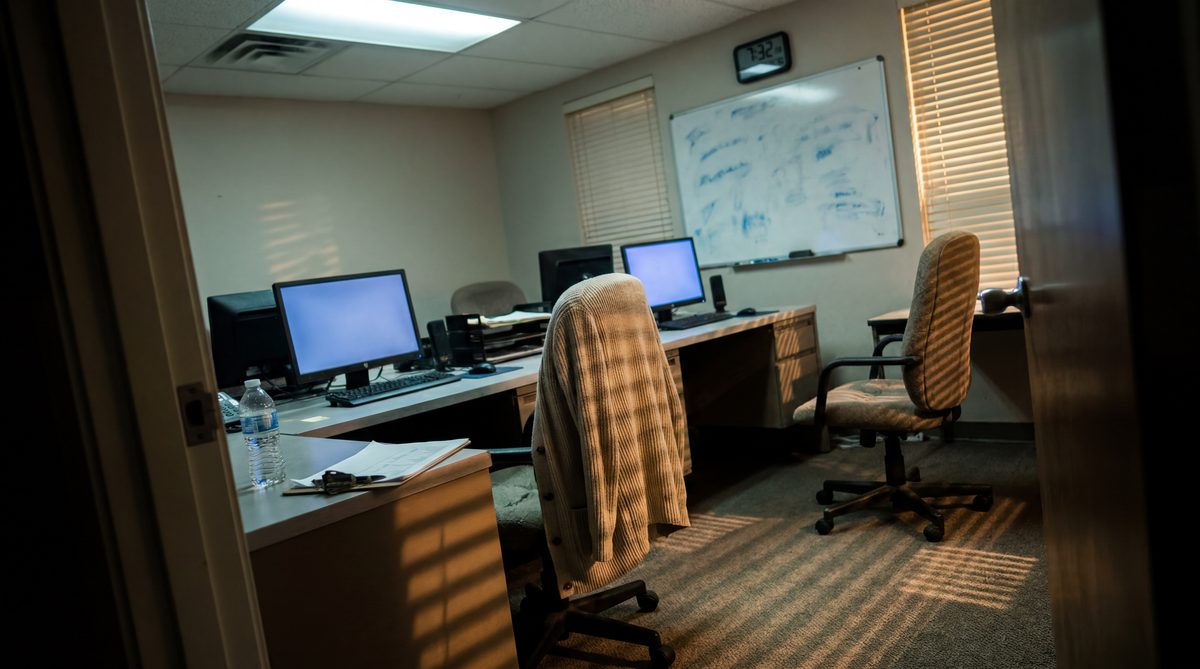
Most HVAC company owners initially try to solve the missed-call problem by hiring. One full-time receptionist covers roughly 40 hours per week. Per Bureau of Labor Statistics CSR data, the fully loaded cost of an HVAC company receptionist runs $50,000 to $70,000 per year once you factor in payroll taxes, benefits, training, and turnover replacement. For a 40-hour-per-week role.
The HVAC week has 168 hours. After-hours emergency calls (6 PM to 8 AM weekdays, all day Saturday and Sunday) account for roughly 128 of those 168 hours. The hours when no-heat and no-cool emergencies actually happen are mostly the hours when nobody is at the front desk.
Hiring a second receptionist doubles the coverage but still leaves the weekend overnight window uncovered. Hiring three receptionists to cover 24/7 costs $150,000 to $210,000 per year, more than the lost revenue most companies were trying to fix in the first place. And even 3-shift coverage drowns on peak days when call volume goes 5-10x normal.
The hiring math simply doesn’t work for HVAC’s call pattern. Something has to scale call answering independent of human shifts, and that something has to specifically understand HVAC dispatch logic (no-heat triage rules, dispatch fee structures, integration with ServiceTitan or Housecall Pro, emergency-vs-routine prioritization) to be worth anything.
How much revenue is your HVAC company losing right now to missed calls?
We’ll mystery-shop your business across normal hours, evenings, weekends, and a fake no-heat emergency at 10 PM, then show you exactly how many calls are slipping and what they’re worth. Free. Results in 48 hours.
What an Answering Service for an HVAC Company Actually Has to Do
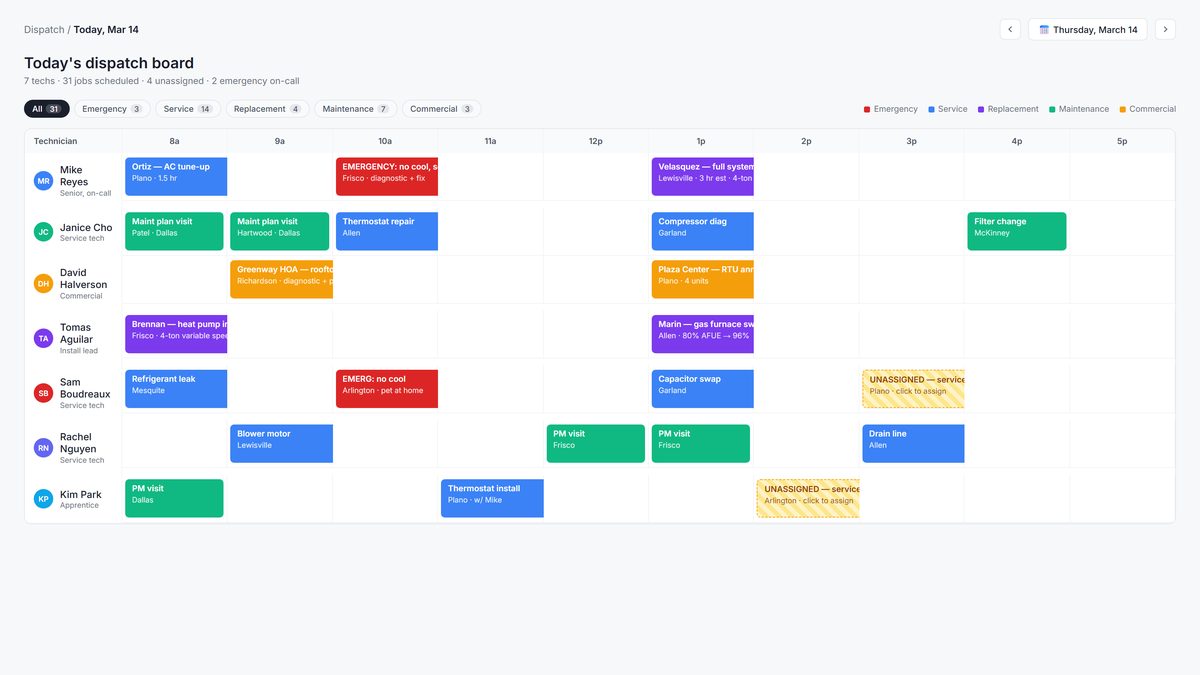
Most generic answering services do not work for HVAC. They take messages. They quote whatever script you gave them. They cannot access your dispatch software, cannot quote dispatch fees, cannot route a no-heat emergency differently from a maintenance check, and cannot handle the seasonal call surge without overage fees.
A real answering service for an HVAC company has to handle six distinct capabilities, and the difference between a service that has them and a service that does not is the difference between recovering missed revenue and just shifting the cost around.
Native ServiceTitan, Housecall Pro, FieldEdge, or Service Fusion integration
The booked appointment has to land directly in your dispatch software, on the right technician’s schedule, with the right service zone tagged, before the call ends. Manual handoff means double-entry errors and 4-8 hour delays that defeat the purpose. Verify the integration is two-way (the service reads your real-time tech availability, not just writes appointments blindly).
HVAC-specific emergency triage rules
The service must distinguish a true no-heat emergency (page on-call tech immediately) from an urgent service issue (schedule first available slot tomorrow) from a routine maintenance request (book into the next maintenance route). This is configured once during onboarding based on your specific rules: heat vs cool, outdoor temp threshold, senior household or not, gas smell, breaker tripping, etc.
A generic answering service has no way to make this judgment, so they either escalate everything (you wake up the on-call tech for thermostat reset issues) or escalate nothing (you miss the actual emergencies).
Dispatch fee quoting on the call
When the customer asks “what does it cost to come out,” the service needs to quote your specific dispatch fee, your weekend/after-hours premium, your finance options through GreenSky or Wells Fargo, and your maintenance plan discount. Not “the office will call you back.” Each of those backwards-handled calls leaks 20-30% of bookings.
Commercial vs residential routing
Commercial property manager calling about a rooftop unit gets routed to your commercial service coordinator with the property address pre-pulled. Residential homeowner with a no-cool issue gets routed into the residential dispatch queue. Different pricing, different scheduling logic, different escalation paths.
Flat-rate pricing that survives peak season
The per-minute pricing model that legacy answering services use guarantees you pay the most on your busiest weeks. A July heat wave that drives 80 emergency calls in 3 days under a per-minute service can run $1,500-$2,500 in surcharges. Flat-rate AI services run the same $400-$1,500/month regardless. For an HVAC company with seasonal surge dynamics, this difference alone is often $5,000-$10,000 per year.
Missed call text back for the edge cases
For the rare calls that drop or hit something the AI cannot handle (very unusual question, bad cell signal, caller specifically requests human), automatic SMS within 30 seconds catches the lead before they dial a competitor. See the broader mechanism in our missed call text back for service contractors post.
AI vs Human Answering Services for HVAC in 2026
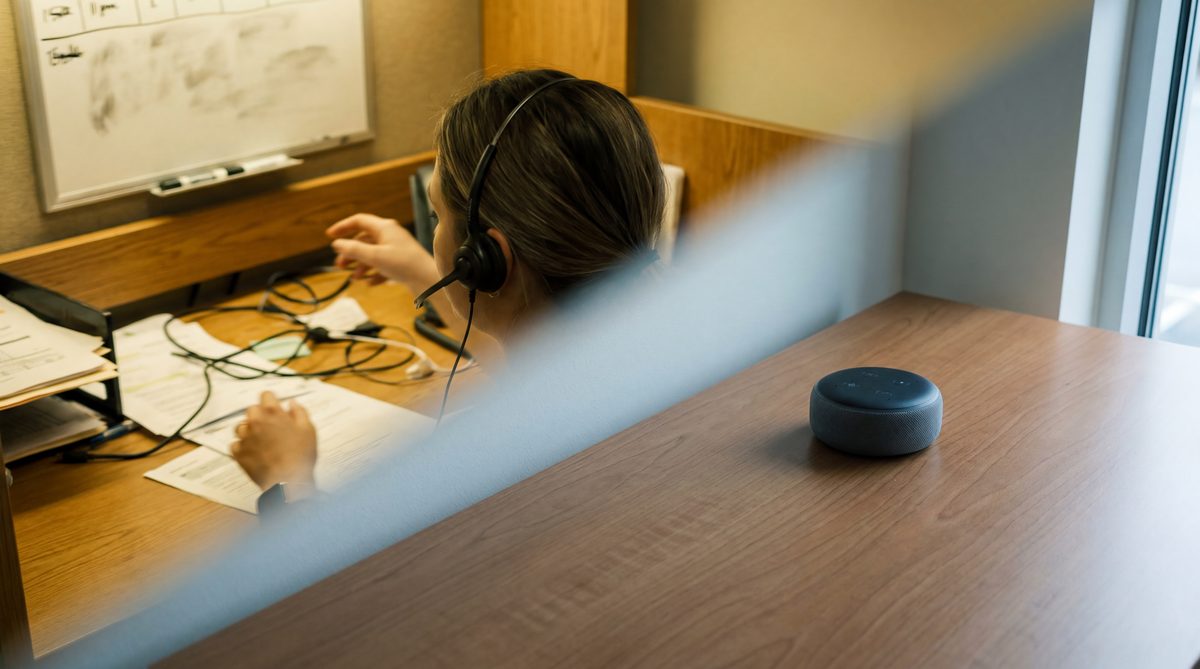
The HVAC answering service market split in 2024-2026 into two distinct categories that buy and price very differently. Most HVAC company owners are still comparing options across both as if they were the same. They aren’t.
Traditional live answering services (Smith.ai, Ruby, AnswerConnect, PATLive, ReceptionHQ, and the human tiers of various BPOs) employ human operators who pick up your calls and follow your script. The good ones are warm and professional. The bad ones are clearly disengaged. The shared limitation across all of them is human-staffing economics: their cost scales linearly with call volume, they charge per-minute or per-call premiums on busy months, their integration with HVAC dispatch software is shallow or nonexistent, and they cannot handle the call surge during a heat wave or polar vortex without queuing callers on hold for 4-8 minutes (which loses the emergency call you most wanted to capture).
Monthly cost for an HVAC company: $300-$800 base + $1.20-$2.50 per minute on overage. Real total cost on busy months: often $1,000-$1,500 once you factor in overage.
AI-powered HVAC-specific answering services handle the call entirely with voice AI configured for your business. The AI picks up within 2 rings, asks the right diagnostic questions for HVAC (heat or cool, when did it start, age of unit, breaker tripping, smell, senior in the home), triages the emergency vs routine decision based on your rules, quotes your dispatch fee, books into ServiceTitan or Housecall Pro directly, sends a Spanish or English SMS confirmation, and runs 24/7/365 with no shift differential or overage. Modern AI answering services handle 50 simultaneous calls without any degradation in response time, which solves the heat-wave problem the human services struggle with.
Monthly cost for an HVAC company: $400-$1,500 flat. Peak season costs the same as slow season. No overage surprises.
For most HVAC companies in 2026, the AI option is the obvious math. The few exceptions are companies with highly unusual call complexity (multi-state commercial accounts requiring nuanced human judgment, premium luxury brands where the answering experience itself is part of the value proposition) where a human-staffed service may still earn its premium. For 90%+ of typical HVAC company call volume, AI handles the work better, faster, and at lower total cost. For the operational deep-dive on how HVAC calls actually get handled, see our companion post on the HVAC answering service (more focused on the emergency-dispatch perspective).
How Ignitvio Handles HVAC Company Calls
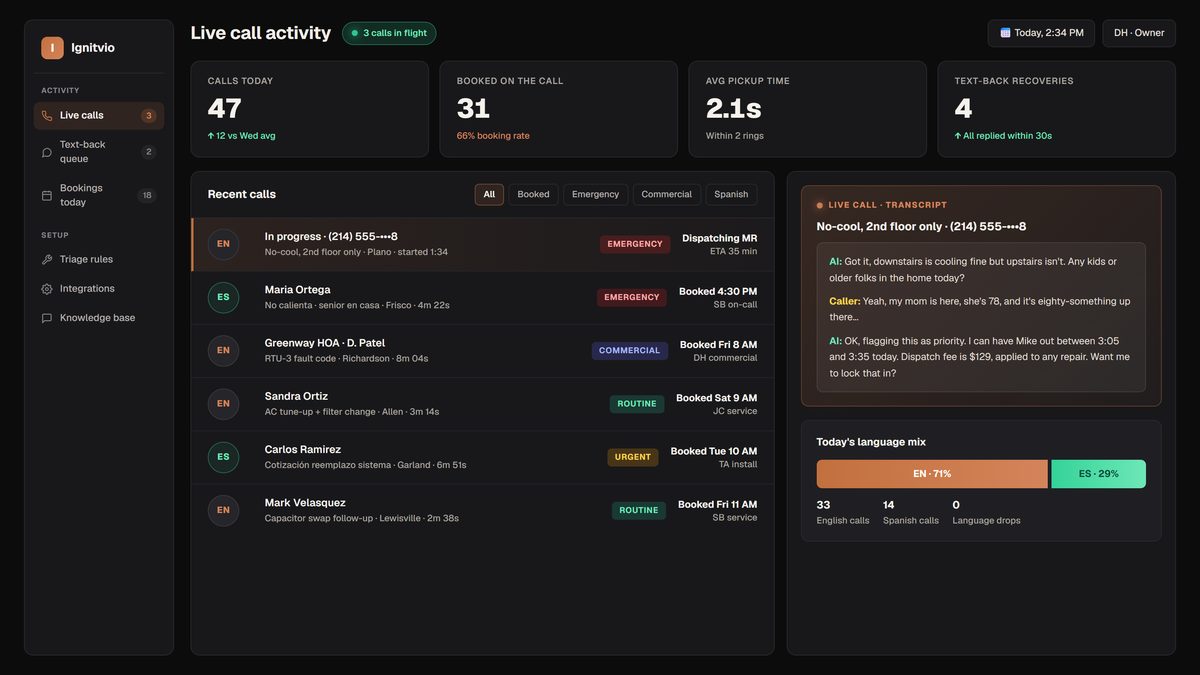
Ignitvio is a done-for-you AI answering system built specifically for HVAC companies that are bleeding revenue to missed calls but cannot justify hiring three receptionists to fix it.
Here’s what it does for an HVAC company:
- Voice AI picks up within 2 rings, during business hours when the front desk is on another line, after hours when the office is closed, during the first 95-degree weekend of the year when the phone won’t stop, in the middle of a polar vortex when no-heat calls are coming in faster than any human dispatcher could possibly answer. The same configuration handles all of it without shift gaps or capacity ceilings.
- HVAC-specific triage rules built into the configuration, no-heat in winter with outdoor temp below 30 pages the on-call tech immediately, no-cool with senior in the home above 78 degrees gets dispatched same-day, intermittent issues without safety concerns get scheduled into the next available slot, thermostat reset questions get walked through on the call to save a truck roll. The rules are set once during onboarding to match how your company actually dispatches.
- Native ServiceTitan, Housecall Pro, FieldEdge, and Service Fusion integration, the booked appointment lands on the right tech’s schedule before the call ends. Customer history, service address, equipment details, and prior service notes are all pulled into the call context so the customer feels like they’re talking to someone who knows their account.
- Dispatch fee quoting, financing options, and maintenance plan upsell, the AI quotes your specific dispatch fee, your weekend premium if applicable, your financing options through GreenSky or Wells Fargo or whichever lender you use, and offers the maintenance plan discount when the customer asks about cost. No callback queue.
- Commercial vs residential routing, commercial property manager call gets tagged commercial, routed to your commercial coordinator, with the property address and prior service history pre-pulled. Residential call gets handled by residential dispatch logic. Same call line, different downstream handling.
- Seasonal surge handling at flat rate, 50 simultaneous calls during a heat wave hit the same AI configuration with no queuing, no hold time, no overage fees. The system that handles 30 calls a week in October handles 300 calls in 3 days during a July heat wave at the same monthly cost.
- Missed Call Text Back catches anything that drops, bad cell signal, dropped call, AI handoff issue, caller insists on human. Automatic SMS within 30 seconds: “Sorry we missed you, what’s going on with your system?” The AI picks up the text conversation and books the appointment or escalates appropriately.
- Spanish + English handled from the same configuration, Spanish-speaking customers get the call answered in natural US Hispanic Spanish, same triage logic, same dispatch fee quoting, same booking flow. See the Spanish-speaking answering service deep-dive for the full breakdown.
The call-recovery economics are not subtle. Model a company at a $1.2M annual run rate that misses roughly 10 high-intent calls per week: recover 6 of them through 24/7 coverage, close them at a normal rate and ticket, and the math lands around $90,000-$130,000 in annual top-line revenue from a single channel, with no additional marketing spend. The calls were already coming in; the only new cost is the coverage.
Without an HVAC-Specific Answering Service vs. With Ignitvio
- 25-35% of calls go to voicemail during business hours, 60%+ after-hours
- No-heat and no-cool emergencies hit voicemail at the moments they matter most
- Overage fees spike $1,000-$2,500 during heat waves and polar vortex weeks
- Generic operator can't access ServiceTitan or quote your dispatch fee
- Commercial property requests get the same handling as a routine maintenance call
- Setup takes 2-4 weeks of script writing and operator training
- Every call answered within 2 rings, 24/7/365 at flat rate
- Emergency triage routes no-heat winter and no-cool senior-household calls in real time
- Peak season costs the same as slow season, no overage fees ever
- Native ServiceTitan / Housecall Pro / FieldEdge / Service Fusion integration
- Commercial calls auto-routed to commercial coordinator with property history pre-pulled
- Done-for-you setup operational in under a week
Illustrative comparison of the two operating models, not a measured client result.
Setup runs under a week. We configure the AI for your service area, your dispatch fee structure, your weekend premiums, your financing partners, your warranty handling, your maintenance plan tiers, your commercial coordinator routing, your specific emergency triage rules, your dispatch software, and your standard follow-up cadence. You tell us how you want each call type handled. We build it in. Then it runs.
Stop Losing No-Heat and System Replacement Calls
See exactly how much revenue your HVAC company is losing
We'll mystery-shop your business across normal hours, evenings, weekends, and a fake no-heat emergency at 10 PM, then show you exactly how many calls are slipping and what they're worth. Free. No pitch.
Get Your Free Revenue Audit
Jake Melendy
Founder, Ignitvio
Jake Melendy is the founder of Ignitvio. He spent 12 years in enterprise sales and sales leadership, including at Oracle, before building Ignitvio, which runs done-for-you outbound appointment setting for commercial contractors and B2B service companies. He writes about pipeline, trigger-based prospecting, and lead response.