Answering Service for Property Management Companies: After-Hours Coverage That Protects NOI
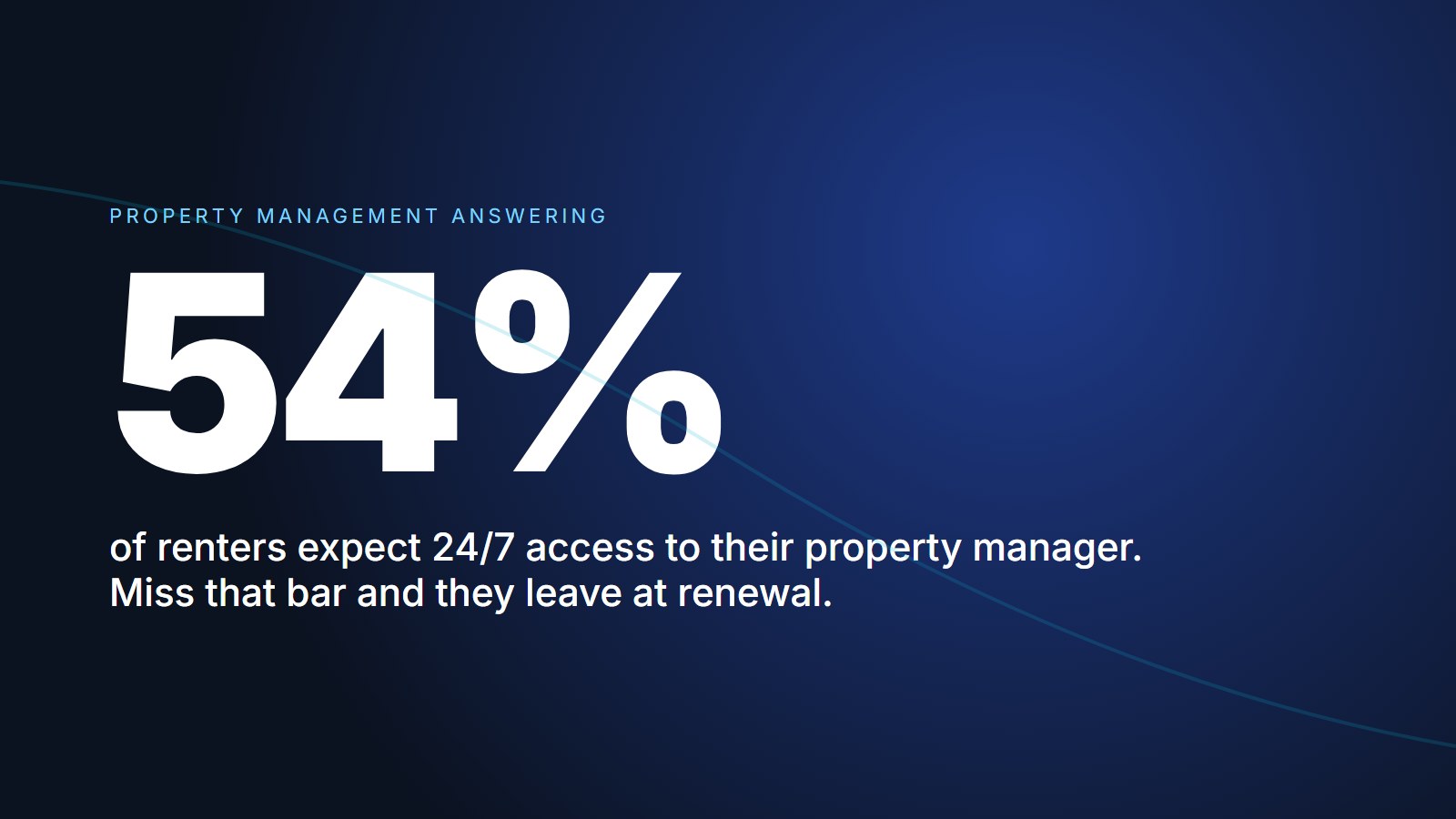
- Renters expect 24/7 access. 54% of tenants say they expect their property manager to be reachable any hour of the day or night, and 39% say they would change PMs over poor communication.
- Property managers field roughly 30-50 calls per unit per year. A 200-unit portfolio sees 6,000-10,000 inbound calls annually, 30-40% of them after hours and on weekends.
- One missed maintenance call can cost more than a year of answering-service fees. Turnover from a single dissatisfied tenant runs $2,000-$3,500 per unit; a delayed leak can run $5,000-$50,000 in property damage.
- A modern AI answering service is not a “voicemail with extra steps.” Done right, it triages emergencies, looks up the lease, dispatches the right vendor, and books the maintenance visit, all on the call, before the tenant hangs up.
- The cost has dropped fast. What used to require a per-minute live call center now runs $300-$1,000/month flat-rate, regardless of call volume or hour.
What an Answering Service for Property Management Companies Actually Is
An answering service for property management companies is a phone-coverage layer that handles inbound tenant, prospect, and owner calls when in-house leasing staff and property managers cannot. The category covers everything from traditional human call centers staffed by remote agents reading scripts, to modern AI voice agents that pick up the call, identify the unit, triage the issue, and dispatch the vendor in a single conversation. What unites them is the operating promise: every call gets answered, on every shift, regardless of whether the office is open.
For a regional manager or portfolio owner, the practical job description is narrower than “general receptionist.” The work concentrates on after-hours emergency triage (water leak in unit, lockout at 11 PM, no heat in February, no AC in August, gas smell, electrical fault), routine maintenance intake, prospect inquiries on vacant units, and rent or lease account questions. The right service routes each of these to its correct outcome instead of dropping a generic message into a voicemail queue, because the cost of misrouting an emergency or losing a prospect during a vacancy window is multiples of the service fee.
The tenant-experience impact is the lever that drives the NOI math. Renters who reach a human voice (or a competent AI) on the first ring during an emergency are dramatically more likely to renew at lease end. NAA retention data ties responsiveness directly to renewal probability, and renewal probability is the single largest controllable input to net operating income on a stabilized portfolio.
The current technical bar is direct integration with the property management software the portfolio already runs on, AppFolio, Buildium, Yardi, or Rent Manager. A service that cannot pull the lease record, post a work order back, and update the resident profile in real time is a service that creates more office work than it removes.
What Tenants Actually Call About, and When
The average tenant doesn’t think of their property manager as a 9-to-5 business. They think of you the same way they think of their landlord, their bank, or any other service: someone who handles a problem when the problem happens.
Problems happen at all hours.
According to AppFolio’s renter research, 54% of renters expect 24/7 customer service from their property manager, and a meaningful share, about 39%, say they would consider switching to a different rental community over poor communication alone. That number is up sharply from a decade ago, and it’s not going back down. The expectation is set.
The call mix breaks down predictably across a typical residential portfolio:
Routine maintenance and service requests
Roughly 40-50% of inbound calls are non-emergency maintenance: a slow drain, a refrigerator on the way out, an HVAC tune-up needed, an appliance making a funny noise. These can wait for normal business hours, but they still need to be captured, tracked, and dispatched, and tenants get frustrated quickly if the request goes into a void.
After-hours emergencies
Lockouts, water leaks, no heat in winter, no AC in summer, gas smell, electrical issues, broken windows. Buildium’s State of the Property Management Industry report consistently shows that emergency maintenance is the single largest source of tenant complaints in surveys of multifamily renters, and the largest source of late-night calls for the PM staff handling them.
Lease and account questions
Rent payment confusion, lease renewal questions, parking permit issues, pet policy questions. These look low-priority, until you realize that an unanswered renewal question often becomes a lost lease.
Inquiries from prospective tenants
The single most expensive call to miss. Zillow’s renter research shows that prospective renters typically contact 3-5 properties before scheduling a showing, and the property that responds first wins the showing a disproportionate share of the time. Voicemail isn’t a response.
When you spread call volume across 24 hours, the pattern is sobering: a property manager handling a typical residential portfolio sees 30-40% of inbound call volume outside of standard business hours, and emergency maintenance calls cluster heavily on evenings and weekends, exactly the times when no one is in the office to take them.
of renters expect their property manager to be reachable 24/7. 39% say they'd consider switching properties over poor communication. The expectation has been set.
Source: AppFolio Renter ResearchWhat a Missed Maintenance Call Actually Costs
Property managers tend to think about missed calls in dollar amounts that are far too small. The instinct is to compare the cost of after-hours coverage ($300-$1,000/month) against the apparent cost of the missed call (a few minutes of inconvenience). That math always points one way: skip the coverage.
The real comparison is different. Three categories of cost compound when calls go unanswered.
1. Direct property damage from delayed emergency response
A burst pipe at 11 PM that gets called in to voicemail and addressed at 8 AM the next morning is a 9-hour leak. Industry insurance data consistently shows that water-damage claims escalate exponentially with response time. A 2-hour leak averages $3,000-$5,000 in damage. A 12-hour leak averages $20,000-$50,000, plus mold remediation, plus possible displacement costs for the tenant.
The same dynamic applies to no-heat calls in winter (frozen pipes, then burst pipes), gas leaks (life-safety event, building-wide evacuation, possible code violation), and water heater failures.
A single missed emergency call can cost more than a year of premium 24/7 answering-service fees.
2. Tenant turnover from poor responsiveness
The cost of replacing a single tenant, vacancy time, marketing, screening, leasing fees, turnover unit prep, averages about $1,800 per unit according to turnover-cost analysis published by the NAA (National Apartment Association), and can climb well past that in major metros. Even a 1% improvement in retention from better responsiveness pays for the answering service many times over for any portfolio above ~50 units.
The mechanic is straightforward: when a tenant has a bad communication experience, a call that goes unanswered, a maintenance request that disappears, an emergency that takes 8 hours to respond to, they don’t usually complain. They wait until renewal, and they leave.
3. Lost prospective leases
Every unanswered prospect call during a vacancy is a tenant going to your competitor. According to Harvard Business Review’s foundational lead-response research, prospects contacted within 5 minutes of inquiry are 21× more likely to qualify than prospects contacted at 30 minutes. For a vacant unit losing $2,000-$3,000 per month in rent during turnover, every day of additional vacancy is real money, and slow response time directly extends vacancy.
The math, summed across these three categories, almost always justifies 24/7 coverage for any portfolio above 30-50 units. The portfolios that don’t have it usually haven’t done the math, or they’re still using a model of coverage that hasn’t kept up with what’s possible technologically.
What Good 24/7 Tenant Coverage Looks Like
The bar has shifted. Twenty years ago, “24/7 coverage” meant an outsourced human call center taking messages and forwarding them to the on-call manager via pager. The model worked, sort of. It was expensive (per-minute pricing), it lost detail in the message handoff, and it created a queue every emergency had to wait through.
Today, “good coverage” means something different. The features that separate a useful service from a bad one are specific, and any solution worth evaluating should hit all of them.
Instant pick-up, no hold queue
Every meaningful call gets answered within 1-2 rings. Voicemail is unacceptable for a tenant in a true emergency, and even non-emergency callers will hang up and call a competitor or escalate to your direct line within 30 seconds of being put on hold.
Emergency triage that actually triages
Not every “emergency” is an emergency. A real triage process distinguishes between “no heat in February when temperature is 12°F” (immediate dispatch), “leaking faucet that’s filled a bucket” (next-business-day priority), and “tenant wants to know about pool hours” (route to general inquiry queue). The triage logic matters more than the politeness of the script.
On-call dispatch that knows your vendor list
When a true emergency call comes in at 2 AM, the right outcome isn’t “we took a message.” The right outcome is “we paged your on-call plumber, sent them the property address and unit number, confirmed they’re en route, and texted the tenant a confirmation with ETA.” Anything less requires you to be woken up to do that work yourself.
Property and unit context, not generic intake
A tenant calling about “the leak” doesn’t want to spell out their unit number, lease start date, or which boiler serves their floor. The system should know, pulled from your property management software, populated automatically. The bar in 2026 is integration, not transcription.
Bilingual coverage
In most metro areas, a meaningful share of tenants prefer Spanish for service calls. A Spanish-language tenant routed to an English-only call center has a worse experience than no call center at all. Look for native bilingual support, not just “we’ll find someone if needed.”
Maintenance booking, not message-taking
For non-emergency maintenance, the call should end with an appointment on your maintenance team’s calendar, not a message in your voicemail queue waiting for someone to read it Monday morning.
When a service hits all six of these, the difference for a property manager is dramatic. After-hours calls stop being a source of stress; they become a source of operational completeness. That shift is the entire reason this category exists.
Why Traditional Answering Services Fall Short for Property Management
Traditional human answering services have been the default for property management coverage for decades, and on the surface they’re reasonable: a friendly voice picks up the call, takes a message, and forwards it to the property manager. The trouble is that this model was designed for a different decade, and the gaps show up immediately when a property management portfolio tries to use it at scale.
The first gap is knowledge. A traditional call center handles dozens of clients across industries. The agent answering your tenant’s call has no idea which building they’re in, who the on-call plumber is, what the lease says about pet emergencies, or whether the water heater is on a maintenance contract. Every call is a cold start. The result is a thin message (“tenant in unit 4B says water leak, please call back”) that loses 80% of the relevant context the tenant actually provided on the call.
The second gap is dispatch. Traditional services almost universally end the call by promising to “have someone call you back.” That’s not a fix, it’s a deferral. For a non-emergency call, that means the maintenance team won’t see the request until business hours and the tenant has lost 8-15 hours of resolution time. For a real emergency, it means the property manager (often you) gets paged at 2 AM to make the actual decision, defeating the entire purpose of having coverage.
The third gap is economics. Traditional answering services price per-minute or per-call, and the rate climbs sharply during nights and weekends. A high-volume portfolio with a busy after-hours emergency season can blow through a budget fast. Industry benchmarks suggest a typical 200-unit portfolio runs $800-$2,500/month on a traditional service, and the bill spikes seasonally exactly when budgets are tightest.
This is the gap that AI answering services, the modern alternative, are designed to close. Not by replacing the human element of property management (the relationships, the judgment calls, the difficult conversations) but by handling the structured, repeatable layer of phone work where humans were never the right tool in the first place.
What an AI Answering Service Actually Does for Property Managers
An AI answering service is, in practice, a voice agent that picks up tenant and prospect calls and runs the conversation to a real outcome. The current generation of these systems is materially different from the rigid IVR menus of 10 years ago. Done well, the experience for the caller is indistinguishable from talking to a competent property management staff member.
The four things a good AI service does, that a traditional service cannot, are:
Recognizes the caller and pulls context automatically
By the time the caller finishes their first sentence, the system has matched the inbound number to the lease record, identified the property and unit, surfaced the maintenance history, and noted any active work orders. The caller never has to spell out their address. AppFolio research consistently shows tenant satisfaction is heavily influenced by the perception of being “known” by the management team, context-aware AI delivers that perception consistently.
Triages emergencies in real time
The AI distinguishes between true emergencies, urgent-but-not-emergency requests, and routine inquiries, using a rubric specific to your portfolio (your definitions of emergency, your priority response times, your specific exclusions). Emergency calls trigger immediate vendor dispatch and SMS confirmation to the tenant. Non-emergency calls go to scheduled appointments. Inquiries get answered directly or routed to the right team queue.
Schedules the maintenance visit on the call
Instead of taking a message, the AI offers the tenant available time slots from your maintenance team’s actual calendar, books the appointment in real time, and texts the tenant a confirmation with the technician’s ETA window. The work order shows up in your property management software automatically, fully populated. Nothing falls into a queue waiting to be re-typed by office staff in the morning.
Handles inbound prospect inquiries during vacancies
For vacant units, the AI captures prospect calls that arrive outside business hours, qualifies them (lease term, move-in date, pet, income range), books showings directly into the leasing calendar, and follows up with text confirmations. Vacant units fill faster because every prospect call is converted to a booked showing, not a voicemail.
The combined effect is structural: the property manager wakes up to a clean inbox of resolved overnight activity, not a chaos of pending callbacks. The phone stops being an interruption layer and starts being a fully managed channel.
How to Evaluate Answering Service Options
For any property manager evaluating modern coverage options, the differences between vendors are real and meaningful. The six factors below predict whether a service will actually deliver on the promise.
1. Property management software integration
The bar is direct integration with AppFolio, Buildium, Yardi, RentManager, or whichever PMS the portfolio runs on. A standalone tool that doesn’t sync work orders, lease lookups, and tenant records back into the PMS is a tool that will create double-entry headaches for the office team within weeks.
2. After-hours and weekend coverage with no per-minute pricing
The whole point is unlimited coverage during the windows when in-house staff isn’t available. Any pricing model that punishes high-volume periods (storms, summer HVAC, peak vacancy seasons) defeats the use case. Flat-rate pricing is the standard to look for.
3. Bilingual support, ideally native
In most U.S. metro areas, a meaningful share of the tenant base prefers Spanish for service calls. Bilingual coverage from day one matters, and “we’ll find someone if needed” is not bilingual coverage. Native English/Spanish AI voice options exist now and are the standard worth evaluating against.
4. Configurable emergency triage rules
Every portfolio defines emergency differently. The service should let you specify what constitutes a Tier 1 emergency (immediate dispatch), Tier 2 (next-day), Tier 3 (next-business-day), and what’s explicitly excluded, and route each appropriately.
5. Direct vendor dispatch (not just message-taking)
The service should be able to dispatch to your actual vendor list, your specific plumber, electrician, locksmith, with a configurable on-call rotation, not just relay messages back to you. The ROI math depends on this layer working.
6. Quality transcripts and call summaries
Every call should produce a searchable transcript and a structured summary that lands in your PMS. This is what makes the system auditable, lets you train new policies, and protects the portfolio if a tenant disputes a call later.
When a service hits all six of these, the operational picture for the property management office changes meaningfully. When it misses two or more, the office ends up doing manual cleanup work that erases most of the value.
How Ignitvio Handles Property Management Calls
Ignitvio was built specifically for the call patterns property management portfolios face. The platform plugs into your existing property management software and handles the phone layer, emergency triage, maintenance booking, prospect intake, lease and rent inquiries, across English and Spanish, 24/7, on a single flat-rate.
In practice, a typical day looks like this. A tenant in a 200-unit portfolio calls at 11
PM about no heat. Ignitvio’s Voice AI picks up on the second ring, recognizes the inbound number against the lease record, confirms the unit and resident, runs the no-heat triage script (current outdoor temperature, thermostat reading, recent service history, vulnerable resident flags), classifies it as a Tier 1 emergency, and pages the on-call HVAC vendor with the property address, unit number, and access instructions. Before the tenant hangs up, the system has texted them a confirmation with the technician’s ETA window. The work order is logged in AppFolio. The property manager sees a single line in their morning inbox: “Resolved overnight. Jose called at 11 PM, no heat in unit 4B, dispatched to Apex HVAC, technician arrived 12 AM, heat restored 1 AM.”That same night, the system handled 14 other calls, 9 routine maintenance requests booked to the next-day schedule, 3 prospect inquiries with showings booked into the leasing calendar, 2 lease renewal questions answered directly. None of them required the property manager to be awake.
Beyond inbound calls, the platform also handles the structured outbound work: missed-call text-back automatically catches any call that doesn’t connect, lead follow-up sequences keep prospects warm through the leasing window, and review automation turns satisfied move-ins into Google reviews, the same compounding loops that are described in detail on the property management industry page.
Pricing is flat monthly regardless of portfolio size, call volume, or season (structure on the pricing page). For a portfolio above 100 units, that pays for itself the first time it prevents a single overnight emergency from becoming a $20,000 water-damage claim.
See exactly how many tenant calls your portfolio is missing
We'll measure your inbound call volume across day, evening, weekend, and overnight windows, and show you what's slipping through. Free.
Get Your Free Property Management Call AuditProperty Management Answering Service FAQ
Will an AI answering service work with my property management software?
Yes, modern AI answering platforms integrate directly with AppFolio, Buildium, Yardi, RentManager, and most other PM software. The integration handles lease lookups, work-order creation, and resident records bidirectionally so the office team doesn’t have to re-enter data. Always confirm specific PMS support before signing.
Can the AI really triage emergencies correctly?
Done well, yes, and arguably better than a tired human at 2 AM. The AI runs a configurable rubric specific to your portfolio (your definitions of Tier 1/2/3, your specific exclusions, your vendor on-call list). Edge cases that don’t fit the rubric escalate to a human on-call manager, but those are typically 1-2% of overnight call volume, not the bulk.
What happens if a tenant doesn’t want to talk to AI?
Most modern systems support immediate human escalation when the caller asks. The AI greets warmly, runs the triage if the caller cooperates, and hands off to a live person (or rings your direct line) the moment the caller asks for one. In practice, most tenants don’t notice or don’t care, they just want their problem handled.
How is this different from missed-call text-back?
Missed-call text-back catches calls that ring and disconnect, it’s a recovery layer for calls that didn’t get answered. An AI answering service catches the call live and handles it. The two are complementary: the AI answers everything in real time, and missed-call text-back is the safety net for the rare disconnect or hang-up.
Is bilingual coverage really included, or is it an upcharge?
For property management specifically, native English/Spanish coverage should be standard, not an upgrade. Tenants in most U.S. metro areas are likely to default to Spanish for service calls, and any service that treats it as an upcharge is mispriced for the use case. Confirm at sign-up.
Can it actually book the maintenance visit, or just take a message?
The whole reason modern AI answering services replace traditional ones is real-time booking. The system should pull your maintenance team’s actual calendar, offer the tenant available windows, book the appointment, and send the confirmation, all on the inbound call. If the vendor only takes messages, you’ve bought a more expensive voicemail.
Stop getting woken up at 2 AM by tenant calls
We'll show you exactly how many tenant calls your portfolio is missing across day, evening, weekend, and overnight windows. Free. No commitment. See if Ignitvio is the right fit before you pay anything.
Run the Free Revenue Audit
Jake Melendy
Founder, Ignitvio
Jake Melendy is the founder of Ignitvio. He spent 12 years in enterprise sales and sales leadership, including at Oracle, before building Ignitvio, which runs done-for-you outbound appointment setting for commercial contractors and B2B service companies. He writes about pipeline, trigger-based prospecting, and lead response.