HVAC Maintenance Contract: Free Templates + Guide
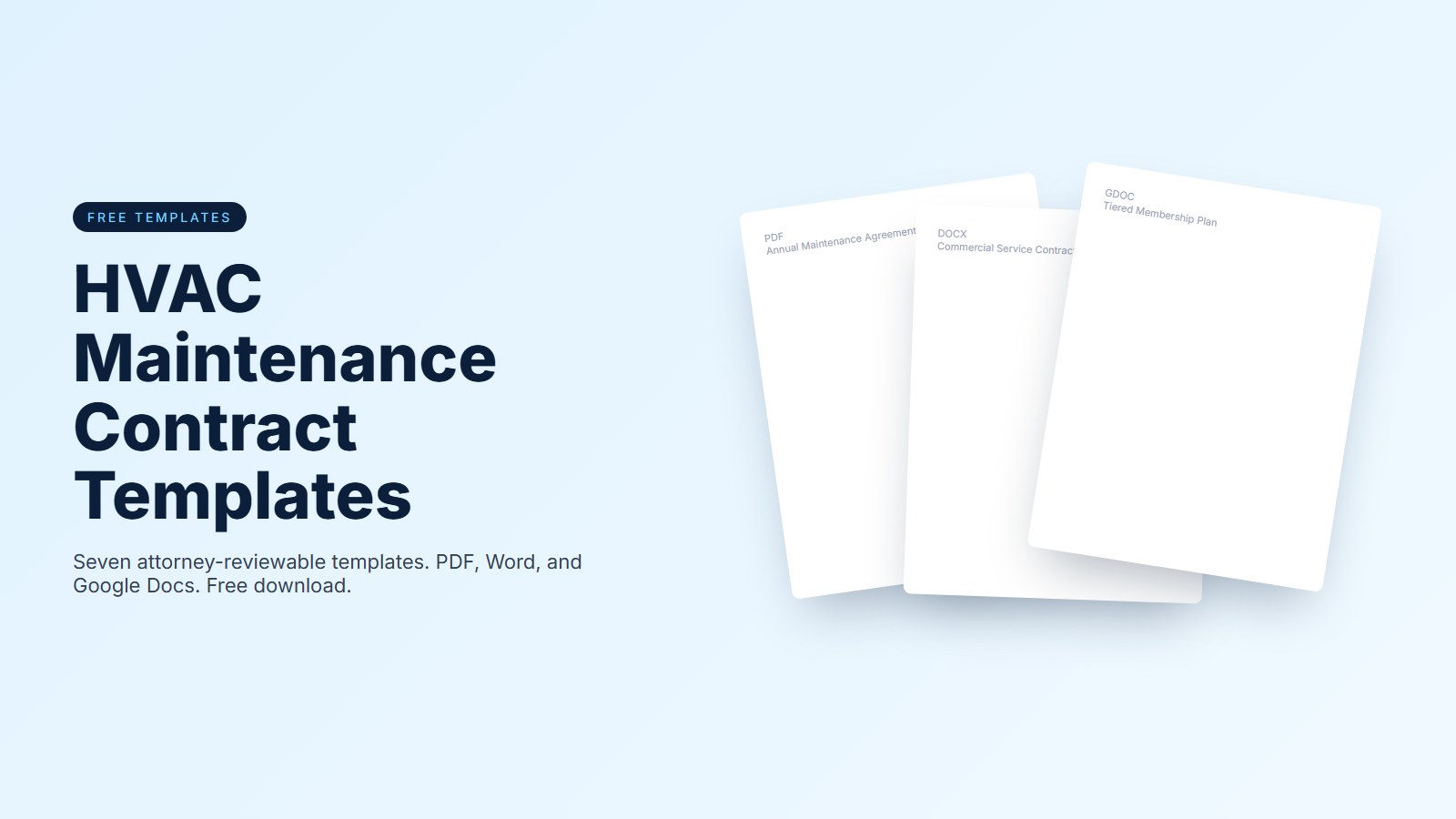
- Jump straight to the 7 free templates ↓, links to PDF, Word, and Google Docs versions you can customize today.
- The 9 clauses every HVAC service contract must include to be enforceable in most states.
- The 5 most common mistakes that void HVAC maintenance agreements and trigger disputes.
- A simple framework for building maintenance plans that actually generate recurring revenue, not just paperwork.
Just here for the templates?
If you’re short on time, the templates section is below. We’ve curated 7 free, attorney-reviewable HVAC contract templates with direct download links.
Skip to the 7 Free Templates →Why Every HVAC Business Needs a Maintenance Contract
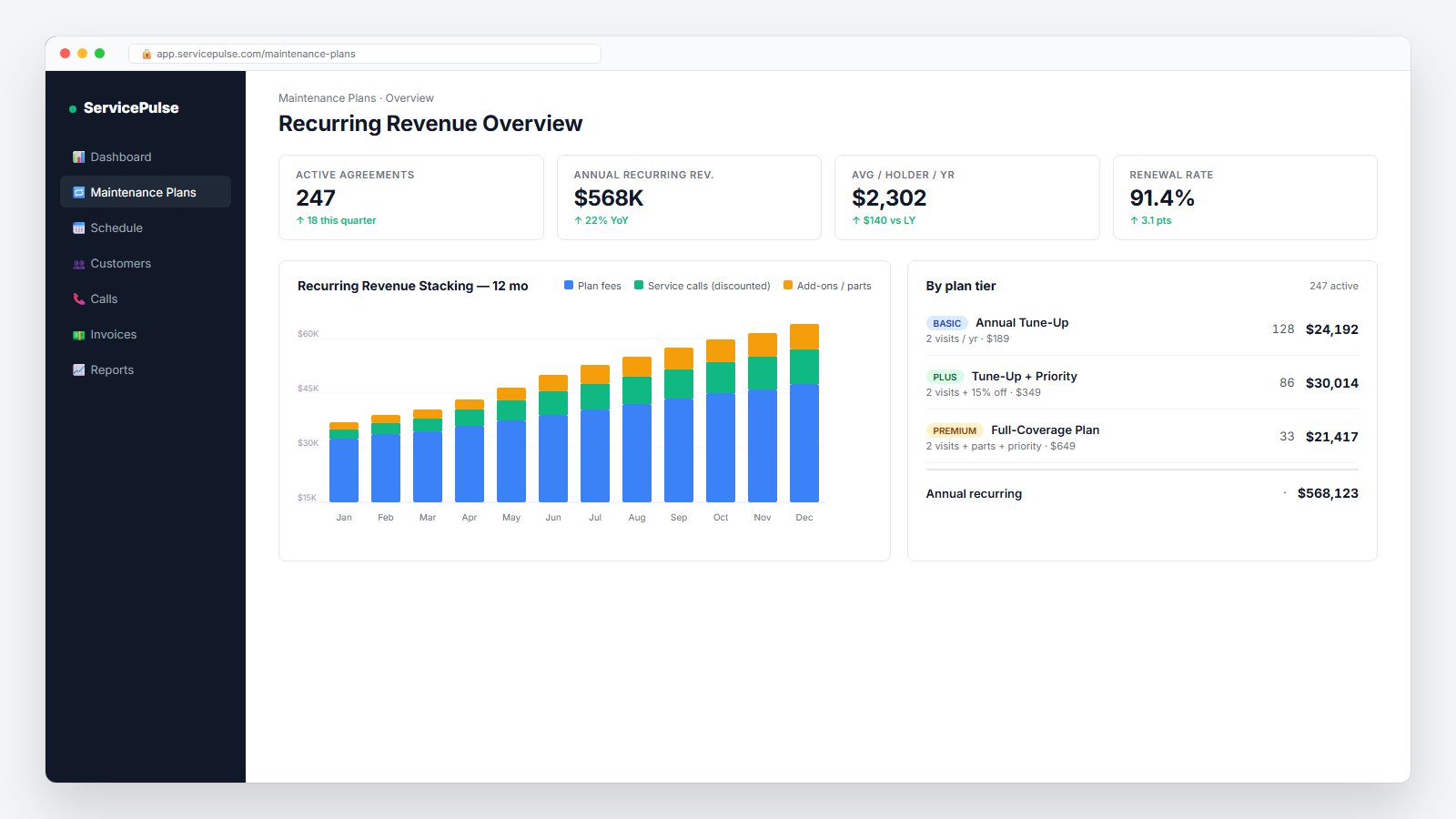
A clean, well-written HVAC maintenance contract is one of the most underused growth assets in the trade. It does three things at once: it locks in recurring maintenance revenue, it protects you legally if equipment fails, and it dramatically increases the lifetime value of every customer who signs one.
The numbers around HVAC service contracts are striking. According to ServiceTitan industry research, contractors with active maintenance agreement programs generate roughly 30-40% of their annual revenue from agreement-holders, while spending dramatically less on customer acquisition for that revenue. Maintenance plan customers are also 4-5× more likely to call your shop first when their system fails, even at a 20-30% premium over emergency competitors.
Despite that, a meaningful share of small-to-mid HVAC contractors operate without a standardized service contract template at all. They write each agreement from scratch, copy a competitor’s contract, or skip the paperwork entirely on a handshake. Each of those approaches costs money, sometimes catastrophically.
The right contract template solves three problems simultaneously:
- Speed. A standardized template lets you close a maintenance agreement during the install or service visit instead of “I’ll email you something later” (which usually never happens).
- Consistency. Every customer gets the same terms. Disputes get resolved by reading the contract instead of arguing over what was said.
- Legal protection. Properly written contracts limit liability for equipment failures, define your warranty obligations, and give you clear escalation paths for non-payment.
The rest of this guide walks through what your contract must include, where to find good templates, the mistakes that get HVAC contractors burned, and how to handle the post-contract operational work without drowning in calls.
The 9 Clauses Every HVAC Service Contract Must Include
If a template you find online is missing two or more of the clauses below, walk away, you’ll be writing that template’s mistakes into every contract you sign on top of it.
The 9 clauses · checklist
Every enforceable HVAC contract has these.
- 1 Parties & contact infoUse the legal entity (LLC), not personal name. Handshakes signed under "John's HVAC" instead of "John's HVAC LLC" expose you personally to liability.
- 2 Scope of workList specific tasks + frequency (biannual tune-ups, filter replacements, refrigerant top-offs). "Routine maintenance" is not a scope, it's a dispute waiting to happen. ACCA's industry standards publish recommended maintenance scopes you can adapt.
- 3 Equipment coveredMake, model, serial number, location, and refrigerant type for each system. Matters for parts pricing and warranty claims.
- 4 Term & renewalLength of agreement and auto-renewal language. CA, NY, and IL all require auto-renewal terms to be conspicuous, fine-print clauses are unenforceable.
- 5 Pricing & paymentAnnual fee, payment schedule, late-payment terms, and what happens if payment lapses. Be explicit; ambiguity defaults to the customer.
- 6 Service-call discountAgreement holders typically get 10-20% off emergency calls and parts. Spell out exclusions (after-hours premium, etc.) so it doesn't become a fight.
- 7 Priority service SLAGuaranteed response window for emergencies (e.g., 4 hours during business days). Match the SLA to your real operational capacity, don't over-promise.
- 8 Warranty & liabilityWhat's covered if equipment fails, your liability ceiling, and exclusions. Defensible cap = 1-2× contract value, not $500.
- 9 Cancellation & disputesCancellation rights and refund formula for both parties, plus the dispute-resolution forum (mediation, arbitration, or specific state court).
Average annual revenue per HVAC maintenance agreement holder, including discounted emergency calls and add-on services. Multiply by 100+ agreements and the recurring revenue compounds.
Source: ServiceTitan industry dataFree HVAC Service Contract Templates (Curated)
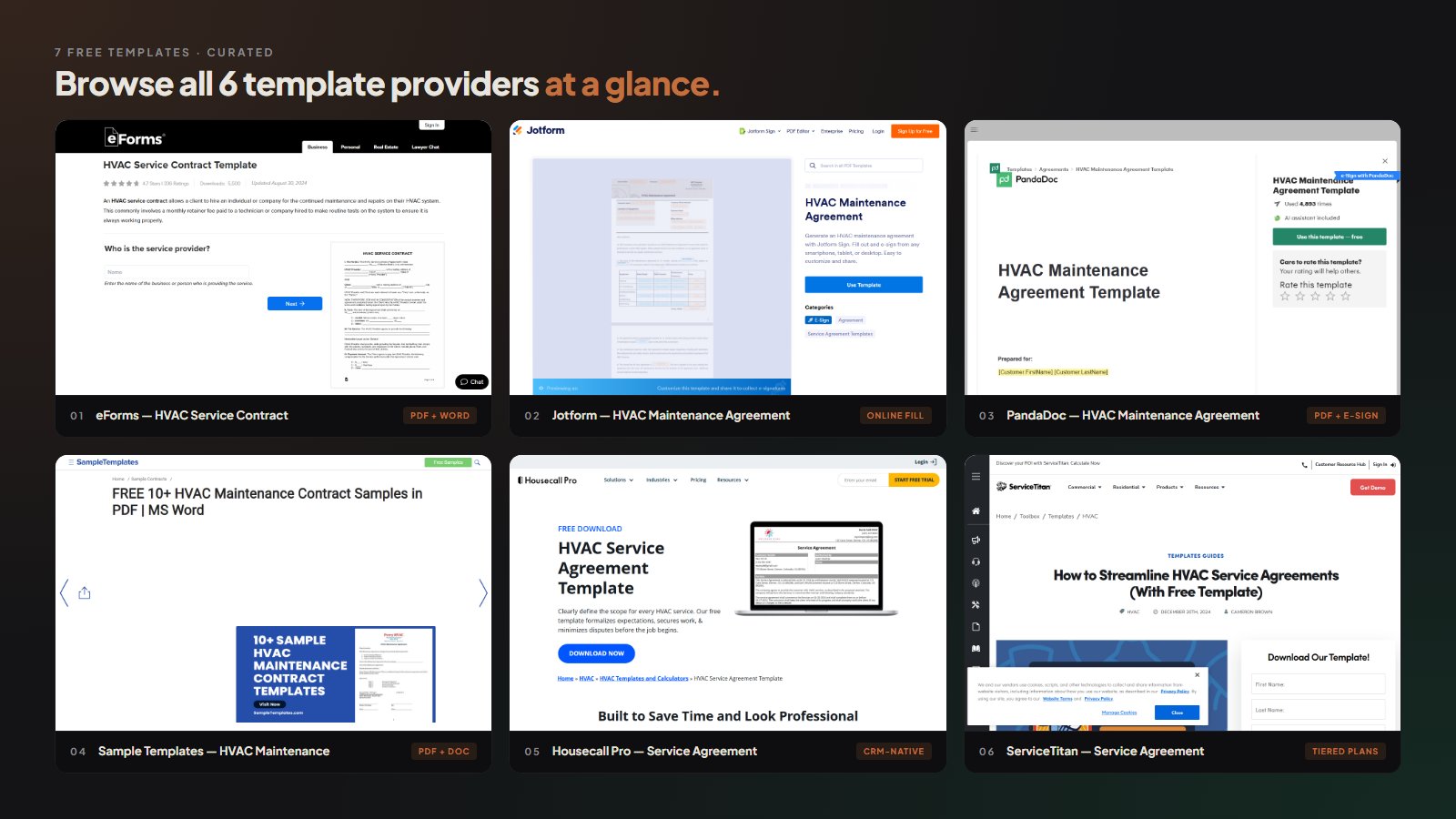
We’ve reviewed the top free HVAC contract templates available online. Each one below covers the nine clauses above (or close to it) and is editable in standard formats. Always have a local attorney review before deploying, these are starting points, not finished legal documents.
Comprehensive structure with warranty and liability language. Strong residential starting point. Editable in PDF and Word.
Download from eforms.com →Online-fillable template that converts to a downloadable PDF after each signing. Built-in e-sign on any device.
Download from jotform.com →Commercial-grade template with electronic signature workflow built in. Free tier; paid tiers add automation.
Download from pandadoc.com →10+ free Word and PDF templates for small residential contractors. Fastest to deploy if you need a starting point today.
Download from sampletemplates.com →Free downloadable template, also built into Housecall Pro’s CRM if you’re a user. Strong residential focus.
Download from housecallpro.com →Free template covering customer info, service location, frequency, payment terms, and equipment details. Works as a tiered-pricing reference.
Download from servicetitan.com →ACCA (Air Conditioning Contractors of America) doesn’t publish a contract template per se, they publish the ANSI/ACCA 4 QM standard, which defines the minimum acceptable maintenance scope. Pair this with one of the templates above to make sure your “scope of work” clause is industry-defensible.
Read the ACCA standards reference at hvac-blog.acca.org →For commercial HVAC contracts (which carry more liability and longer terms), pair one of the templates above with attorney review. A 1-hour legal review on your first commercial template (~$300-$500) is dramatically less than the cost of a single dispute over an unclear scope clause.
The 5 Most Common Mistakes That Void HVAC Service Contracts
Legal review · 5 mistakes flagged
5 mistakes that void HVAC contracts.
HVAC Maintenance Service Agreement
Annual residential plan, DRAFT v3 · Marked for review
2. Scope of Work
Contractor agrees to provide routine maintenance of the customer's HVAC system on a regular basis. 1
4. Term & Renewal
This Agreement shall remain in effect for one (1) year from the Effective Date. Subject to the terms set forth on page 4, this Agreement may automatically renew under conditions described therein. 2
8. Warranty & Liability
Contractor's total aggregate liability shall not exceed five hundred dollars ($500), regardless of cause. 3
10. Cancellation
Either party may cancel this Agreement at any time. No specific terms regarding refund, prorated balance, or cancellation fees are included. 4
11. Dispute Resolution
[Section intentionally left blank] 5
The same five mistakes show up in nearly every disputed HVAC service agreement. Each one is fixable in your template before the next signing.
Mistake #1: Vague scope of work
“Routine maintenance” is not a scope. The customer thinks it includes refrigerant top-offs and electrical inspections; you didn’t quote that work. Six months later, you’re in a dispute. Always list specific tasks, with frequency, in the scope clause.
Mistake #2: Auto-renewal language buried in the fine print
Many states (California, New York, Illinois among others) now require auto-renewal language to be conspicuous and re-acknowledged at renewal. Auto-renewal terms hidden in 8-point text on page 4 are increasingly unenforceable and can trigger consumer-protection claims.
Mistake #3: Liability caps that don’t survive equipment failures
A $500 liability cap reads great until a faulty install leads to $40,000 in water damage. State courts often refuse to enforce overly aggressive liability caps, especially for residential consumers. Your cap should be defensible, usually 1-2× the contract value, not a token amount.
Mistake #4: Missing cancellation and refund terms
If a customer cancels mid-term, what do they owe? What gets refunded? Contracts that don’t specify almost always default in the customer’s favor. Write the cancellation math explicitly: prorated refund minus a documented administrative fee.
Mistake #5: No dispute resolution clause
Without a chosen forum (mediation, arbitration, or specific state court), every dispute becomes a procedural fight before you ever discuss the merits. Pick a forum, name it, and state which state’s law governs. American Bar Association resources have plain-language templates for these clauses.
A useful filter: if you can’t explain to a customer in 90 seconds what they’re agreeing to, your contract is too complicated and you’ll lose disputes you should win.
After the Contract: The Operational Bottleneck Most HVAC Shops Miss
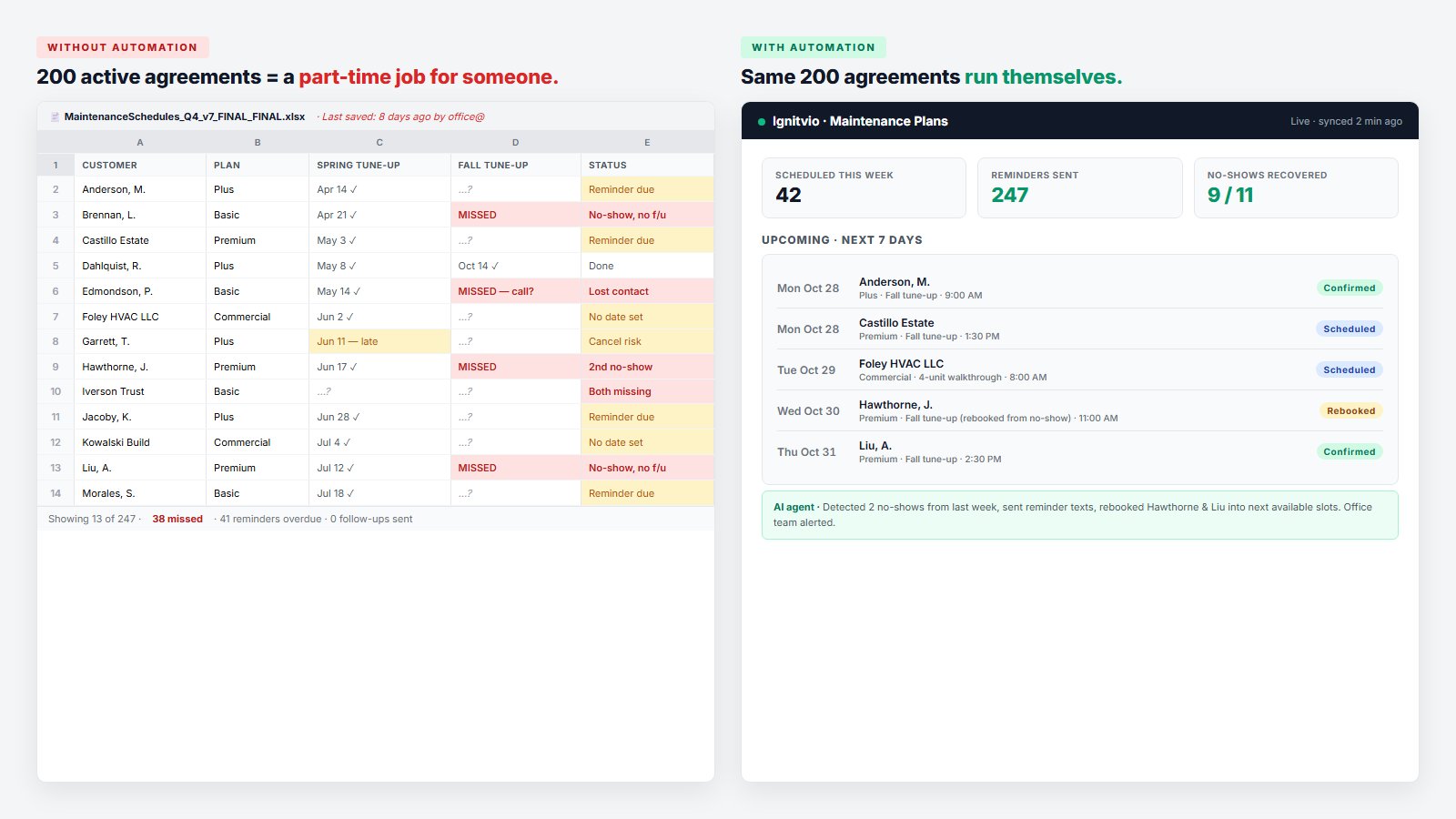
Signing the contract is the easy part. The hard part, the part that determines whether maintenance agreements actually pay off, is the operational follow-through afterward.
Each agreement creates ongoing work: scheduling the biannual tune-ups, sending reminders, taking the inbound call when the customer calls early about a problem, dispatching the right tech, and following up if the customer no-shows the appointment. Multiply that across 200-500 active agreement holders and you’ve created a part-time job for someone, usually the office manager who already has three other jobs.
The math gets uglier when you factor in CallRail benchmarks on missed calls in HVAC: shops with active maintenance programs typically see 25-40% of agreement-holder calls go to voicemail during busy seasons. A maintenance agreement customer who can’t reach you is exactly the kind of customer who cancels at renewal.
This is the bottleneck that automated call handling is solving for HVAC businesses right now. The category, sometimes called AI answering services, AI receptionists, or virtual receptionists, has matured to the point where the best tools can:
- Answer agreement-holder calls 24/7, including after hours and weekend emergencies
- Recognize agreement holders by phone number and apply the contracted discount automatically
- Schedule the biannual tune-ups directly into your calendar based on contract anniversary dates
- Send proactive reminders 48 hours and 24 hours before each scheduled visit
- Trigger automatic recovery flows if a tune-up gets missed or rescheduled
For a shop with 200 active maintenance agreements, the operational lift of even partial automation is substantial. The math typically pencils out at 1 booked emergency per month, anything beyond that is pure margin.
For a deeper look at how this works, see our guides on how AI answering services handle home services and why most HVAC companies lose leads, both walk through the operational gap in more detail.
How Ignitvio Handles Post-Contract Operations for HVAC Shops
Ignitvio is built for HVAC contractors who want maintenance agreements to drive recurring revenue without drowning the office in inbound calls and reminders. The platform handles the operational layer that sits between the signed contract and the eventual booked service visit.
Voice AI answers every inbound call, recognizes agreement holders, applies their contracted discount automatically, and books service or tune-ups to your calendar in real time, including after hours, weekends, and during peak summer call volume when your office line gets buried.
Automated maintenance scheduling triggers tune-up appointments based on each agreement’s anniversary date, sends proactive customer reminders 48 and 24 hours out, and auto-reschedules no-shows into your next available slot.
Emergency-call qualification distinguishes between agreement-holder routine calls and true emergencies (no heat in winter, no AC in summer) and escalates emergencies to your on-call tech immediately while routing routine calls into the booking flow.
For HVAC shops running 100-500+ active maintenance agreements, the ROI math is straightforward: if automation captures even 5-10 additional agreement-holder calls per month that would have otherwise hit voicemail, the platform pays for itself many times over.
See exactly how many maintenance-agreement calls you're missing
We'll measure your current call answer rate during business hours, after hours, and during peak season, and show you what automated handling would change.
Get Your Free Revenue AuditHVAC Service Contract FAQ
How much should I charge for an HVAC maintenance agreement?
Industry-typical residential pricing runs $150-$300/year for a basic biannual tune-up plan, $300-$500/year for plans that include parts discounts and priority service, and $500-$800/year for premium plans with full coverage. Commercial agreements price based on equipment count and complexity, typically $50-$150 per ton of cooling capacity per year.
Can I sell maintenance agreements during a service call?
Yes, and this is the most effective sales context. Customers who just paid for an emergency repair are 3-5× more likely to sign a maintenance agreement than cold customers. Train your techs on the agreement pitch and have a one-page version they can hand the customer before they leave the property.
What’s the difference between a service contract and a maintenance agreement?
The terms are often used interchangeably, but generally: a service contract covers a specific scope of work (e.g., a single repair or installation) for a finite period, while a maintenance agreement covers ongoing periodic service (typically annual or biannual). Maintenance agreements are recurring; service contracts usually aren’t.
Do HVAC service contracts need to be in writing?
Yes, every HVAC service contract should be in writing. Many states require written agreements for any HVAC work above a certain dollar threshold (often $500-$1,000), and verbal agreements are nearly impossible to enforce in disputes.
How do I get more customers to sign maintenance agreements?
The biggest lever is timing, pitch during or immediately after a service call when the customer just experienced the value. The second-biggest lever is having a tiered offering (Basic, Plus, Premium) so customers self-select. The third is making signing fast, ideally a one-page contract the tech can sign in the truck.
What happens if a maintenance customer calls me with a non-covered emergency?
Your contract should specify discounted (not free) emergency service for agreement holders. Typical contracts give 10-20% off the emergency call rate plus parts discount. Make sure the emergency call is logged against the contract for renewal-conversation purposes.
Stop losing maintenance-agreement calls to voicemail
We'll show you exactly how many of your agreement-holder calls go unanswered, what that costs in churn at renewal, and how AI call handling closes the gap. No sales pressure.
Run the Free Revenue Audit
Jake Melendy
Founder, Ignitvio
Jake Melendy is the founder of Ignitvio. He spent 12 years in enterprise sales and sales leadership, including at Oracle, before building Ignitvio, which runs done-for-you outbound appointment setting for commercial contractors and B2B service companies. He writes about pipeline, trigger-based prospecting, and lead response.