AI Search for Contractors: Why 87% Are Invisible
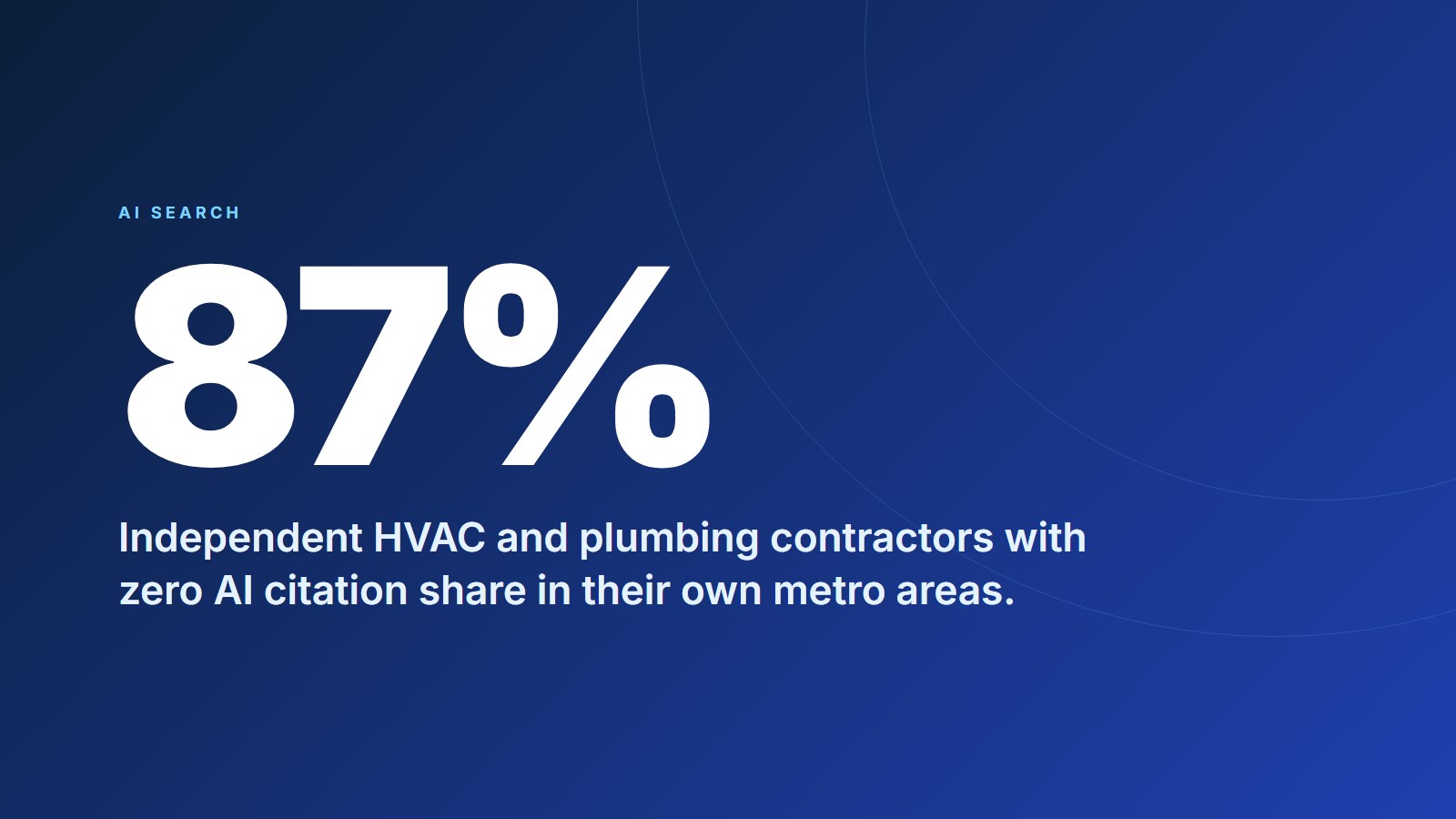
AI search for contractors is the new front door to your business. A May 2026 study published in Plumbing & Mechanical magazine tested 65 consumer prompts across ChatGPT, Claude, Perplexity, and Google AI Overviews. About 87% of independent HVAC and plumbing contractors have zero AI citation share in their own metro areas. The AI genuinely doesn’t know they exist.
That number matters because the audience has moved. According to Contractor Magazine (citing BrightLocal’s 2026 Local Consumer Review Survey), 45% of consumers now use AI tools to find local services, up from 6% a year earlier. Your Google ranking didn’t follow them there.
The Invisible Majority: Most Contractors Have Already Lost Their AI Slot
The research methodology is worth understanding. Plumbing & Mechanical’s 5W HVAC & Plumbing AI Visibility Index ran 65 consumer-style prompts, things like “who’s the best HVAC company in Charlotte” and “find me an emergency plumber in Denver,” across four major AI platforms. Researchers then checked which contractors appeared in the responses.
The pattern was stark. Roto-Rooter, ARS Rescue Rooter, and Mr. Rooter together pulled about 19% of all consumer-intent AI citations across the tested markets. A handful of well-reviewed regional players captured another 8-10%. The remaining 87% of independent contractors pulled zero.
This gap has a structural cause. AI recommendation and Google ranking use different evidence. Google weighs your website content, backlinks, and technical SEO. AI engines weight entity strength: whether your business has been cited by credible third-party sources, whether your data is consistent across directories, whether your review volume is documented across multiple platforms.
A 30-year-old HVAC company in Memphis with 600 Google reviews and a well-ranked website can still have zero AI citation share. Happened consistently in the research.
For a deeper look at how large language models evaluate service businesses, the LLM SEO breakdown for local businesses covers the evidence weighting in detail.
Why Franchise Brands Win Every AI Recommendation You’re Not Getting
The franchise brands dominate AI recommendations for a structural reason. AI systems build their understanding of businesses from the web’s corpus of evidence. Roto-Rooter has Wikipedia pages. National press coverage. Wikidata records. Trade magazine profiles going back decades. Those are entity-strength signals independent contractors simply don’t have.
That doesn’t mean you can’t compete. It means you need to build the signals AI engines use. The evidence layer that gets a Knoxville HVAC company cited in a ChatGPT response to “who does emergency AC repair near Knoxville” is entirely achievable. It just requires knowing which signals matter.
Contractor Magazine notes that AI recommends roughly 1.2% of local businesses. That number sounds discouraging. It’s actually an opening. Contractors who build the right signals right now are capturing citation share before competitors figure out what’s happening.
The contractors seeing AI citation share right now did not get there because they have more reviews than everyone else. They got there because they built the right combination of signals across multiple platforms before anyone else in their market did.
of independent HVAC and plumbing contractors have zero AI citation share in their own metro, based on 65+ consumer prompt tests across ChatGPT, Claude, Perplexity, and Google AI Overviews
Source: 5W HVAC & Plumbing AI Visibility Index, Plumbing & MechanicalThe Four Signals AI Search for Contractors Actually Runs On
Knowing the signals matters. Guessing burns months.
Research from multiple independent sources points to the same four-factor picture:
1. Google Business Profile completeness and freshness. An AI engine pulls from your GBP for basic business data: services, location, hours, categories, photos. A stale profile with outdated hours and no recent photos sends a low-trust signal. Active profiles with posts from the last 30 days, updated service descriptions, and responded-to reviews signal an operating, cared-for business.
2. Review volume and spread across multiple platforms. Your Google reviews matter. So do Yelp, BBB, and Facebook. According to Superpath’s research on contractor AI visibility, review presence across multiple platforms correlates strongly with AI citation rates. AI engines cross-reference sources. A business with 200 Google reviews and nothing else anywhere looks different than a business with 200 Google reviews, 80 on Yelp, and a BBB A+ rating. Both have the same number of Google reviews. Only one has entity coverage.
3. LocalBusiness schema markup. Schema is code that tells AI crawlers exactly what your business does, where you operate, and what you offer. Most contractor websites don’t have it configured. Implementing LocalBusiness, ServiceType, and FAQPage schema on your service pages makes your content parsable. AI engines prefer structured data over unstructured text.
4. Content that directly answers the questions AI gets asked. When a homeowner asks ChatGPT “how much does a heat pump installation cost in Austin,” the AI looks for a local contractor whose content answers that question. Service pages that include specific prices, timelines, and service area details get cited. Generic “we’ve been serving Austin for 20 years” pages don’t.
For more on building review volume and recency at scale, the guide to getting more Google reviews covers the signals that matter most.
What an AI Recommendation Is Actually Worth Per Job
Here’s where the math gets interesting.
RunMarshal and Semrush research found that visitors arriving from AI-generated recommendations convert at 4.4x the rate of standard organic search traffic. The explanation is simple: someone who finds you by Googling “HVAC company” is browsing. Someone who asks ChatGPT “who’s the best HVAC company in Tulsa for emergency AC repair” and gets your name is ready to call. The research phase is already done.
For an HVAC company with a $450 average emergency ticket and a 30% baseline close rate, AI-referred callers would close at roughly 1.32 per inquiry versus 0.30 per inquiry from organic search. At $450 per job, that’s $594 recovered per lead versus $135. Getting recommended five times a day changes the math of your business.
The dynamic favors early movers: the first contractor in a metro to build comprehensive AI citation signals captures a disproportionate share of AI-referred calls before competitors catch on. The window is open right now. It won’t stay open forever.
AI optimization platforms handle the infrastructure, covering review management across platforms, citation consistency, schema implementation, and content architecture. These are the tools that build signals systematically rather than one-off.
Check Your AI Citation Share in 10 Minutes
Before building signals, check where you stand today.
Open ChatGPT, Perplexity, and Google AI Overviews separately. Run 6 to 8 prompts in the style your customers actually use:
- “Who is the best [your trade] company in [your city]?”
- “Find me an emergency [your trade] contractor in [your city] available tonight”
- “Who does [specific service] in [your neighborhood or zip code]?”
- “I need a [your trade] company that can come out this weekend in [your city]”
Screenshot the results. Note which businesses appear. Note whether you appear.
Most contractors running this test for the first time find they appear in zero of eight prompts, even with 400+ Google reviews and strong traditional search rankings. According to Contractor Magazine’s analysis of the behavioral shift, the gap between traditional search visibility and AI citation share is widening across every trade category. That’s the baseline. And it’s recoverable.
For a detailed breakdown of how to structure content specifically for ChatGPT recommendation, the ChatGPT SEO guide for local businesses covers the content signals in depth.
The AI Search for Contractors Signal-Building Plan: Three Months
Building AI citation share is a stacking sequence, not a single afternoon’s work.
Month 1: GBP and Schema Foundation
Audit your Google Business Profile for completeness. Every service listed with a specific description. Current hours, including holiday hours. At least 20 recent photos. Active posts from the last 30 days. Respond to every unanswered review.
Then add LocalBusiness schema to your website. ServiceType schema for each specific service. FAQPage schema on any page with questions. A developer familiar with structured data can typically implement this in a day.
Month 2: Review Diversification
Your review base needs spread. Get Yelp, BBB, and Facebook pages claimed and actively collecting reviews. Homeowner directories like Angi, Thumbtack, and Houzz count as third-party sources too.
The goal is not to abandon Google. It’s to give AI engines multiple independent sources confirming you’re an established, trusted business. One platform with 500 reviews looks weaker than three platforms with 200 each, from an entity-strength standpoint.
Month 3: Content and Citation Layer
Write or update service pages to directly answer the questions AI engines field about your trade and market. Actual prices or price ranges. Service area specifics down to the neighborhood level. FAQ content in plain language.
Get listed in trade-specific directories and local “best of” guides. Those citations are exactly what AI systems pull when forming recommendations.
For specific steps on the ChatGPT recommendation process, how to get recommended by ChatGPT covers the ranking signals with implementation steps.
The contractors seeing the fastest results aren’t doing all three months in sequence. They’re running months one, two, and three simultaneously. The signals reinforce each other.
When the Signals Stack, the Compound Effect Is Real
Take a roofing company in Portland, Oregon with 280 Google reviews, no schema, and no multi-platform review presence, invisible across all eight test prompts. Implement full GBP optimization, LocalBusiness plus ServiceType schema, and active Yelp and BBB profiles, and the realistic 90-day target is showing up in a few of those prompts.
At a $12,000 average roofing estimate and a 25% close rate on AI-referred calls, three additional monthly estimates are worth $9,000. Annually, that’s $108,000 in revenue from a channel the company didn’t exist in before.
The math works because of the conversion rate gap. AI-referred customers arrive having already chosen you. The call is confirmation, not comparison shopping.
- Invisible in 87% of local AI searches across your trade
- Google rankings don't transfer to AI recommendation engines
- Franchise brands capture most AI citation share in your market
- High-intent AI callers go to whoever the AI does recommend
- No visibility into AI referral volume or citation share
- Appears in AI responses for trade-specific local queries
- Consistent citation across ChatGPT, Perplexity, and Google AI
- Multi-platform review spread signals entity trust to AI engines
- AI-referred callers convert at 4.4x standard organic rate
- Trackable citation share that compounds as signals build
How Ignitvio Builds AI Visibility for Contractors
Ignitvio’s Answer Engine Optimization platform constructs the full signal stack AI engines use to recommend contractors.
The platform deploys four components in parallel:
- Review automation across Google, Yelp, and BBB, so every completed job adds to your multi-platform review footprint without manual follow-up from your team
- Citation management that monitors and corrects NAP consistency across 50+ directories, eliminating the conflicting signals that suppress AI recommendations
- Schema implementation across your service pages, with LocalBusiness, ServiceType, and FAQPage schema configured for your specific trades and service area
- AI-ready content architecture that restructures your service and location pages to directly answer the questions AI engines get asked about your trade in your market
The contractors who build this infrastructure now are positioning for a channel shift that is already underway. The ones who wait until competitors appear in AI recommendations will be building from behind.

Jake Melendy
Founder, Ignitvio
Jake Melendy is the founder of Ignitvio. He spent 12 years in enterprise sales and sales leadership, including at Oracle, before building Ignitvio, which runs done-for-you outbound appointment setting for commercial contractors and B2B service companies. He writes about pipeline, trigger-based prospecting, and lead response.