Where to Find Commercial Lawn Care Bids
Owners tell us the same story every spring. The crew is solid, the trucks are paid off, the residential routes are full, and then a big account rolls off or the shoulder season hits and there is nothing in the backlog to keep the guys going. Commercial work would fill the gaps. The only commercial work most of them can find is a bid board, where they are one of dozens of shops bidding blind on price and winning, by their own count, somewhere between one in ten and one in twenty.
Every lawn care owner I know wants commercial accounts. Almost none of them can tell me where those contracts actually get posted. Not the portals, not the timing, not the paperwork.
That gap is the opportunity. Commercial grounds work moves through formal bids: government solicitations, school district RFPs, property management rebids, HOA proposals. Most of it sits on public portals.
Free to read. Updated daily. Your competitors are not looking.
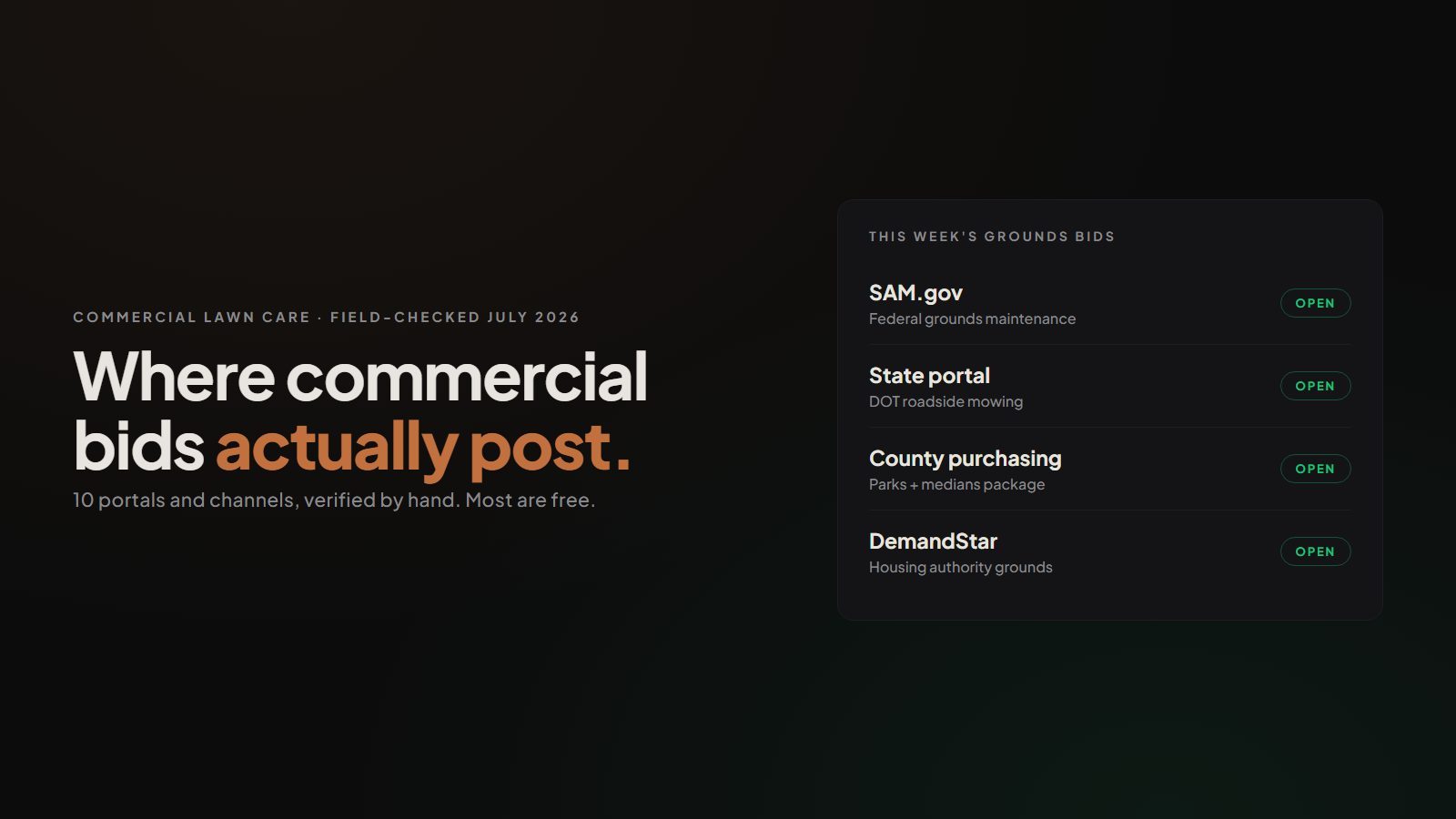
I verified every portal in this guide myself in July 2026. Ten places, how to register for each, and what the competition looks like once you are in.
The size of the U.S. landscaping services market in 2026, split across roughly 556,000 businesses. The commercial slice moves through contracts, and contracts move through bids.
Source: IBISWorld- Government portals (SAM.gov, your state, your city and county) post grounds maintenance bids year-round, and registering is free.
- One e-bidding network, DemandStar, carries solicitations from 1,400+ agencies with a free supplier tier.
- Property managers and HOA management companies award more lawn contracts than portals do, and those bids go out by invitation.
- The best contracts never get posted at all. Proactive outreach to facility and property managers wins them before an RFP exists.
1. SAM.gov, the Federal Bid Firehose
Federal properties in your county need mowing. Military installations, VA campuses, federal courthouses, national cemeteries. Grounds maintenance contracts for those sites post to SAM.gov, the official U.S. government system for federal contracting.
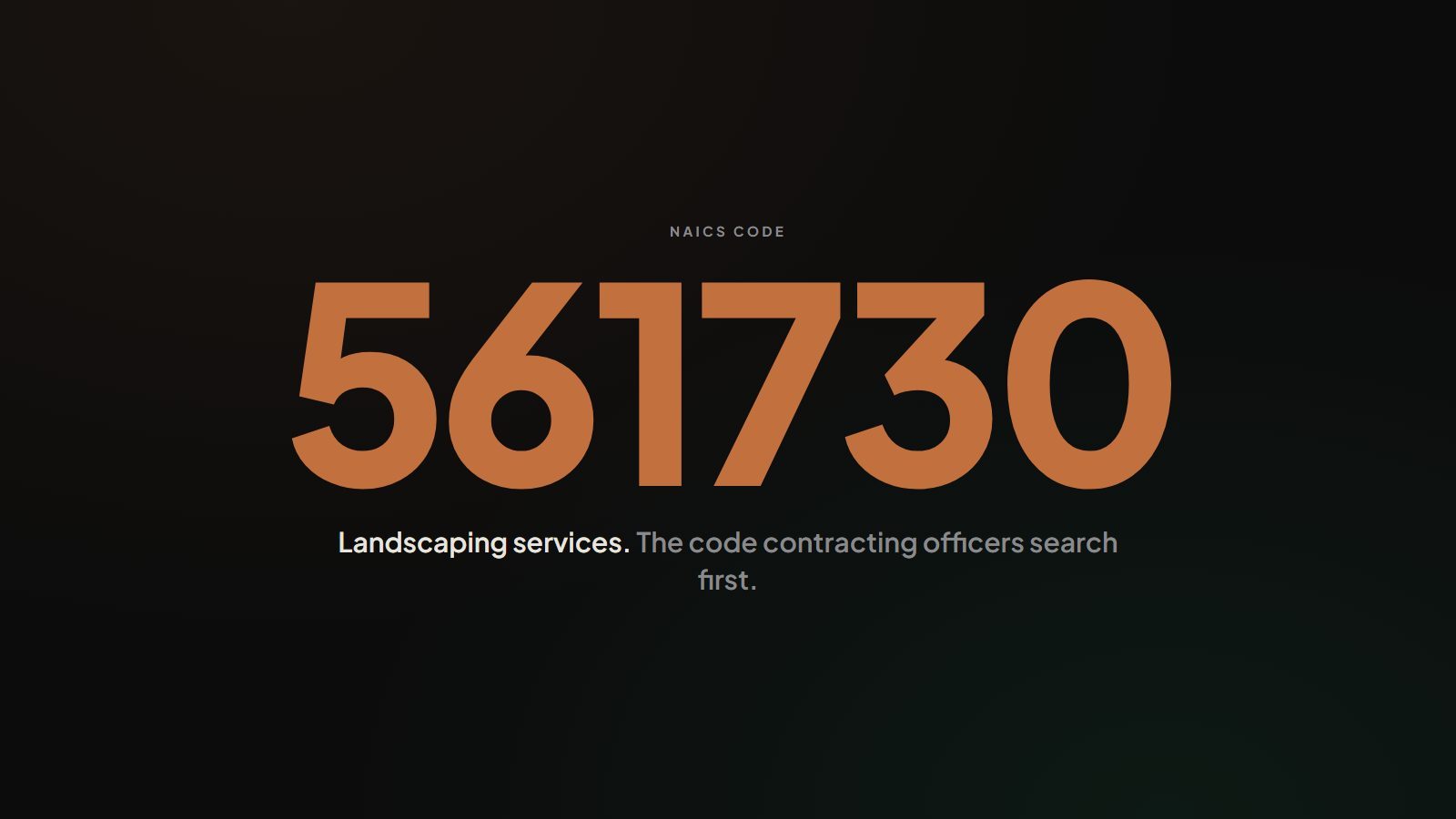
How to register: create an account, get a Unique Entity ID, and complete the entity registration. One afternoon of setup. Free, start to finish. List NAICS code 561730 (landscaping services) so contracting officers can find you. Then save a search for grounds maintenance terms and let the alerts come to you.
The competition: thinner than you would expect outside major metros. Federal paperwork scares off most small operators. Their loss. The ones who push through it keep winning. Many solicitations are set aside for small businesses, so you are often bidding against firms your own size.
2. Your State Procurement Portal
Every state runs one. Grounds contracts for universities, DOT roadsides, state hospitals, and parks flow through it. Texas, for example, posts on the Electronic State Business Daily, and you do not even need to sign in to browse open solicitations.
Find yours by searching for your state’s procurement portal.
Register as a vendor, pick your commodity codes, and turn on email alerts for mowing and landscape maintenance terms. Set it once. No more manual checking.
The competition: statewide firms fight over the big multi-site packages. Single-site contracts near your shop draw much shorter bidder lists. Start there.
Statewide packages draw statewide firms. The single-site contract near your shop draws a handful.
3. City and County Purchasing Pages
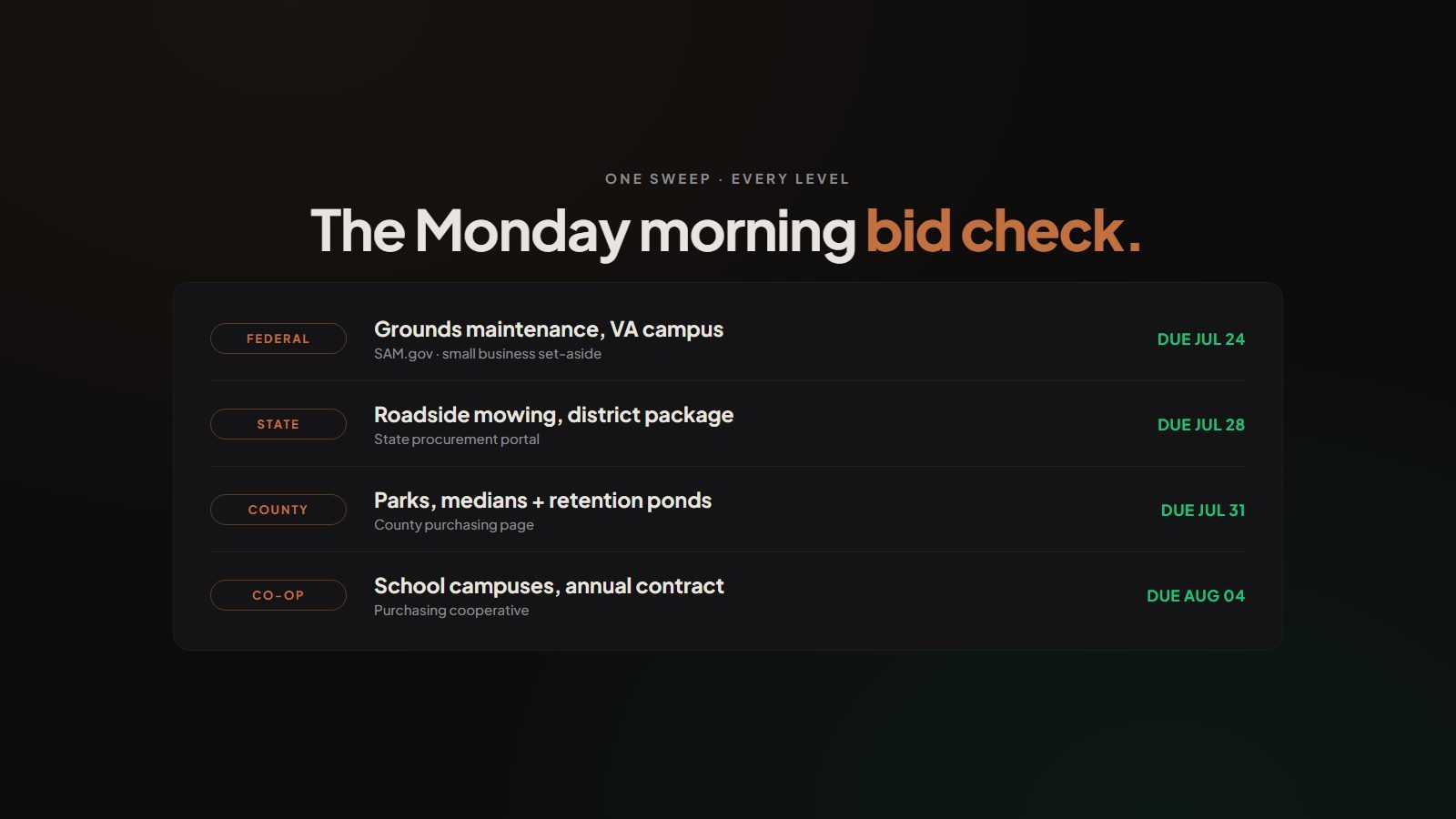
This is the most winnable tier of government work. Parks departments, libraries, municipal buildings, medians, retention ponds, water district easements. Cities and counties mow more acreage than almost any private client, and they rebid it on a schedule.
The system: pull up the purchasing page for every city and county inside your service radius. Bookmark each one.
Check them every Monday morning. Fifteen minutes a week. The whole habit.
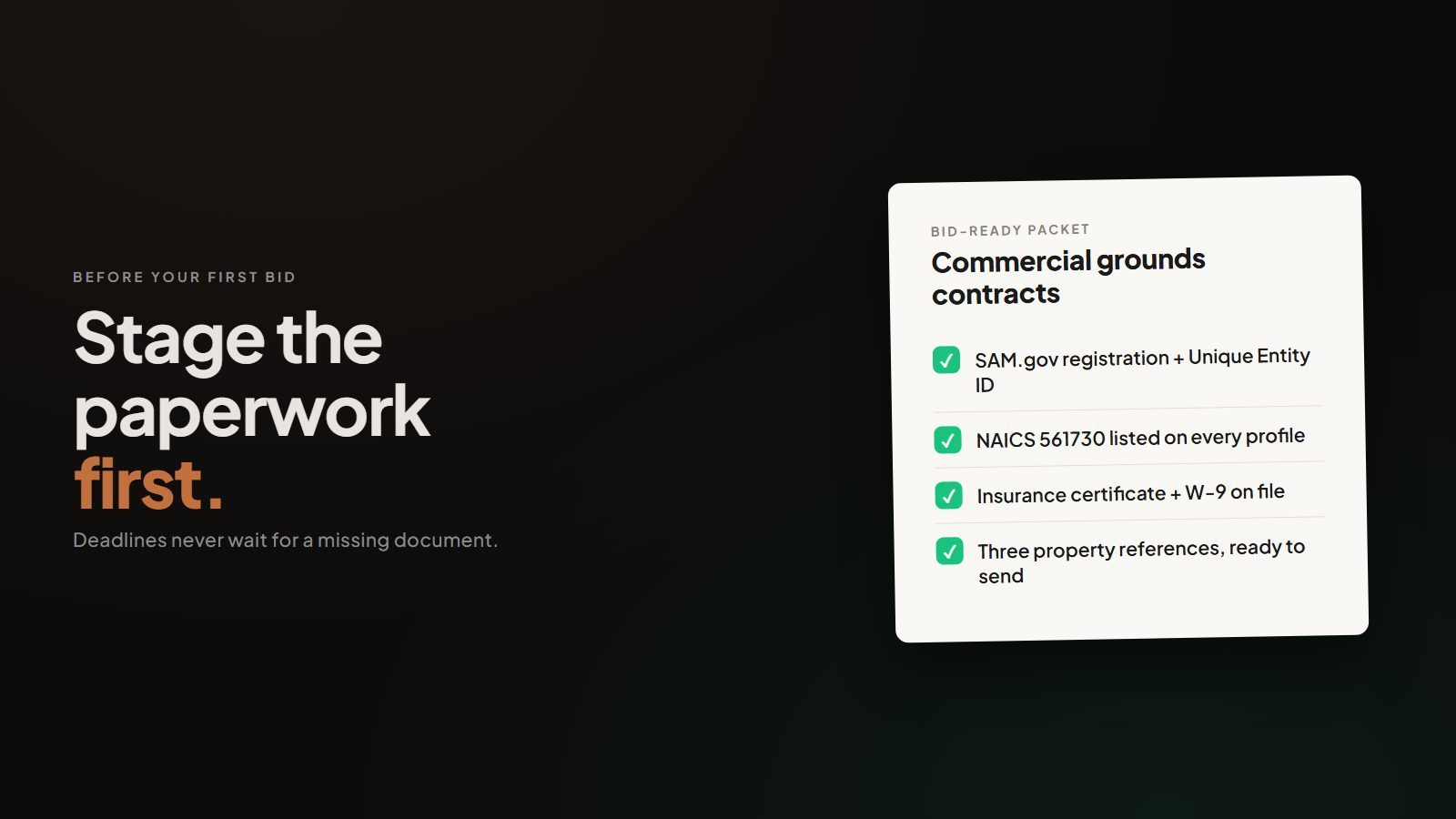
The competition: a handful of local firms, and often just the incumbent. When nobody else shows up, the incumbent wins on autopilot. Be the second bidder and you change the math immediately. Before you submit your first one, stage the boring paperwork so a deadline never catches you flat.
4. DemandStar and the E-Bidding Networks
Instead of checking 30 municipal pages by hand, e-bidding networks pull agencies into one feed. More than 1,400 government agencies post directly on DemandStar, from towns and villages to counties, housing authorities, airports, and school districts. Suppliers can start on a free subscription and get notified the moment a matching bid drops.
How to register: create a supplier account, select your service categories and counties, and let the notifications run. Ten minutes, maybe fifteen.
The competition: broader, because every other subscriber in your category sees the same alert. Speed decides who gets the walk-through. More on that below.
5. School Districts and Buying Co-ops
School districts buy mowing two ways. Some post RFPs on their own procurement pages, usually in late winter for summer work. Others buy through purchasing cooperatives like BuyBoard, where membership is free for schools, cities, counties, and nonprofits, and one awarded vendor contract puts you in front of many buyers at once.
How to get in: watch your local districts’ purchasing pages directly, and respond to co-op proposal invitations when they open.
Becoming an awarded co-op vendor is a longer play. Worth it. Once you are on contract, member districts can buy from you without running a full bid.
The competition: sports fields and campuses are big, visible work, so established firms show up. Smaller districts outside metro areas get far fewer bidders. Same mowing, shorter line.
One co-op award, many buyers. Member districts can purchase from an awarded vendor without running a bid of their own.
6. Property Management RFP Lists
Here is where the volume lives. Commercial property managers control office parks, retail centers, and industrial sites, and they rebid landscaping every one to three years.
Those RFPs rarely hit a public portal. Invitation only. They go by email to a short list of vendors the manager already knows.
So the job is getting on the list before the rebid, and there is a room where those managers gather. BOMA International, the leading trade association for building owners and managers, runs local chapters across the country. Join yours, show up, and become the grounds person every manager in the room recognizes. Face time first, proposals second.
We wrote a full playbook on this relationship channel in our guide to getting commercial landscaping contracts.
Portal bids are public and crowded. Property management bids are private and earned.
7. HOA Management Companies
Homeowners associations outsource vendor selection to management companies, and each management company runs a portfolio of associations. Win one manager’s trust and you inherit their whole book of neighborhoods. Every cul-de-sac of it.
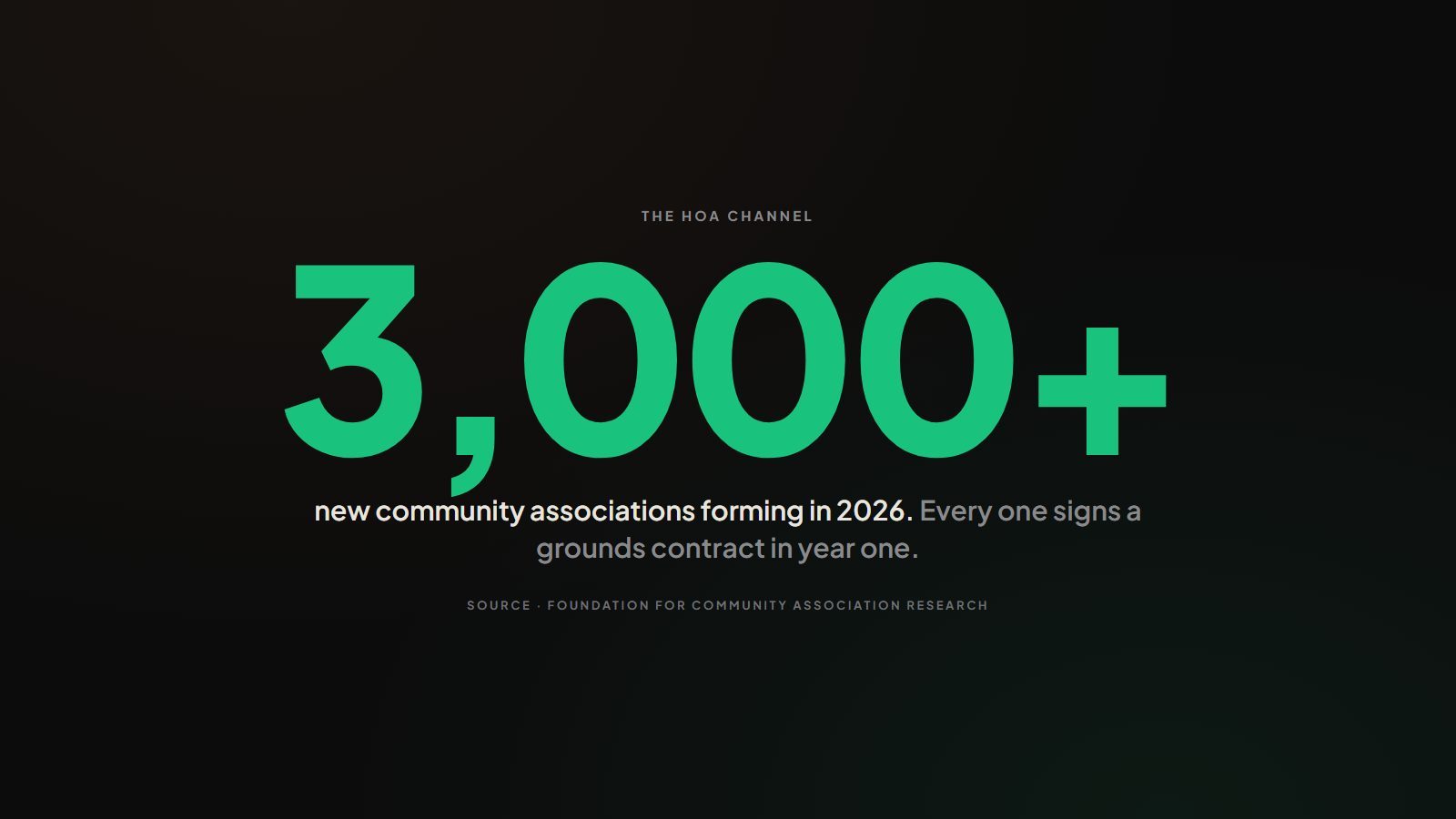
The market keeps growing, too. The Foundation for Community Association Research expects 3,000 to 4,000 new community associations to form nationwide in 2026.
Every one of them signs a grounds contract in its first year. No incumbent to unseat.
How to get in: search for HOA management companies in your city, call each office, and ask how they take vendor bids. Most keep a formal vendor packet. Insurance minimums, W-9, references.
Get your packet on file with five management companies and proposals start arriving without you hunting for them. Five packets. Then wait.
8. Facility-Services Aggregators
National facility-maintenance companies win master contracts with big chains and REITs, then subcontract the actual mowing to local crews. Their contract, your mower. Lessen recruits landscaping vendors into its provider network year-round, and Divisions Maintenance Group runs a become-a-provider program that covers landscaping and snow.
How to register: apply through each company’s provider portal with your certificate of insurance and service area. Standard vendor paperwork, nothing exotic.
The competition: entry is easy, which tells you something. Aggregator work is base-load revenue that keeps trucks busy between better contracts. Fill-in work. Margins are compressed and the terms are theirs. I would not build a company on it, but plenty of owners use it to add route density in a new territory.
Properties served by facility-services aggregator Lessen, which fills the work through a vendor network of more than 30,000 local providers, landscaping crews included.
Source: Lessen9. Construction Bid Boards and Paid Feeds
New commercial construction ends with a landscape install, and installs turn into maintenance contracts. PlanHub puts its network at more than 500,000 general contractors, subcontractors, and suppliers, with a dedicated landscaping lane where GCs post funded commercial projects. Funded, not hypothetical.
Paid aggregators round out the stack. Find RFP indexes lawn care and grounds keeping bids across federal, state, and local governments. One search, every level.
One caution: paid feeds sell convenience, not exclusive inventory. Nearly everything they list is public somewhere. Same bids, nicer wrapper.
Pay for a feed when the weekly sweep stops fitting in fifteen minutes. Not a day before.
The Bids Go to Whoever Answers First
Getting on the list is half the game. Here is the other half, and almost everybody blows it.
In May 2026 we ran an inbound response test in a neighboring trade. We contacted 102 roofing companies across Dallas-Fort Worth as a buyer with a real roof problem and tracked who answered and who called back. 56% never picked up or called back.
Among the companies that did respond, the median callback took 31 minutes, and we measured a 30x gap between the fastest and slowest responders. Thirty-one minutes. For a buyer holding a job. The full method and numbers are in the DFW roofing response study.
More than half of an entire market never responded to money calling them. That is the bar you are competing against.
Those were roofers answering homeowners. The property managers who award grounds contracts hire from that same pool of local vendors, and they behave the same way homeowners do. Same instinct, bigger budget. They shortlist whoever answers, and the walk-through goes to whoever answers first.
If a bid alert sits in your inbox until Friday, you built the pipeline and then handed it away. Friday is too late.
A Conversation Instead of a Competitive Bid
Owners who have lived on the bid boards describe the same pattern. The spec is already written by the time they see it, the incumbent helped write it, and dozens of shops are pricing the same scope blind. More often than they would like, the manager already knows who is getting the work, and the other bids exist to keep that number honest. The bids that turn into accounts start earlier, when you get in front of somebody before the RFP exists and the conversation is about the property, the crew, and what the last contractor kept missing. Price comes up last, and you are the only bid in the room.
Answering fast is the part any organized office can fix. The harder half is the calendar that never rings on its own: the property managers and facility directors who will rebid grounds next season and have no reason to call you first. That is the gap done-for-you appointment setting fills in the trades. Somebody works those decision-makers by phone, email, and LinkedIn and books the walk-through before the RFP is written, while your crews stay on mowers. How that runs for grounds companies is on our commercial landscaping leads page.
- Every competitor sees the RFP the same day you do
- The incumbent helped shape the spec you are bidding on
- Price becomes the only lever left
- Pipeline goes quiet between bid seasons
- You meet decision-makers before the rebid is written
- Walk-throughs happen on your calendar, not award season
- Scope gets discussed before price does
- Meetings land year-round from trigger-based outreach
10. The Bids That Never Get Posted
Most commercial lawn care agreements never touch a portal.
A distribution center opens on the edge of town. An office park changes management companies. A medical campus adds a building.
Within weeks, somebody signs a grounds contract, and the only companies considered were the ones that reached out while the concrete was still curing. No RFP. No posting. No bid deadline.
The same change events cut the other way, and owners tell us that is how they lost the accounts they never expected to lose. The mowing was fine for years. Then a new property manager arrived, or a new management company took over the portfolio, or the building sold, and the thirty-day notice came with it. Nobody at the shop saw it coming because nobody was watching. Those same signals, watched on your competitors’ accounts instead of your own, tell you exactly when an incumbent is exposed, and almost nobody in lawn care tracks them.
That is trigger-based outreach: watch for buying signals (new facility openings, expansions, lease events, hiring surges), identify the facility manager or property manager, and send a short, specific email asking for a walk-through. One signal, one decision-maker, one short email.
You can run this yourself with Google Alerts, a spreadsheet, and ten emails a week. Ten. That is the whole cadence. And if you are still filling residential routes, start with our guide on how to get lawn care customers before chasing contract work.
When the Owner Is the Only One Selling
A word on fit first. Everything above this line, the small business set-asides, the single-site municipal bids, the aggregator fill-in work, is how a two-crew operation grows into a real commercial book. Run the ten-email cadence yourself at that stage. It works, and it costs you an hour a week.
Done-for-you outbound is built for the company on the other side of that climb: commercial landscaping and grounds companies above $3M in revenue, with the crews and account management to absorb new contracts without dropping the ones they already have. At that size the constraint is the owner’s calendar, and the ten emails a week stop happening the first month a storm or a hiring gap eats the week.
Owners at that size tell us the same two things. They are the only one selling, and prospecting is the first job that falls off the truck when the week gets busy. And the accounts that drift in on their own from portals and aggregators run small: single-site, one-visit-a-week properties that take the same estimating, scheduling, and management attention as a forty-acre campus and never pay it back. The work is getting in front of the people who sign the bigger contracts, on purpose, every week, while you run the company.
This is the system we run at Ignitvio as commercial landscaping lead generation. We watch the trigger data across your service area: permits and zoning approvals, building sales, lease events, personnel and management-company changes, and the contract renewal dates that tell you when an incumbent is exposed. We build verified lists of the facility managers, property managers, and owners who actually sign grounds contracts. Then a dedicated human caller, one person assigned to your account rather than a call center or an AI dialer, works those lists by phone, backed by cold email and LinkedIn, and books the walk-through straight onto your calendar.
Done-for-you outbound
Where done-for-you outbound fits
Ignitvio runs outbound for you: a dedicated human caller (never a call center, never AI dialing) working alongside cold email and LinkedIn, armed with trigger data such as permits, zoning approvals, personnel changes, building sales, lease events, and contract renewal dates. Every meeting is qualified against criteria we agree on up front and approved by you before it counts. The qualified-meeting minimum goes in writing, and if we miss it we keep working at no charge until it is hit.
-
We qualify
Every prospect is screened against criteria we agree on with you up front.
-
You approve
A meeting counts toward the minimum only after you sign off on it.
-
You close
Your team runs the meeting and the deal. We keep the calendar full.
Built for commercial landscaping companies above $3M.
A qualified meeting means the right decision-maker, a property that fits your size and service area, and a genuine agreement to the call. No coffee chats. Every meeting is screened against criteria we agree on with you up front, and you approve it before it counts toward the minimum. We put that qualified-meeting minimum in writing, and if we miss it, we keep working at no charge until it is hit.
The story we hear most from owners who have paid for meetings before goes like this. They drove to a walkthrough, and the manager did not know who they were, or had only said yes to get the caller off the phone, or was not the person who signs, or never showed up. The invoice arrived anyway, and the refund took months of fighting. Everything about how a meeting gets approved here exists because of that story.
So, the answers to the questions those owners ask next. The caller is a person, US-based, assigned to your account, and trained on your services, your minimums, and your service radius in your own words, never an AI dialer and never a rotating call center. Qualified is never the honor system: you see every meeting before it happens and pick one of three options, approve it, send the caller back for more information, or cancel it at no charge. Callers are not commissioned on meetings that miss the criteria, so nobody on our side is paid to push a maybe onto your calendar, and no-shows are not billed. The refund on the build fee is written into the contract at an agreed gate, and we take one client per vertical per metro, so your caller is never dialing the same property managers for a competitor across town.
What should a working system produce? At typical volumes, expect a trigger-based campaign to land 8 to 15 qualified meetings a month, and owners who close 20 to 30 percent of those sign 2 to 4 new contracts. Directional math, offered as illustration only.
The number that lives in writing is the meeting minimum, never a revenue or close figure. Your closing does the rest. A commercial roofing company running this program closed its first deal inside 45 days and cleared 100%+ ROI before its second milestone payment came due. Different trade, same buyer pool of property and facility managers. How we think about pipeline across the trades lives on our lead generation hub.
If you would rather see the raw material before a call, the Free Pipeline Audit pulls a sample prospect list and trigger map for your metro and runs a lead response check on your own inbound, so you can judge what a full program would run on.
Portals hand you the bids everyone can see. Outreach hands you the ones nobody else knows exist.
Want a pipeline beyond the bid boards?
Fifteen minutes to see whether trigger-based outbound can hit a written meeting minimum in your market.
Book a 15-Minute Fit CallFrequently Asked Questions
Where can I find commercial lawn care bids for free?
How do I bid on government lawn care contracts?
What do I need before submitting a commercial lawn care bid?
When do commercial lawn care contracts go out to bid?
Can a small lawn care company win commercial bids against big regional firms?
What counts as a qualified meeting in commercial lawn care lead generation?
Is it a person cold calling or is it AI?
What if I show up and the manager says the caller was persistent and told them I was just in the area? Do I still pay?
Will you work with my competitor in the same city?
Above $3M and want to see the raw material first?
A sample prospect list and trigger map for your metro, plus a lead response check on your own inbound. Delivered within five business days.
Get My Free Pipeline Audit
Jake Melendy
Founder, Ignitvio
Jake Melendy is the founder of Ignitvio. He spent 12 years in enterprise sales and sales leadership, including at Oracle, before building Ignitvio, which runs done-for-you outbound appointment setting for commercial contractors and B2B service companies. He writes about pipeline, trigger-based prospecting, and lead response.