How to Get Commercial Landscaping Contracts
Ask landscaping owners how commercial work comes in and the story is usually the same. The owner is the only one selling, so prospecting happens from the truck between jobs. The contracts that do get chased come off a bid portal: price it blind against nine other crews, lose to the low bid, repeat next fall, and count a one-in-ten hit rate as a decent year. Then a property held for years walks out the door because a new manager came in and rebid it, and nobody saw it coming.
The companies building real commercial books get in front of the property manager before the bid exists, so the first meeting is a conversation instead of a competitive bid.
I run outbound campaigns for local-service companies, and commercial landscaping is one of the cleanest markets I have studied. The contracts are big, they renew every year, and the buyers are reachable by name. Here is who signs the check, when contracts go to bid, and the exact math on a 6-acre office park.
- Three buyers sign almost every commercial landscaping contract: HOA boards, commercial property managers, and municipal procurement offices.
- Bid season peaks in the fall. Contracts priced in October typically start January 1, while municipal fiscal years often start July 1.
- Price from a site walkthrough, never from an aerial photo. Cost-up math (labor, drive time, equipment, overhead, margin) beats per-acre guessing.
- The fastest path to new contracts is direct outreach to named decision-makers, timed to triggers like new construction, management changes, and budget season.
Who Actually Signs Commercial Landscaping Contracts
Landscaping in the US is a $176.7 billion industry in 2026, per IBISWorld, and the commercial side runs through a surprisingly small set of buyers. Learn the three and you know where every contract in your city comes from.
HOA and community association boards. The board votes on the contract, but the community association manager (CAM) builds the shortlist. Win the CAM and you are one presentation away from a multi-year agreement.
Community associations operate in the US, housing 78.1 million residents. More than a third (35.2%) of American housing sits inside an association.
Source: Foundation for Community Association ResearchCommercial property managers. Office parks, retail centers, medical campuses, industrial sites. A portfolio manager at a regional management firm might oversee 15 to 40 properties, and they buy in bundles. One relationship can hand you six sites.
Municipal and institutional grounds. Parks departments, school districts, county facilities. Formal procurement: sealed bids, published RFPs, lowest responsive bidder. Slowest sales cycle of the three. Stickiest revenue once you are in.
And the competition? IBISWorld counts 556,238 landscaping businesses in the US in 2026. The overwhelming majority never send a single proposal to any of these buyers. That gap is your opening.
Bid Season Runs on the Buyer’s Calendar, Not Yours
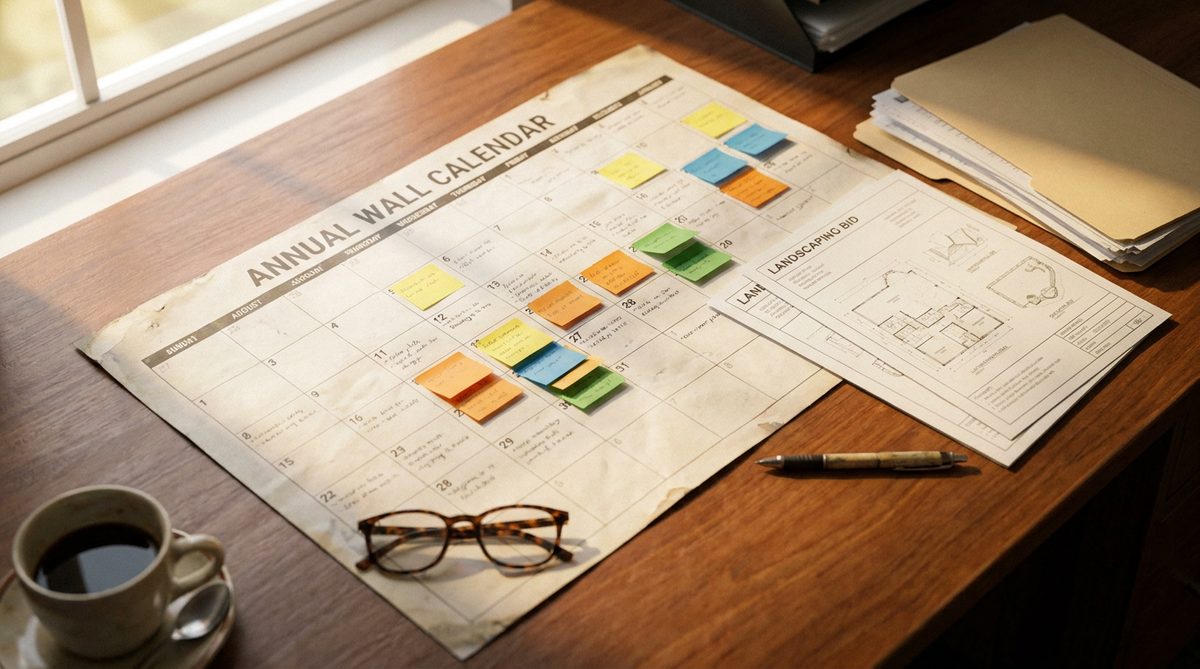
Commercial landscaping contracts move on a schedule, and the buyer’s budget cycle sets it.
HOA boards build next year’s budget between September and November. Grounds care is one of the biggest recurring line items, so when a board rebids the contract, the RFP goes out in late summer or early fall, the award happens by December, and the new vendor starts January 1.
Office and retail property managers run a similar calendar because their operating budgets reset with the new year. Municipal buyers are the exception: most city and county fiscal years start July 1, which puts their RFP windows in late winter and early spring.
The contract you want to mow in March was priced in October and signed in December.
Miss the window and you wait a year. So work backward. Introduce yourself in spring and summer, walk properties in early fall, submit in October.
Two documents will be demanded before anyone signs, according to Insureon’s guidance on landscaping contracts: a certificate of insurance before you are hired, and bonding on many commercial and government jobs. Line both up before bid season. A CAM will not hold a board vote while you shop for coverage. Paperwork wins tie-breakers.
Off-cycle openings exist too: a management-company change, a vendor fired after botching storm cleanup, a new CAM who wants to rebid. And if you want the portal route as well, here is how to find commercial lawn care bids before they go stale.
The Site Walkthrough Is Where Bids Are Won
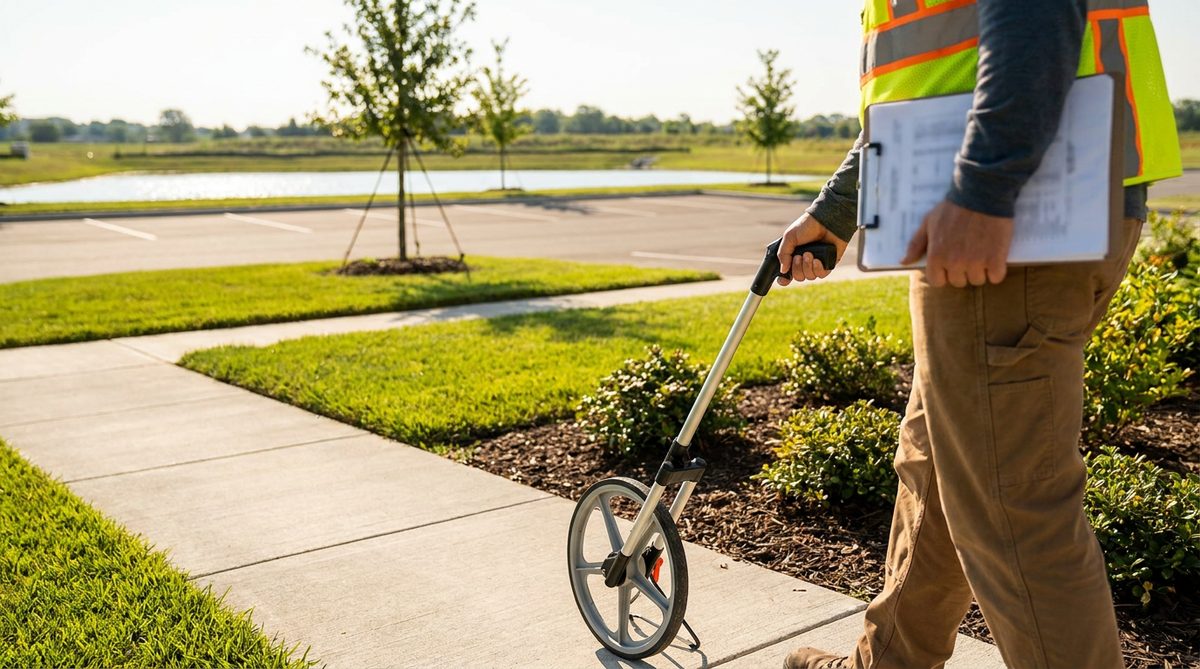
Never price commercial work from an aerial photo. Satellite turf looks flat, obstacle-free, and irrigated. Real properties are none of those things.
Walk every property with a checklist and a measuring wheel:
- Mowable turf acreage, not parcel acreage. A “10-acre property” is often 6 acres of actual turf.
- Linear feet of edging along curbs, walks, and beds. Edging is the labor sink nobody prices.
- Bed square footage and mulch depth. Mulch is your enhancement upsell in month three.
- Obstacle density: parking islands, dumpster corrals, signage, retention ponds, playgrounds.
- Slope, drainage, and anything a 60-inch deck cannot reach.
- Irrigation age and controller condition. An old clock means repair revenue later, and complaints you will inherit now.
- Gate widths, trailer parking, and traffic exposure for the crew.
Then interrogate the property manager, politely. What did the last vendor miss? What generates complaints? What is the budget window? Who besides them touches this decision?
Those four answers are worth more than the measurements.
Here’s the thing. The walkthrough is also your sales call. You are showing the manager how you think before they ever see a number.
Per-Acre Bid Math: A Worked Example
Let’s run the numbers on a realistic example: a 6-acre office park in Charlotte, weekly service April through October, biweekly the rest of the year, 38 visits a year.
- Crew: 3 people at a fully loaded $26 per hour each, so $78 per crew-hour.
- On-site time: 2.5 hours per visit to mow, trim, edge, and blow. That is 7.5 labor-hours, or $195.
- Drive time: 30 minutes round trip for the crew, about $39.
- Equipment, fuel, and consumables: $36 per visit.
- Direct cost per visit: $270.
- Overhead at 25% of direct cost: $68 more, so break-even lands at $338.
- Add a 15 to 20% margin: the bid comes out between $395 and $405 per visit. Call it $400.
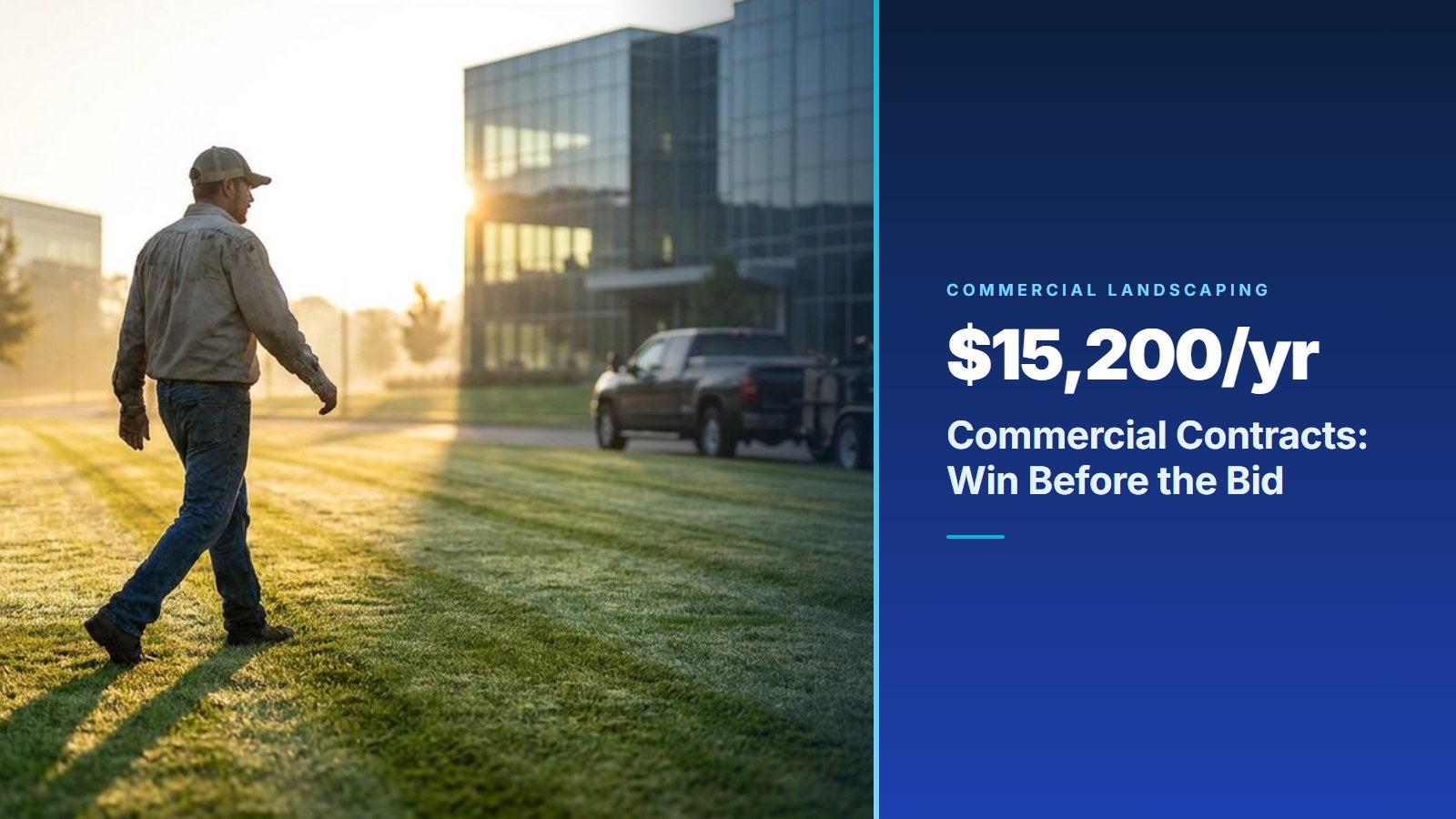
38 visits at $400 is a $15,200 annual contract, usually billed as 12 equal monthly payments of about $1,267. Sanity-check it per acre: $400 across 6 acres is roughly $66 per acre per visit, a defensible number for an obstacle-heavy office park.
Bottom line: cost-up first, per-acre second. Pricing from someone else’s per-acre chart means bidding a competitor’s cost structure with your payroll.
Small accounts eat the same energy as big ones
Run the same math on a strip center that wants a bed cleanup once a month and you will see why owners describe the same problem over and over: the little accounts get the same walkthrough, the same proposal, the same invoicing, and the same share of the owner’s attention as the office park, and they never pay it back. The contract worth chasing is the one that fills a crew-day and keeps the crew going on a route, which is why the target list matters more than the bid count. Twenty properties that could each absorb a crew-day beat a hundred that cannot.
How to Grow a Commercial Landscaping Business
Referrals top out. A CAM who loves your work can hand you two more properties, and then you are back to waiting. Three levers actually grow a commercial landscaping business past that ceiling.
Density over spread. Five contracts in one submarket beat five scattered across the metro. A crew mowing three adjacent office parks bills seven hours a day; the same crew crossing town bills five.
Windshield time is unbilled payroll.
Revenue per crew-hour, not headcount. Labor is the constraint everywhere. Jobber’s industry statistics roundup counts 1,296,100 landscaping and groundskeeping jobs in the US, with only 65,200 more projected through 2033. You will not out-hire that market, so grow what each crew produces through dense commercial routes. Still building the residential base that funds the push? Start with how to get lawn care customers.
A proactive pipeline. This is the lever most owners never pull, and it separates the regional players from everyone stuck at three trucks.
The bar in the green industry is low, and there is trade data on exactly how low. Valve+Meter submitted web-form inquiries to more than 450 home services companies, lawn care professionals included, and tracked who answered.
Up to this share of outdoor services companies were not responding to customer inquiries within five days of receipt, per Valve+Meter research covering more than 450 home services companies. Only 60% of the contractors responded at all, and 55% of those that did took at least one full day.
Source: Green Industry Pros, reporting Valve+Meter researchUp to four in ten outdoor services companies went invisible the moment a buyer reached out. Answering the same day puts you in the top half of your market by default.
Property managers live this from the other side. Ask one how many of their vendor emails ever get a reply, let alone a same-day one. Answering a property manager the same day is a competitive weapon that costs nothing, and it is the inbound half of the commercial landscaping lead generation system: outbound fills the calendar, and fast inbound response keeps the CAM who found you on their own from calling the next crew.
Follow-up matters just as much after the proposal. Aspire’s bidding guide notes that clients may hold onto a proposal for weeks or months before they have the resources to sign a contract. Silence is normal. Plan five touches over 60 days, then a check-in every quarter until budget season.
Decision-Maker Outreach That Gets Walkthroughs

The direct path to commercial landscaping contracts is a list of named decision-makers and a reason to email each one this week.
Build the list
Pull every office park, retail center, HOA, and medical campus in your service area. Then find the human behind each one: the portfolio property manager, the community association manager, the facility director. Twenty properties, twenty names, twenty verified emails. That is a week-one list.
Time it to a trigger
Cold outreach lands when something just changed:
- A new building or phase opened with no grounds vendor history.
- The property switched management companies, which voids old vendor loyalties.
- A new CAM inherited the portfolio. New managers rebid contracts to make their mark.
- Budget season. A September email lands on a desk that is actively pricing next year.
- Visible neglect: a dead turf median, unedged walks. Photograph it and mention it kindly.
Property managers do not wake up thinking about their landscaper. They wake up thinking about the complaint email from building two.
So write the email about their building. Three sentences: the trigger you noticed, one specific observation from their property, and an ask for a 15-minute walkthrough. No brochure attachment. No services paragraph.
- Find RFPs after every competitor already has
- Price blind against 8 to 10 low bidders
- One shot per property per year
- Win rate rides on being cheapest
- Pipeline stalls between bid seasons
- Reach the decision-maker before the RFP exists
- Walk the site and help shape the scope
- A reason to email 20 buyers every week
- Win rate rides on relationship and fit
- Walkthroughs booked year-round
Doing this every week is a part-time job on its own, which is why appointment-setting services and done-for-you outbound shops exist for the trades. Janitorial companies run the identical play on the same property managers; see how to get commercial cleaning contracts if you doubt the pattern travels.
What a Done-for-You Pipeline Looks Like
This is the work we do at Ignitvio for commercial landscaping companies. Everything above is the play. This is who runs it, what feeds it, and how it gets measured.
The engine is three channels working one list. A dedicated human caller works your market: one person who learns your service area and your property types, never a call center and never an AI dialer. Cold email and LinkedIn run alongside the calls, so the CAM who lets a voicemail sit sees the same name in two other places that week. The caller matters more in this trade than most. A property manager can leave an email unanswered for a month, while a phone conversation can put a walkthrough on the calendar in one exchange that email might take five touches to earn.
A conversation instead of a competitive bid
Owners tell us the same story about the account they lost: a new manager came in, rebid it, and the notice showed up before anyone knew there had been a change. Almost none of them track when the contracts they lost come up for renewal, either. The fix for both is the same thing that feeds the caller: trigger data, so the first meeting is a walkthrough and a conversation months before an RFP exists. Commercial landscaping throws off more of it than most trades:
- Permits and certificates of occupancy on new office parks, retail centers, medical campuses, and residential phases: properties with no grounds vendor history.
- Zoning approvals and site-plan filings, which surface a project months before there is turf to mow.
- Building sales. A new owner inherits the old vendor and usually rebids within the first year.
- Lease events. A new anchor tenant or a full-building lease changes who cares about curb appeal, and how much.
- Personnel changes. A new CAM, portfolio manager, or facility director, and new managers rebid to make their mark.
- Contract renewal dates, so the outreach lands 60 to 90 days before the incumbent gets re-signed instead of after.
- Management-company changes and expansions. A switch voids old vendor loyalties; an expansion adds acreage the incumbent never priced.
Every one of those becomes a reason to call a named decision-maker this week, with a specific building in the first sentence.
Done-for-you outbound
Where done-for-you outbound fits
Ignitvio runs outbound for you: a dedicated human caller (never a call center, never AI dialing) working alongside cold email and LinkedIn, armed with trigger data such as permits, zoning approvals, personnel changes, building sales, lease events, and contract renewal dates. Every meeting is qualified against criteria we agree on up front and approved by you before it counts. The qualified-meeting minimum goes in writing, and if we miss it we keep working at no charge until it is hit.
-
We qualify
Every prospect is screened against criteria we agree on with you up front.
-
You approve
A meeting counts toward the minimum only after you sign off on it.
-
You close
Your team runs the meeting and the deal. We keep the calendar full.
Built for commercial landscaping companies above $3M.
The questions that come up on almost every fit call get answered here, before you ask. The person on the phone is a US-based caller on our team, trained on your property types and your talk track, and assigned to your account; we do not run an offshore call center and we do not use AI dialing. Whether a meeting counts is never left to the honor system: before anyone drives to a walkthrough you see the meeting and pick one of three options, approve it, send the caller back for more information, or cancel it at no charge, and callers are not commissioned on meetings that fail the criteria, so they are paid to disqualify. The refund election on the build fee is written into the contract at an agreed gate rather than promised on a call. And we take one landscaping company per metro, so every walkthrough booked in your market goes to you.
The guarantee is structural. We agree on a qualified-meeting minimum in writing, and if we miss it, we keep working at no charge until we hit it. Every meeting is qualified against criteria we set together, and you approve it before it counts toward that minimum. We never guarantee revenue or closed contracts, and you should distrust anyone who does, because no outreach firm controls your close rate.
What does good look like? Treat any number here as arithmetic rather than a promise. Our commercial landscaping page illustrates a healthy trigger-based campaign at 8 to 15 qualified meetings a month, so take the middle of that range: 10 qualified walkthroughs in a month, close 2 of them, and at the $15,200 contract size from the worked example above, that single month of pipeline adds over $30,000 in annual contract value. Owners judge this in months to payback, and that is the right lens; the fit call is where that math gets run on your numbers instead of ours. Every market is different, which is why the minimum gets scoped per engagement rather than quoted in a blog post.
A qualified meeting has a strict definition, by the way: the right decision-maker for your target property type, a property that fits your crew capacity and service area, and a person who genuinely agreed to the call. A no-show harvested from a purchased list counts toward nothing, and neither does a meeting you reviewed and rejected. Neither does the walkthrough where the manager only said yes to stop the calls, or the one where the person you met turned out to have no say over the vendor.
One fit note before you book, because this post has two readers. The program is built for commercial landscaping companies above $3M in revenue, with the crews and estimating bandwidth to absorb two to four new commercial contracts a month; below that, run the outreach play above yourself, keep the lawn care customer engine funding the push, and come back when the trucks are there.
Want walkthroughs on your calendar instead of bid-portal alerts?
Fifteen minutes, no deck. We look at your service area, tell you what trigger volume looks like there, and whether a meeting minimum makes sense for your property types.
Book a 15-Minute Fit CallFor the full breakdown of targeting, cadence, and the guarantee, see the commercial landscaping lead generation page, or the broader lead generation hub for how the same engine runs across other trades.
Frequently Asked Questions
How do commercial landscaping contracts work?
How do you bid on commercial landscaping jobs?
How profitable are commercial landscaping contracts?
When do commercial landscaping contracts go out to bid?
How do I get government or municipal landscaping contracts?
What is a qualified meeting in landscaping lead generation?
What if I show up and the property manager says your caller was persistent and I was just in the area? Do I still pay?
Does a meeting with a property manager count, or does it have to be the owner?
What if you book more walkthroughs than my crews can staff?
Want to judge the targeting before you book anything?
A sample prospect list and trigger map for your metro, plus a check on how fast your own inbound inquiries get answered. Judge the targeting yourself, then decide.
Get the Free Pipeline Audit
Jake Melendy
Founder, Ignitvio
Jake Melendy is the founder of Ignitvio. He spent 12 years in enterprise sales and sales leadership, including at Oracle, before building Ignitvio, which runs done-for-you outbound appointment setting for commercial contractors and B2B service companies. He writes about pipeline, trigger-based prospecting, and lead response.