How to Get Lawn Care Customers Fast
- The fastest first customer comes from the doors around lawns you already mow. Same day. Zero dollars.
- 97% of consumers read reviews for local businesses, so the Google map pack decides who gets the call.
- Residential fills a route. Commercial accounts (HOAs, office parks, retail centers) can bill 12 months a year and renew in writing.
- Commercial grounds contracts get decided months before the RFP. HOA boards approve next year’s budget between July and October, so a January start is usually won in September.
Your trailer is loaded by 6
in the morning and the route has nine lawns on it. The truck is paid off, the work is good, and the schedule still has holes you could park a skid steer in.The holes are a selling problem, and the seller is you. Owners tell us the same story: the referrals that built the first route have flattened out, the phone rings while you are on the mower, the estimate gets written at nine at night, and every hour spent trying to get in front of somebody is an hour the crew is not billing. This list is written for that owner.
Lawn care sits inside a $188.8 billion landscaping services industry in 2025, per IBISWorld figures compiled by LawnStarter, and the National Association of Landscape Professionals counts roughly 661,000 landscaping businesses fighting for it, per figures compiled by Jobber. Plenty of pie. Brutal competition for every slice.
Here are 10 ways to get lawn care customers, ranked by how fast each one puts a paying name on your schedule. The first five are residential quick wins you can run this week. The last five build commercial accounts: slower to land, and worth 10 to 60 lawns apiece once you do.
Ranked by speed, split by ceiling
One filter for the whole list: how many days between working the tactic and cashing the first check.
Door knocking pays this afternoon. A Google review flywheel takes a month to spin up. A trigger-based outreach system takes a few weeks to book its first meetings, and then it compounds.
The second filter is ceiling. A residential lawn bills $40 to $60 a cut for a 28-week season in most of the country. A commercial property bills every month of the year and renews on paper. Keep both filters in mind as you pick.
1. Knock the doors around every lawn you already mow
Speed: same day.
You are already on the street. Your truck is parked in front of visible proof of your work, and the three houses on either side can hear your mower running.
Knock before you load the trailer. Twenty seconds: you mow the lawn two doors down every Thursday, you have room on the route, and you can quote their yard right now while you are standing on it.
The cheapest customer you will ever land lives 40 feet from a lawn you already mow.
Do the math. Angi data compiled by Jobber puts average homeowner spend at $300 a month for general landscaping services. Ten minutes of knocking to add a $3,600-a-year route stop is the best hourly rate in this industry.
2. Post where your neighbors actually talk
Speed: 24 to 72 hours.
Nextdoor reaches 90 million users, and 77% of them are homeowners, per Nextdoor’s own business data. Local Facebook groups run the same way: someone posts “anyone know a lawn guy?” and the first credible reply usually gets the job.
Set alerts. Answer those threads within minutes, with a photo of your work and a real price, and you will out-convert every competitor who replies tomorrow.
Those threads are decided inside the first hour.
Post your own before-and-after shots once a week and skip the sales pitch. A striped lawn photo captioned “opened two Thursday slots in McKinney” does the selling for you.
3. Text every quote that went quiet
Speed: 2 to 5 days.
Go back 18 months. Every estimate that never answered, every “let me think about it,” every one-time cleanup that never became a weekly cut. That list is warmer than any ad audience you will ever buy.
One text: you have slots opening on their street this month, and you will honor the old quote for two weeks. Send 50 of those and the phone moves.
Phone tag kills quotes. Text threads keep them alive.
4. Stack Google reviews until you own the map pack
Speed: 2 to 4 weeks to visible movement.
of consumers read online reviews for local businesses, per BrightLocal's 2026 Local Consumer Review Survey. In lawn care, the profile with the most recent reviews gets the call.
Source: BrightLocalThe tactic is boring and it works: ask for the review at the moment of the compliment. Customer says the yard looks great, you text them the Google link before you pull away from the curb.
Two reviews a week beats a burst of 20 in March, because recency works as a ranking signal and a trust signal at the same time.
Reply to every single one. Prospects read your replies to gauge how you will treat them the first time a mow gets skipped.
5. Door hangers, but only around active jobs
Speed: 1 to 3 weeks.
Blanketing a zip code with door hangers is a donation to the print shop. Response rates on cold drops run low single digits at best, and you eat the drive time on every stray call that does come in.
A tight radius changes the economics. Thirty homes around every active job, hung the same day you mow, with the customer’s street named on the card. Hung that way, the card reads as a neighbor’s endorsement instead of an ad.
Density is the hidden profit lever anyway. Three customers on one street beat six spread across three towns, because windshield time is the biggest unbilled cost on your P&L. For the wider local-visibility playbook, see our guide to the best marketing for contractors.
Residential pays the bills. Commercial builds the business.
Everything above fills a residential route. Now for the ceiling problem: every residential customer you add also adds a driveway, a gate code, an invoice, and a churn risk. 44% of landscape companies report difficulty raising prices, per Lawn and Landscape’s 2025 State of the Industry report, and residential is where that pressure bites hardest.
Commercial flips the model. One decision-maker, one contract, one property that bills 12 months a year.
One mid-size HOA contract can replace 60 residential lawns. And it renews in writing.
- One lawn, one invoice, $40 to $60 a cut
- Season ends in October across most of the country
- Customers cancel by text when money tightens
- Growth means re-selling your route house by house
- One property can bill every month of the year
- Contracts renew on paper, with notice periods
- Budgets get planned and approved a year ahead
- One meeting with one manager can move your year
Small accounts eat the same energy as big ones
Owners who have landed a few commercial properties tell us the same thing: the $45 lawn and the office park both want a callback, a schedule change, an invoice question, and a crew that shows up on time. The lawn returns one season of cuts for that energy. The office park returns a contract that keeps the crew going through January, and the walkthrough that wins it takes about the same hour as a residential estimate.
The rest of the list is ranked the same way: fastest commercial wins first.
6. Get realtors and property managers sending you work
Speed: 1 to 3 weeks.
Residential property managers are the on-ramp to commercial. One manager might control 40 rental homes that all need reliable, photo-documented mowing between tenants, billed to one office.
Realtors need speed more than price. A listing shoot on Friday needs the lawn cut by Wednesday, and the company that answers and shows up inside 48 hours becomes the only number they save. Pitch them both like accounts, because that is what they are:
- Flat per-property pricing
- One monthly invoice
- Photo proof on every visit
Ten relationships like this can out-produce a thousand door hangers.
7. Answer every call the first six tactics generate
Speed: immediate, and it multiplies everything else.
Tactics 1 through 6 all end the same way: a homeowner, a realtor, or a property manager picks up the phone or fills out a form. What happens in the next few minutes decides whether the tactic paid for itself.
35 to 50% of sales go to the vendor that responds first, per HubSpot research compiled by ZoomInfo. In a trade where every truck is on a mower from 7 to 5, that is a structural edge for whoever solves the ringing phone.
Whoever picks up first is usually the only one who picked up at all.
We have measured how low that bar sits in a neighboring trade. Our May 2026 inbound response-time test of 102 Dallas-Fort Worth roofing companies, written up in how to get commercial roofing leads, found that 56% never picked up or called back. Different trade, same phones, and I have no reason to believe lawn care answers any better.
Three things close the gap, and you can put all three in place without changing how you run crews: a person or a receptionist service that answers during mowing hours, a text back on every missed call so the caller knows you saw it, and a same-day callback rule that one named person owns. Treat all three as plumbing under the sales process. The follow-up sequence that turns a returned call into a signed quote is in lead follow-up for contractors.
Bottom line: every dollar you spend on tactics 1 through 6 is wasted if the calls they generate ring out.
8. Bid HOA contracts before budget season closes
Speed: 1 to 6 months, on a fixed calendar.
community associations operate in the U.S. as of the end of 2025, housing nearly 80 million Americans. Almost every one of them contracts out grounds maintenance.
Source: Foundation for Community Association ResearchHOAs run on calendars, and the calendar is the whole game. Boards typically approve next year’s budget between July and October, which means the contract that starts in January was actually won in September.
Miss the window, wait a year.
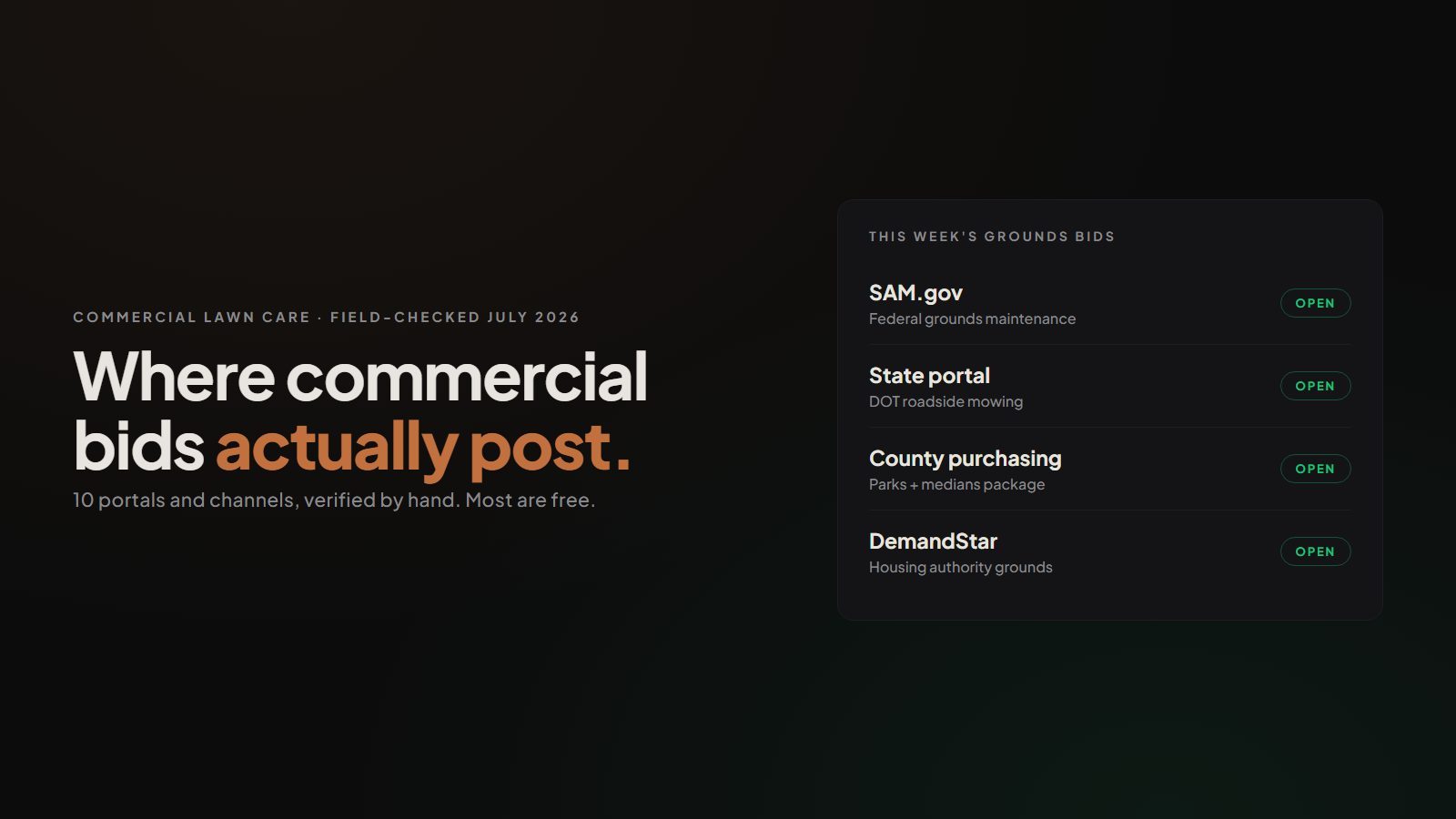
Let’s apply that. Introduce yourself to the community manager now, ask when grounds contracts come up for review, and get on the bid list months before you need the revenue. We broke down the full process, including where the bid boards live, in how to find commercial lawn care bids.
9. Walk the office parks nobody else is bidding
Speed: 2 to 8 weeks.
Every retail strip, medical plaza, and office park in your service area has a property manager, and the name is usually posted at the entrance or in the building directory. Most lawn companies never make that call. The few that do end up on bid lists with two or three competitors instead of thirty.
Make a Tuesday morning route of it. Ten properties, one question each:
Who handles your grounds bids, and when does the contract renew?
Leave behind something a manager actually keeps. A one-page rate card for common property sizes beats a brochure every time. The full commercial playbook, from insurance requirements to bid-walk etiquette, is in how to get commercial landscaping contracts.
A conversation instead of a competitive bid
The reason to walk the parks and ask the renewal question is timing. Get in front of the manager the month the building changes hands, or the month the current crew misses a mow, and you are having a conversation about what the grounds need. Wait for the RFP and you are one of thirty bids ranked on price. Owners who have won both ways tell us the conversation is easier to win and builds a stickier account. It is also the only way to be first in line when the contract you lost last year comes up for renewal on a date nobody wrote down.
10. Cold email commercial managers on buying triggers
Speed: 2 to 4 weeks to first meetings, then it compounds.
Walking properties works. It also caps out at how many doors you can physically visit. The scaled version is outbound email to commercial decision-makers, and the difference between spam and pipeline is one word: triggers.
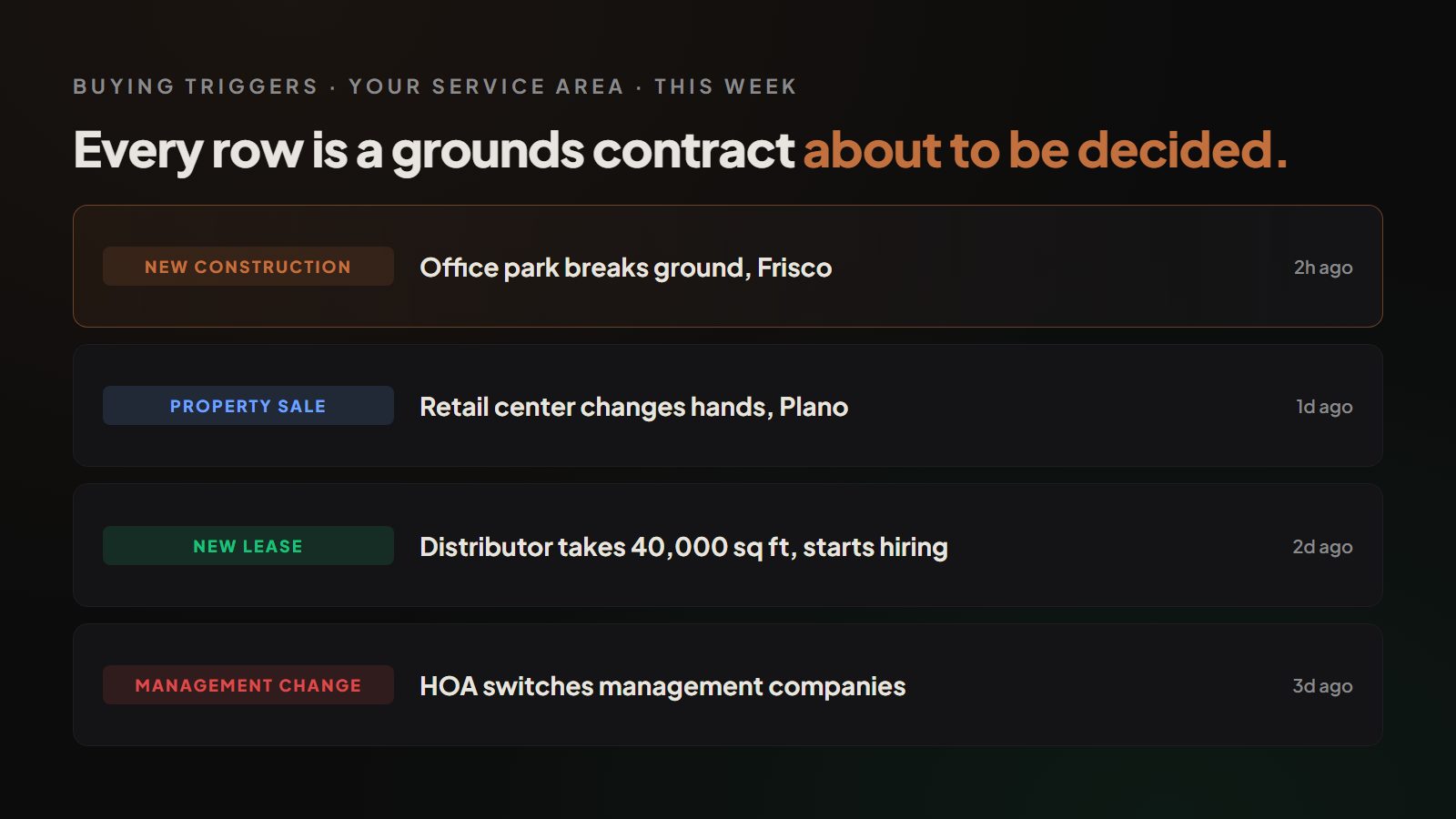
A trigger is a public buying signal. A new office park breaks ground in Frisco. A retail center changes hands in Plano. An HOA switches management companies. A distributor leases 40,000 square feet and starts hiring. Each one means somebody is about to decide who maintains that property, and almost nobody is in their inbox when they decide.
The mechanism, start to finish: watch for triggers across your service area, build a verified list of the actual decision-makers (facility managers, property managers, office managers, owners), send short personalized emails from a domain-safe sending setup so your main domain never carries the risk, pick up the phone on every warm reply, and book the interested ones straight onto your calendar.
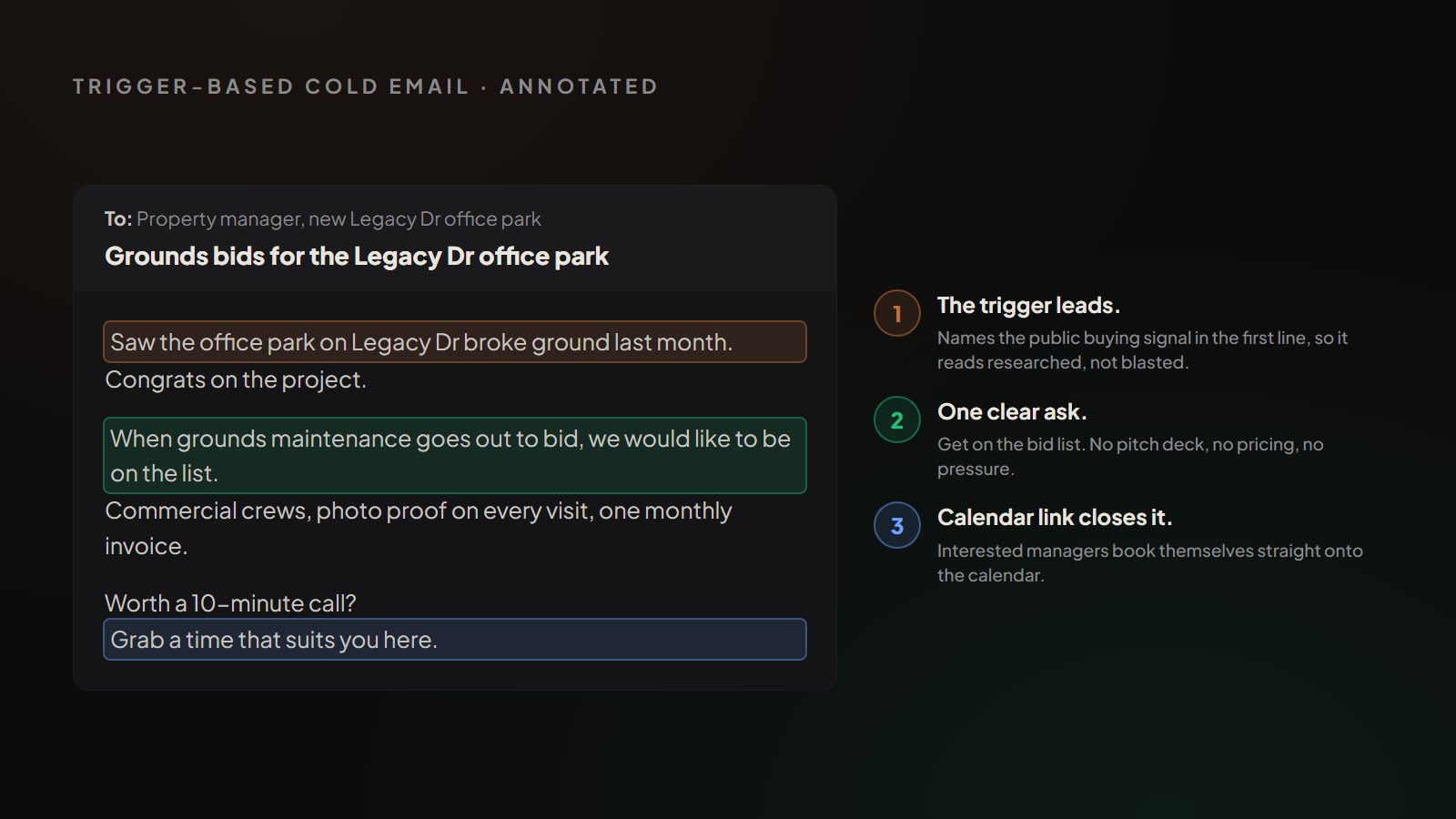
You can run this yourself at the scale of one office manager and a spreadsheet, and for most lawn care companies that is exactly the right move. Work tactics 8 and 9 on the properties inside your service area, add a trigger feed for permits and property sales, and follow the step-by-step version in how to get commercial landscaping contracts. Above roughly $3M in commercial revenue the math changes. At that size one won contract covers a dedicated caller many times over, and the constraint becomes the hours nobody on your team has to work the list.
That second lane is the one Ignitvio is built for: commercial landscaping and grounds companies above $3M that want the whole outbound motion run for them. If that is you, the program is laid out on the commercial landscaping lead generation page, and the fastest way to see whether your metro has enough triggers to support a written meeting minimum is the Free Pipeline Audit: a sample prospect list and trigger map for your metro, plus a lead response check on your inbound. If you are below that line, skip the fit call, run tactics 8 and 9 this month, and come back when one commercial account is worth five figures a year to you.
Done-for-you outbound
Where done-for-you outbound fits
Ignitvio runs outbound for you: a dedicated human caller (never a call center, never AI dialing) working alongside cold email and LinkedIn, armed with trigger data such as permits, zoning approvals, personnel changes, building sales, lease events, and contract renewal dates. Every meeting is qualified against criteria we agree on up front and approved by you before it counts. The qualified-meeting minimum goes in writing, and if we miss it we keep working at no charge until it is hit.
-
We qualify
Every prospect is screened against criteria we agree on with you up front.
-
You approve
A meeting counts toward the minimum only after you sign off on it.
-
You close
Your team runs the meeting and the deal. We keep the calendar full.
Built for commercial landscaping companies above $3M.
Owners who have paid for meetings before ask the same handful of questions before they believe any of that, so here are the answers up front. The caller is a person, US-based, dedicated to your account, and trained on your grounds work in your own words before the first dial; never a call center, never AI dialing. A meeting is never the honor system: before it lands on your calendar you see who the contact is and why the property is in play, and you approve it, send the caller back for more information, or cancel it at no charge. Callers are not commissioned on meetings that miss the criteria, so nobody is paid to book you a walkthrough with a manager who only said yes to stop the calls, was not the person who signs, or never shows. The meeting minimum and the refund election on the build fee are written into the contract, and we take one client per vertical per metro, so your caller is never dialing the same office parks for a competitor.
What does good look like at that size? Anchor the math to the qualified-meeting minimum in the agreement. A healthy campaign at typical volumes lands 8 to 15 qualified meetings a month. Close commercial work at 20 to 30% and that is 2 to 4 new contracts a month. Treat those as illustrative numbers, because your close rate is yours. The meeting minimum is the part that goes in writing, sized to your territory and capacity on the fit call. The lead generation overview covers the other commercial trades the same system runs in.
Working toward your first commercial accounts? Start here.
Bid seasons, per-acre math, insurance requirements, and the outreach scripts that book property-manager walkthroughs, in one guide.
Read the commercial contracts guideFrequently Asked Questions
What is the fastest way to get lawn care customers?
How do I get lawn care customers with no money?
How many lawn care customers do I need to make 100K a year?
How do lawn care companies get commercial accounts?
When is the best time of year to find lawn care customers?
What counts as a qualified meeting in commercial lead generation?
Is it a person cold calling, or is it AI?
What if I drive to the walkthrough and the manager says the caller was persistent and I was just in the area? Do I still pay?
What if you send too many meetings and I can't staff them?
Pick one tactic from each half
Run tactic 1 this week: knock the doors around every lawn on your route. Then start one commercial motion, whether that is a Tuesday property walk or a bid-window conversation with an HOA manager, because January contracts get decided in September.
The route fills from the street. The business gets built on contracts.

Jake Melendy
Founder, Ignitvio
Jake Melendy is the founder of Ignitvio. He spent 12 years in enterprise sales and sales leadership, including at Oracle, before building Ignitvio, which runs done-for-you outbound appointment setting for commercial contractors and B2B service companies. He writes about pipeline, trigger-based prospecting, and lead response.