How to Get Commercial Cleaning Contracts
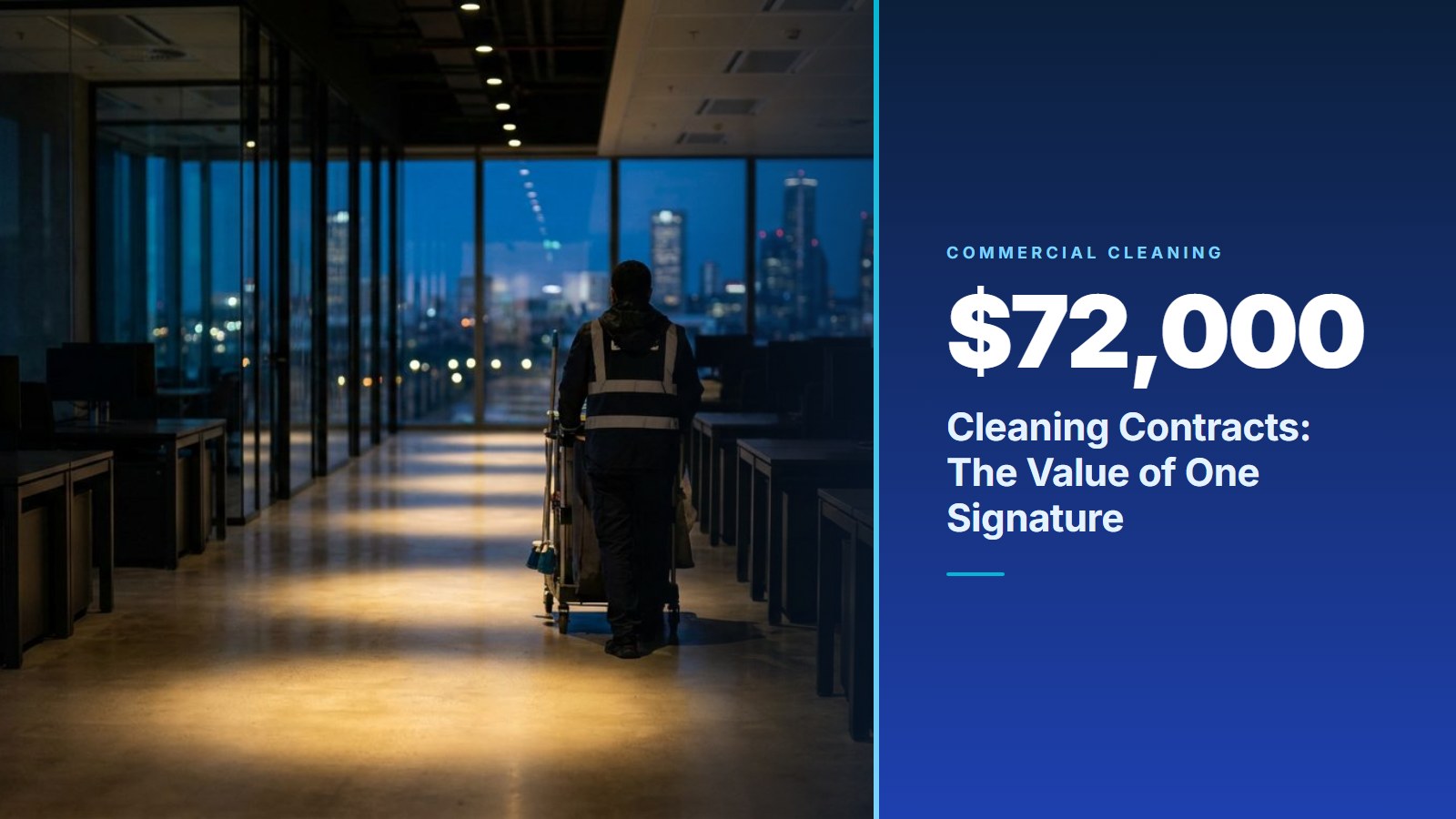
- One $2,000 per month office is $24,000 a year, and commercial accounts renew by default.
- Standard office cleaning prices between $0.07 and $0.20 per square foot. Bids are won or lost on workloading math.
- Government janitorial bids are posted in public on SAM.gov and state procurement portals. Registration costs nothing but an afternoon.
- Most vendors never follow up after the first touch. A five-touch cadence over 30 days wins buildings by default.
Somewhere in your service area tonight, an office manager is reading an angry tenant email about overflowing trash cans and a restroom that smells like a locker room. Tomorrow morning she starts shopping for a new cleaning vendor. Within three weeks, she signs with whoever showed up first.
That is the market in one scene. Commercial cleaning contracts change hands when the incumbent slips, and the replacement is whoever was already in her inbox. Position, not persuasion.
Owners tell us the same story from the other side of that desk. Referrals carried the company for years and then flattened out. You are the one selling, and the selling happens in whatever hours are left after crews, quality checks, and payroll. The walkthroughs you do land skew toward one-day-a-week accounts that take the same management as a five-night building and return a fraction of it. And the account you held for years walks on a 30-day notice because a new president came in with his own vendor, and nobody saw it coming. Every step below is about getting in front of the right somebody, at the right building, before the day she needs you.
This is the playbook for how to get commercial cleaning contracts on purpose: build a named target list, run walkthroughs that build trust, price with real per-square-foot math, reach decision makers directly, and follow up longer than anyone else bothers to.
Commercial Cleaning Contracts Pay Like Annuities
A commercial cleaning contract is a recurring agreement: fixed monthly price, defined scope, defined frequency, usually a 12-month term that renews automatically with a 30-day termination clause. You invoice the same amount every month. Easy building or brutal one.
That structure changes how you grow. Residential cleaners hunt new jobs every week. Commercial operators stack contracts. Different game entirely.
The size of the US janitorial services market in 2026, up 1.7% from the year before.
Source: IBISWorldRun the math on one modest account. A $2,000 per month office is $24,000 a year. Keep it three years and one signature was worth $72,000.
One signature. Three years. $72,000. That is why smart operators fight for buildings, not one-off jobs.
Most contracts are fixed monthly pricing with a scope schedule: which tasks happen nightly, which weekly, which quarterly. Strip-and-wax, carpet extraction, and window work ride on top as separate line items. Payment runs net 30, so plan cash for the gap between your first night of service and your first deposited check.
Recurring commercial work behaves this way across the trades; HVAC contractors build the same annuity with commercial maintenance agreements. And cleaning contracts renew by default, because nobody enjoys switching vendors. Your accounts will stick once you land them. The incumbent’s accounts stick too, which is why prying a building loose takes a system instead of a flyer.
Build the Target List Before You Print a Flyer

Most new janitorial owners market backwards. They order polo shirts, print flyers, boost a Facebook post, and wait. Nothing happens, because the person who signs a cleaning contract was never going to find them that way. Wrong audience, wrong channel.
Here’s the thing. Commercial cleaning is a named-account business. There is a finite, knowable list of buildings in your service area worth cleaning, and a specific person runs each one. Your job is to know that list cold.
Build it in three passes:
- Pick one building type. Offices between 5,000 and 50,000 square feet, medical suites, daycares, dealerships. One type. Every walkthrough starts to look like the last one, and your bids get sharper.
- Draw a 30-minute radius. Crews burn margin in windshield time. Density wins.
- Name the decision maker. Single-tenant office: the office manager. Multi-tenant building: the property manager. Corporate campus or plant: the facility manager. LinkedIn, the county appraisal district, and the lobby directory get you most of the names in an afternoon.
A list of 150 buildings with named contacts beats 10,000 flyer impressions. Every time.
Jobber’s cleaning industry data found that 64% of leads for cleaning businesses come from repeat customers. Translation: your first 10 accounts become the referral engine for the next 30. The list gets you those first 10.
Frequency Beats Square Footage
One more filter before the list is done, and it is the one owners bring up most when they talk about accounts that never paid back: sort by service frequency before building size. A once-a-week account takes the same walkthrough, the same crew scheduling, the same supervisor visits, and the same invoicing as a five-night building, and it returns a fraction of the revenue. A small suite on nightly service often out-bills a big floor cleaned on Fridays. When you build the 150, weight it toward buildings that need someone in there every night, because those are the accounts that keep the crew going and pay back the effort of landing them.
The Walkthrough Is Where the Contract Is Won

Nobody signs a janitorial contract off a phone quote. The walkthrough is the sales call, the estimating session, and the trust builder rolled into one 40-minute visit. One visit, three jobs.
BSCAI’s bidding guidance is blunt about this: schedule an onsite visit, document everything with notes, photos, and measurements, and ask directly what the current contractor is getting wrong. That last question is gold. The answer becomes your scope differentiator and the opening paragraph of your proposal.
Walk in with a checklist:
- Total square footage, then cleanable square footage. Subtract server rooms, mechanical rooms, and locked storage. You only price what you clean.
- Restroom and fixture count. Restrooms drive labor harder than any open floor plan.
- Flooring breakdown. Carpet, VCT, polished concrete, tile. Each has its own line items.
- Traffic and schedule. A 24-hour call center cleans differently than a 9-to-5 law office.
- Security requirements. Badge access, escort rules, background checks. Banks and clinics add cost.
- The complaint log. Ask what would make them switch vendors tomorrow. Write down the exact words.
Count the restrooms twice. Facility managers are paid to remove risk, and your tape measure is the cheapest trust signal you own.
Bid Math: A Real Per-Square-Foot Example

Let’s apply that. Say the walkthrough was a single-tenant office in Plano, Texas: 12,400 total square feet, five nights a week, standard scope (trash, vacuuming, restrooms, break room, entry glass). Nothing exotic.
Step one: cleanable square footage. The server room, two storage rooms, and the mechanical closet total 1,900 square feet you will never touch. Cleanable space: 10,500 square feet.
Step two: the rate. Housecall Pro’s 2026 pricing guide puts standard recurring office cleaning between $0.07 and $0.20 per square foot. Five-nights-a-week service on a standard office sits mid-range. Call it $0.15.
The going per-square-foot rate for standard recurring office cleaning. Frequency and scope decide where your bid lands in the band.
Source: Housecall ProStep three: the price. Recurring contracts bill monthly, so quote it that way: 10,500 square feet times $0.15 is $1,575 per month. $18,900 a year.
Step four: check the price against your cost. This is the step that separates operators from hobbyists. Workload the job: at roughly 3,500 square feet per hour on a standard office scope, this building is a 3-hour night, and five nights a week comes to about 66 labor hours a month.
- Labor: 66 hours at $15 loaded is $990
- Supplies and consumables: about $80
- Overhead at 15% of revenue (BSCAI recommends factoring in 10 to 20%): $236
- Total monthly cost: about $1,306
That leaves roughly $269 a month in profit, a 17% margin. Thin but real, and typical for a first-year shop. If your workloading says the crew needs 4 hours a night instead of 3, the margin is gone. Bid higher or walk.
Bids die on the cost line. The market sets the price. Your walkthrough sets the cost.
Stack that discipline across a book of 15 similar buildings and you are running about $280,000 a year in recurring revenue at margins you actually chose.
Janitorial Contracts Hide on Government Bid Portals
Everything above covers the private market. Government and institutional janitorial contracts are a separate channel, and most small operators never touch it because the paperwork looks scary. Their loss.
If you have wondered how to get janitorial contracts with cities, school districts, or federal buildings, the unglamorous answer is: register, set alerts, and bid. That’s it. Public agencies are required to post the work.
Where the bids actually live:
- SAM.gov is the official federal system. Register your entity, get a Unique Entity ID, and you can search and bid on federal janitorial work. Free; budget an afternoon for the paperwork.
- State procurement portals. Every state runs one; register as a vendor under janitorial or custodial service codes.
- City, county, and school district sites. Janitorial Manager’s bid-source roundup points to county bid pages, city vendor portals with email alerts, aggregators like GovernmentBids.com, and JaniJobs, an RFP marketplace built for the cleaning industry.
Two warnings from operators who fish this water. First, government bids are spec-driven: read the RFP line by line, because you are pricing the scope they wrote. Second, have your paperwork ready before you bid. Agencies and most property managers want proof of general liability coverage, and Insureon notes that janitorial surety bonds may be required to secure commercial contracts, especially with larger clients.
Government work pays slower and the margins run tighter. But the contracts are bigger, they run for years, and the incumbent’s winning bid is public record. You can literally see the number you have to beat. No guessing.
Office Cleaning Contracts Go to Whoever Shows Up First
Now the private-market question everyone actually types: how to get office cleaning contracts when the building already has a vendor. The answer: get in front of the decision maker before the day she needs you, so you are the obvious call when the incumbent slips. And the incumbent will slip. Always does.
The bar is lower than it looks. Jobber’s cleaning industry data shows 85% of cleaning businesses respond to a new lead the same day, but only 26% respond within an hour. The same-day number sounds fine until you picture the office manager with a tenant complaint on her screen. She is not waiting until 4 p.m. to hear back, and roughly three out of four cleaning companies leave that first hour open.
The share of cleaning businesses that respond to a new lead within an hour, per Jobber's cleaning industry data. Most of your competitors leave the first hour open.
Source: JobberMost cleaning companies answer the same day. Very few answer within the hour. The walkthrough goes to the vendor who was already in the inbox and picked up first.
The office manager who emails three cleaning vendors at 9 a.m. will probably hear from all three by the end of the day. She will hear from one by 10 a.m. Be that one and you win by forfeit.
The outreach itself is simple. A short email to the named decision maker: one specific observation about their building, one sentence on who you serve, one ask (a 15-minute walkthrough). A phone call two days later. No brochure attachments and no filler.
New President, New Vendor
Ask an owner about the accounts they lost and the cleaning is almost never the reason. A new president arrived with a vendor he already trusted, ownership changed hands, a new facilities director wanted her own people, and the 30-day notice showed up with no warning because nobody was watching for it. Turn that around and it is the best news in this section: every building you do not clean is one personnel change away from shopping, and most of those changes are visible weeks before anyone posts an RFP, if someone is watching.
Timing beats copywriting. The best moments to land in an inbox: a new lease, a construction permit, an expansion, a hiring announcement, a building sale that installs a new property manager, a new facility manager taking over a portfolio. Each one means cleaning needs are changing and no vendor relationship is settled yet. The most valuable signal of all is the one the incumbent forgets to track: the contract renewal date. When a facility manager says the contract runs through spring, write that date down, because the vendor who comes back at 90 days and again at 60 is the one she remembers. Appointment-setting services build their entire model around watching those signals; I broke down that vendor landscape in the best commercial cleaning lead generation companies.
The Follow-Up Cadence Most Cleaning Companies Skip
One email is a lottery ticket. A cadence is a system.
Decision makers ignore the first touch for reasons that have nothing to do with you: budget season, a bad week, an incumbent contract with five months left on it. The vendor still in the inbox when the timing turns gets the walkthrough. The same discipline that wins inbound leads wins outbound appointment setting for cleaning companies: show up fast, then keep showing up. Longer than feels polite.
The cadence I recommend for a named-account list:
- Day 1: short personalized email. One building-specific detail, one ask.
- Day 3: phone call. Voicemail is fine; reference the email.
- Day 7: second email with something useful, like a one-page scope checklist or a photo-backed observation about their entryway.
- Day 14: drop by with a card, or a LinkedIn touch for corporate buildings.
- Day 28: the breakup note. “Closing the file unless cleaning is on your radar this quarter.” This one gets the most replies.
- Then quarterly until the account opens up.
- Pipeline depends on the phone ringing
- Losing one account is a 20 percent revenue hit
- You only bid when a building calls you
- The incumbent keeps every renewal by default
- 10 to 20 named decision makers contacted weekly
- Walkthrough requests land every week
- You bid buildings before an RFP ever posts
- You are the first call when the incumbent slips
Bottom line: the list is the asset, the cadence is its maintenance schedule. Run it weekly and walkthroughs stop being random.
What Done-for-You Outreach Looks Like

Everything above is doable solo, and if you are building your first book of buildings, do it solo. The list, the walkthrough, the bid math, and the cadence are the whole business at that stage, and running them yourself is how you learn your market.
The math changes once you are past roughly $3M in contract revenue and the accounts worth chasing are $4,000 a month and up: multi-location offices, medical, industrial. At that size the cadence above is a full-time seat, and it competes with crews, quality checks, and payroll for the same hours. That tradeoff is why Ignitvio runs outbound appointment setting for commercial cleaning companies as a done-for-you program.
Before the mechanism, the reason it is built the way it is. Owners at that size tell us the same story about the last appointment vendor they paid: the walkthrough was on the calendar, they drove out, and the person at the front desk did not know who they were, or had said yes to stop the calls, or could not sign anything, or never came out at all. The invoice arrived anyway, and the argument over it took longer than the meeting would have. That vendor had no reason to disqualify anyone, because they were paid per appointment and nothing was tied to whether it turned into a building. Every piece of the program below exists to close that gap.
The mechanism, start to finish:
- Trigger data for your metro. New facilities, expansions, building sales, lease events, construction permits, and personnel changes such as a new facility manager taking over a portfolio. Each one is a building that needs coverage or a contract about to move, usually months before it reaches any bid board.
- A dedicated human caller works the list. One person assigned to your market who learns your buildings, your buyers, and your voice. Never a call center, never AI placing calls. Cold email and LinkedIn run alongside the phone from domain-safe infrastructure, so your primary domain stays out of cold volume.
- Every renewal date gets logged. When a facility manager says the contract runs through spring, that date goes on your renewal calendar, and your caller re-enters the conversation at 90 days and again at 60, while the incumbent still assumes the account is asleep.
- Meetings are qualified against your criteria and approved by you. Decision-maker, account size, service fit, and a person who genuinely agreed to the call. Then it comes to you before it happens with three options: approve it, send the caller back for more information, or cancel it at no charge. Only approved meetings count. You show up and run the walkthrough. That part stays yours.
“Qualified” has a written definition here: the right decision maker for your target buildings, an account that fits the $4,000-plus monthly profile we define with you, and a person who knew who they were meeting and why. A name on a calendar who thought they were getting a free carpet shampoo does not count, and neither does any meeting you decline to approve. Callers are not commissioned on meetings that miss that definition, so nobody on our side is paid to push a soft yes onto your calendar.
The guarantee is structural: a qualified-meeting minimum in writing. Miss it, and we keep working free until we hit it.
We never guarantee revenue or signed contracts, because nobody honest can. Closing the walkthrough is your job. Run the numbers on the accounts this program targets, though: a $4,000-a-month account is $48,000 a year, recurring, before day porter add-ons or floor care, and it renews by default when you perform. That is the account size the program is built around.
Done-for-you outbound
Where done-for-you outbound fits
Ignitvio runs outbound for you: a dedicated human caller (never a call center, never AI dialing) working alongside cold email and LinkedIn, armed with trigger data such as permits, zoning approvals, personnel changes, building sales, lease events, and contract renewal dates. Every meeting is qualified against criteria we agree on up front and approved by you before it counts. The qualified-meeting minimum goes in writing, and if we miss it we keep working at no charge until it is hit.
-
We qualify
Every prospect is screened against criteria we agree on with you up front.
-
You approve
A meeting counts toward the minimum only after you sign off on it.
-
You close
Your team runs the meeting and the deal. We keep the calendar full.
Built for commercial cleaning companies above $3M.
Owners who have been burned before ask the same four questions before they believe any of this, so here are the answers. Is the caller a person or AI? A person: US-based, trained on the cleaning trade and on a recorded session where you explain your buildings, your buyers, and how you talk about the work, assigned to your account and nobody else’s. No AI placing calls, no shared call-center queue. Is a qualified meeting the honor system? No. You see every meeting before it happens and choose to approve it, send the caller back for more information, or cancel it at no charge, and the caller earns nothing on a meeting that misses your criteria.
Is the guarantee real? The qualified-meeting minimum, the work-free period if we miss it, and your refund election on the build fee at the agreed gate are written into the contract before the first call is placed, so there is nothing to fight over later. Will you work with my competitor? No. One commercial cleaning company per metro, so the trigger data and the caller in your market work for one company.
Two fit notes so nobody wastes a call. We do not target accounts under $1,000 per month, and we decline engagements built around them, because a dedicated caller, trigger data, and multi-channel follow-up cost more than a once-a-week account can repay. Owners judge a program like this in months to payback on net profit, and so do we, which is why that floor exists. And the program is built for commercial cleaning and janitorial companies doing $3M+ in contract revenue; below that, the playbook above is the better investment, and it is free.
The full breakdown, including the renewal-window system and the meeting definition word for word, is on our commercial cleaning lead generation page. The same trigger playbook powers our done-for-you lead generation across trades; the version for roofers is in how to get commercial roofing leads. Prefer proof first? The Free Pipeline Audit pulls a sample prospect list and trigger map for your metro, the buildings and decision makers in a buying window right now, plus a lead response check on how your own inbound inquiries get handled. Nobody at Ignitvio contacts the companies on that list; it is built for you either way.
See the renewal windows and trigger activity already open in your metro
For commercial cleaning companies above $3M chasing $4,000-plus monthly accounts. You see the exact buildings we would target before you commit to anything.
Book a 15-Minute Fit CallFrequently Asked Questions
How do I get my first commercial cleaning contract with no experience?
How much are commercial cleaning contracts worth?
How do you bid on a commercial cleaning contract?
Where can I find janitorial contracts up for bid?
Do I need insurance to get commercial cleaning contracts?
What if I show up to the walkthrough and the person does not know who I am, or only said yes to stop the calls?
Is it a person cold calling or is it AI?
Does a meeting with a property manager count as a qualified meeting?
Go Book the Walkthrough
The operators winning commercial accounts keep a named list, measure buildings, price off workloading math, and follow up on day 28 when everyone else quit on day 2.
Build the list this week. Walk one building. Run the cadence. The contracts are already out there, renewing by default for incumbents who slipped months ago. Go be the inbox the office manager finds when the trash night gets missed.
If you are already past $3M and would rather see the list before you build it, the Free Pipeline Audit is the shortcut: a sample prospect list and trigger map for your metro, plus a check on how fast your own inbound inquiries get answered, back within five business days.
Get the Free Pipeline Audit for your metro
A sample prospect list, a trigger map of the buildings in a buying window now, and a lead response check on your own front door. Built for you whether or not we ever work together.
Get My Free Pipeline Audit
Jake Melendy
Founder, Ignitvio
Jake Melendy is the founder of Ignitvio. He spent 12 years in enterprise sales and sales leadership, including at Oracle, before building Ignitvio, which runs done-for-you outbound appointment setting for commercial contractors and B2B service companies. He writes about pipeline, trigger-based prospecting, and lead response.