Commercial HVAC Maintenance Contracts 101
- Commercial maintenance agreements come in three working structures: full-coverage, preventive-only, and labor-only. The label on the cover page tells you almost nothing.
- Expect $200-$1,000 per visit and roughly $0.12-$0.65 per square foot per year, depending on how much repair risk the contractor absorbs.
- For contractors, agreements run around 40% gross margin, renew near 90%, and pull $1-$3 of repair work behind every $1 of agreement revenue.
- The buildings that need a new maintenance vendor announce themselves: new facilities, expansions, lease events, hiring surges.
Three Bids, One Building, a $4,100 Spread
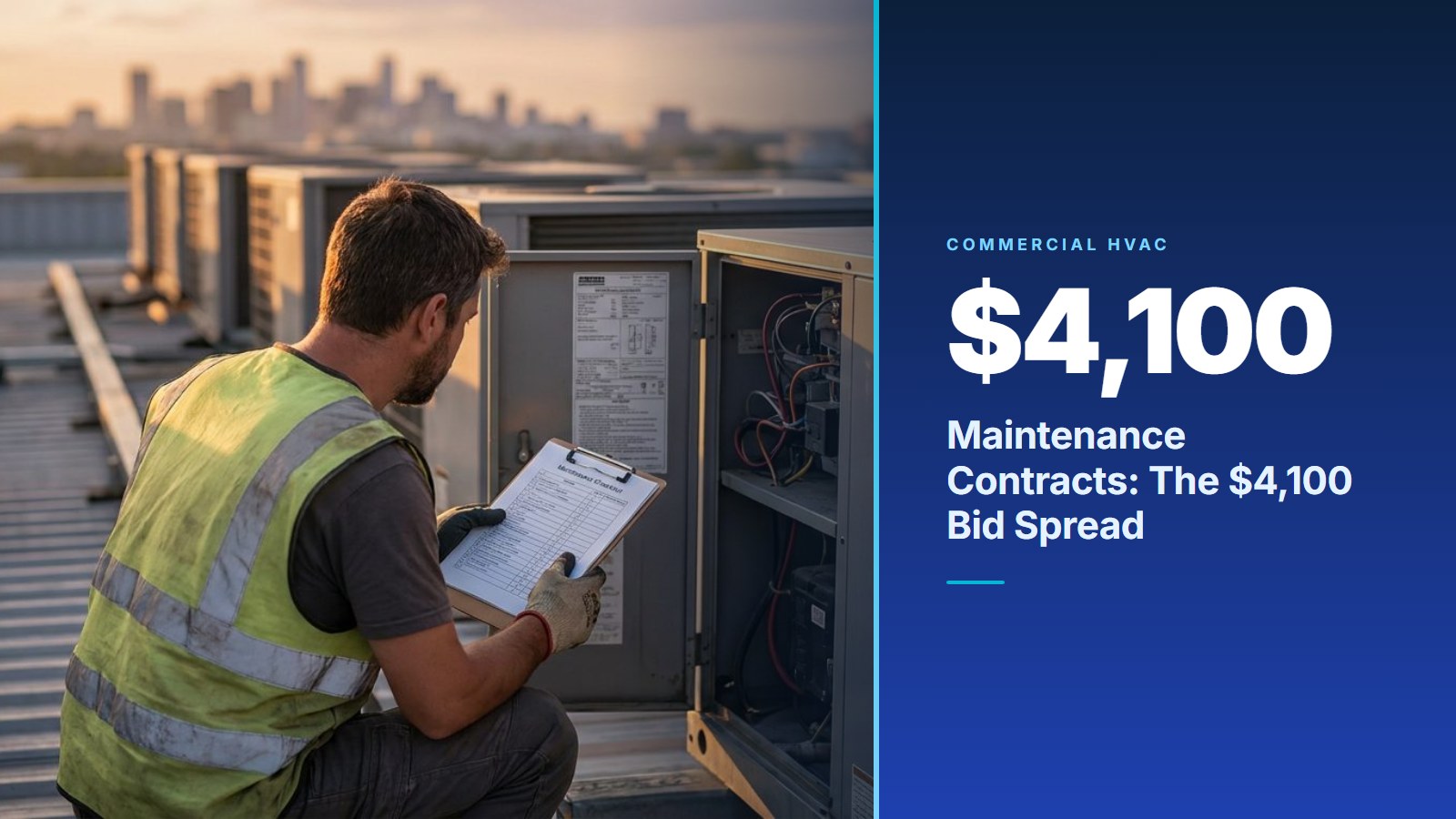
Ask three contractors to quote maintenance on the same twelve rooftop units in Charlotte and the annual spread between the low and high bid can hit $4,100. All three cover pages say the same two words: preventive maintenance.
Same building. Same tonnage. Three completely different deals.
Two words on the cover. A $4,100 gap underneath.
A commercial HVAC maintenance contract is the most misread line item in a facility budget. The label says nothing about who carries the risk when a compressor dies in August. The structure underneath says everything.
This guide runs both directions. The first half is for whoever signs the contract: the structures, the pricing norms, the checklist. The back half is for the contractor selling it. Margin math, pricing method, and where the next twenty agreements come from.
The Three Contract Structures, and Who Each Protects
Commercial agreements sort into three main structures, plus a junior fourth. Universal Services HVAC, a New York commercial shop, splits the market into full-coverage, full-labor, preventive-maintenance, and inspection-only tiers. That taxonomy matches the bids I see in every metro.
Full-coverage: budget certainty, priced like it
Full-coverage bundles 100% of labor, parts, and materials, plus scheduled maintenance and 24/7 emergency response, into one number. You are buying an insurance policy. One premium, zero surprise invoices. The contractor absorbs the risk of a $14,000 compressor failure, so the premium reflects it.
Right call when downtime costs more than the contract: restaurants, server rooms, medical suites, cold storage.
The cheapest full-coverage bid in the stack is the contractor betting you will never file a claim. Read the exclusions twice.
Preventive-only: the set-visit tune-up plan
A fixed annual fee buys a set number of scheduled visits with a defined task list. Coils, filters, belts, refrigerant checks, controls. Repairs bill separately at an agreed labor rate.
The workhorse structure for owner-occupied buildings. You keep the repair risk. You also keep the money when nothing breaks.
Labor-only: the middle ground
The contractor covers repair labor, you pay for parts. Cheaper premium than full-coverage, softer landing than pure preventive. The trap hides in the parts markup, so get that percentage in writing. In ink, before the first visit.
Inspection-only agreements, periodic check-ins with a written report, are the bottom rung. Fine for new equipment still under manufacturer warranty. A waste of paper on a 15-year-old system.
What a Fair Commercial Contract Costs
Four pricing methods show up in commercial bids. Per visit, per unit, per square foot, per ton.
Per visit first. Harold Brothers Mechanical pegs a single commercial maintenance visit between $200 and $1,000 or more, with annual contracts running anywhere from $1,000 to $10,000 or more per year. Wide range. On purpose: unit count, equipment age, and roof access drive it.
Per square foot next. The cleaner benchmark for portfolio buildings. Universal Services’ 2026 numbers run $0.12 to $0.25 per square foot annually for basic labor-only coverage, $0.25 to $0.45 with parts coverage, and $0.45 to $0.65 for full-coverage.
The 2026 per-square-foot annual pricing band for commercial HVAC maintenance, from basic labor-only coverage up to full-coverage agreements.
Source: Universal Services HVACReal-world anchors help more than formulas. The Cooling Company in Las Vegas prices a small office suite at $800 to $1,500 per year for two seasonal visits, a mid-size building running 5 to 15 units at $3,000 to $8,000, and large multi-tenant properties at $15,000 to $40,000 per year. Real bids, real bands.
Per-ton quotes exist too, but published per-ton benchmarks vary wildly from one source to the next. Treat per-unit and per-square-foot norms as your sanity check.
Here’s the thing. Bids are only comparable when they itemize the same lines. Before you sign anything, make every bidder spell out the eight items below, especially the two most shops leave blank.
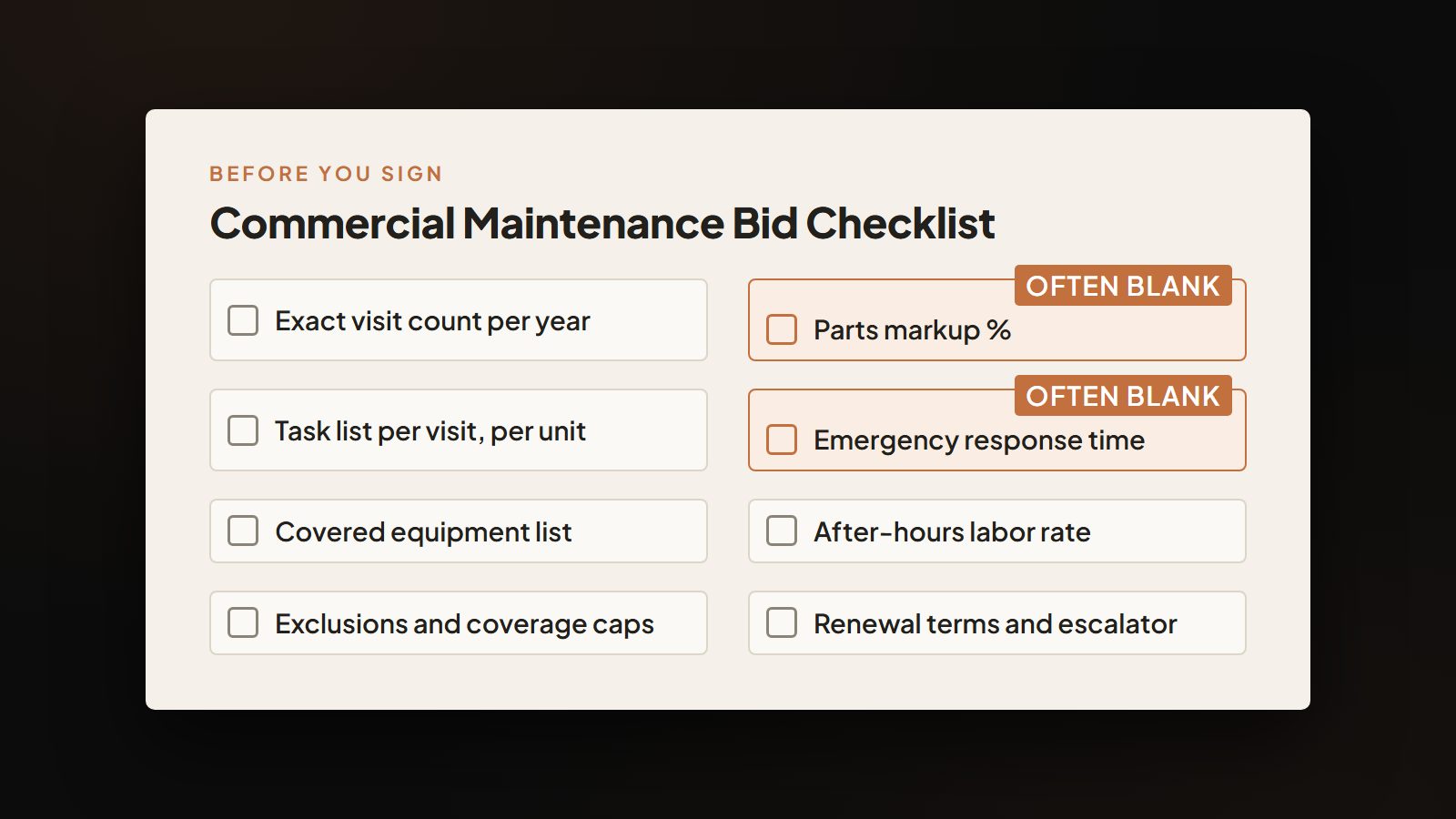
The eight, in plain terms:
- The equipment schedule. Every unit listed by model, serial, and location, so nothing gets disputed later as off the schedule.
- Visit count and timing. A number and the seasons, in writing, never a promise to come out as needed.
- The task list per visit. What gets cleaned, tested, and replaced on each unit type.
- Repair labor rates. Business hours and after hours, both stated.
- Parts markup. The percentage over cost. Blank spot number one on most bids.
- Emergency response time. A commitment in hours. Blank spot number two.
- Exclusions. What the agreement will never cover, from refrigerant caps to code-required upgrades.
- Renewal terms. How much the price can rise at renewal, and how much notice you get.
A bidder who resists putting items five and six on paper is telling you exactly where the profit hides.
Frequency norms are simpler. Twice a year is the floor. Spring and fall. Harold Brothers recommends quarterly for most commercial systems, and heavy-use facilities go monthly. Commercial kitchens, data rooms, and anything carrying a 24-hour load justify the tighter cadence, because a filter that lasts a quarter in a quiet office clogs in six weeks over a fry line.
One last owner-side note: maintenance is partly an energy play. ENERGY STAR reports that sealing and insulating ductwork alone can improve heating and cooling efficiency by as much as 20 percent. From ductwork alone. A neglected system bleeds money quietly long before it fails loudly.
Flip It: Why Contractors Love These Agreements
Now flip the table. If you run an HVAC shop, everything above is your sales script, and the economics explain why agreements deserve the top slot in it.
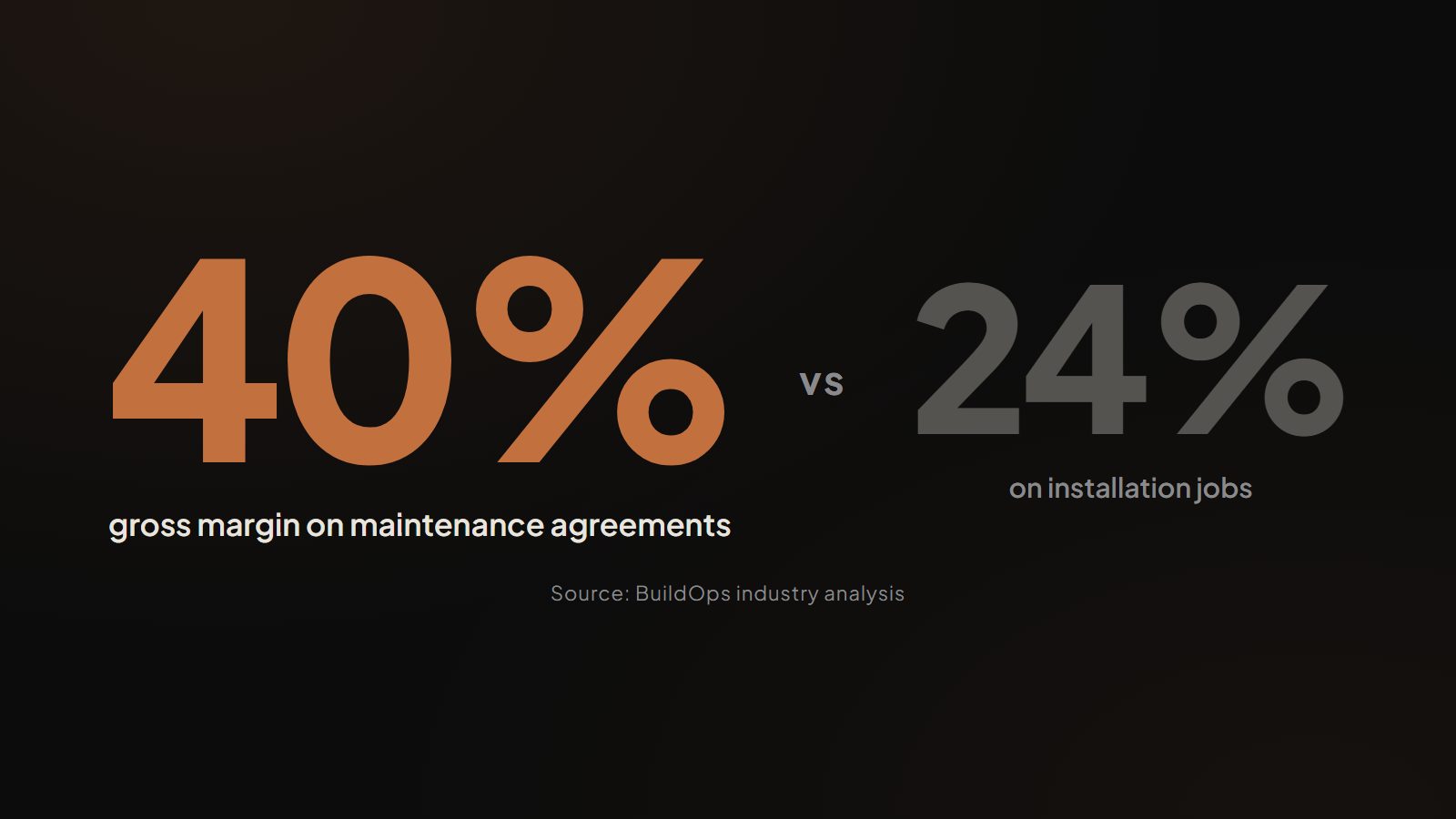
BuildOps puts maintenance agreements at around 40% gross margin, against roughly 24% on installation jobs. The same analysis found agreements typically renew at around 90% year over year and pull $1 to $3 in additional repair and replacement work behind every $1 of agreement revenue. ServiceTitan’s contract guide lands in the same zone: preventive agreements typically produce 2-4x in pull-through equipment repair and replacement work. Two sources, one conclusion.
Let’s apply that. A $6,000 agreement at 40% margin earns $2,400 before a single repair. Add the pull-through and that one signature can drive $12,000 to $24,000 of work. Most of it in spring and fall, right when the install calendar goes quiet.
- Revenue restarts at zero every January
- Trucks sit idle through shoulder seasons
- Every job bid against five other shops
- Buyers only call when something breaks
- Renewals compound year over year
- Spring and fall visits fill the calendar
- Agreement holders call you first, no bid
- Pull-through repairs come pre-sold
Recurring agreements are also the asset a buyer pays for if you ever sell the company. If you are mapping the longer arc of growing an HVAC business, the agreement book is the compounding engine.
How to Price an Agreement That Renews
Price from your costs up. Never down from whatever the shop across town quoted.
Task hours first. List every unit, assign realistic task hours per visit, and multiply by your fully loaded labor rate, meaning wages plus burden plus truck. Add materials (filters, belts, a refrigerant allowance). Then overhead. Then margin. If the finished number cannot clear 40% gross, the scope is too fat or the price is too thin.
Then build three tiers that mirror the structures above. Inspection, preventive, full-coverage. Buyers anchor to the middle one.
Typical year-over-year renewal rate on HVAC maintenance agreements. Price for a decade-long relationship, because the revenue compounds.
Source: BuildOpsThe mistake I see most: underpricing year one to win the logo. That customer leaves over a $200 correction in year two, and the renewal math dies with them.
Build the correction into the contract instead. A written annual escalation of 3 to 5 percent, tied to labor and materials costs, turns the awkward year-two price conversation into a clause the customer already signed at kickoff. Nobody fights a line they agreed to on day one, and your margin keeps pace with wage inflation without a single hard phone call.
Selling Agreements: Your Service Board Goes First
Your warmest prospects are already in your dispatch software. Every repair ticket is a maintenance pitch with the pain still fresh: the unit already failed, the tenant already complained, the invoice already stung. No cold list required.
The ACCA sets the bar bluntly: service technicians should convert a minimum of 25% of service calls into service agreements, and dedicated maintenance technicians can hit 70% or higher. If your techs sit at 5%, that gap is worth six figures a year. The script is one sentence: this repair would have been caught in the spring visit.
Then comes the part most shops fumble. ServiceTitan’s industry advisor Johnathan Day notes it takes about six contacts on average to close a deal in this industry. Six.
Most shops stop at one voicemail. The six-touch shop takes the agreement.
Phone tag kills agreements. If your office cannot run a six-touch cadence, appointment-setting services exist to carry exactly that load. Pairing agreement sales with a broader HVAC lead generation system keeps the top of the funnel from starving.
The Responsiveness Bar Is on the Floor
You might assume commercial trades fight hard for recurring revenue like this. We tested that assumption in a neighboring trade. In May 2026 we called 102 roofing companies across Dallas-Fort Worth, posing as a buyer with a real job. The full method and numbers are in that writeup.
56% never picked up and never called back. The gap between the fastest and slowest responders was 30x. The median callback took 31 minutes.
Different trade, same buyer experience. Facility managers award maintenance agreements the way homeowners award roof repairs: to whoever acts like they want the work. Answer fast, follow up six times, and you win agreements your competitors never knew were in play. That is the entire logic of speed to lead, and it costs nothing but discipline.
Where the Next 20 Agreements Come From
Referrals and repair-call conversions eventually flatten. The shops that keep adding agreements go find buildings at the exact moment they need a vendor, and those moments are public. Public, and time-stamped.
A building permit gets filed for a 42,000 square foot distribution center in Fort Worth. A three-floor office backfill gets leased in Plano. A cold-storage operator in Garland posts 38 open roles. Each one is a building about to need scheduled maintenance, with a decision-maker who has not picked a vendor yet.
Bottom line: the buildings announce themselves. Somebody just has to be watching.
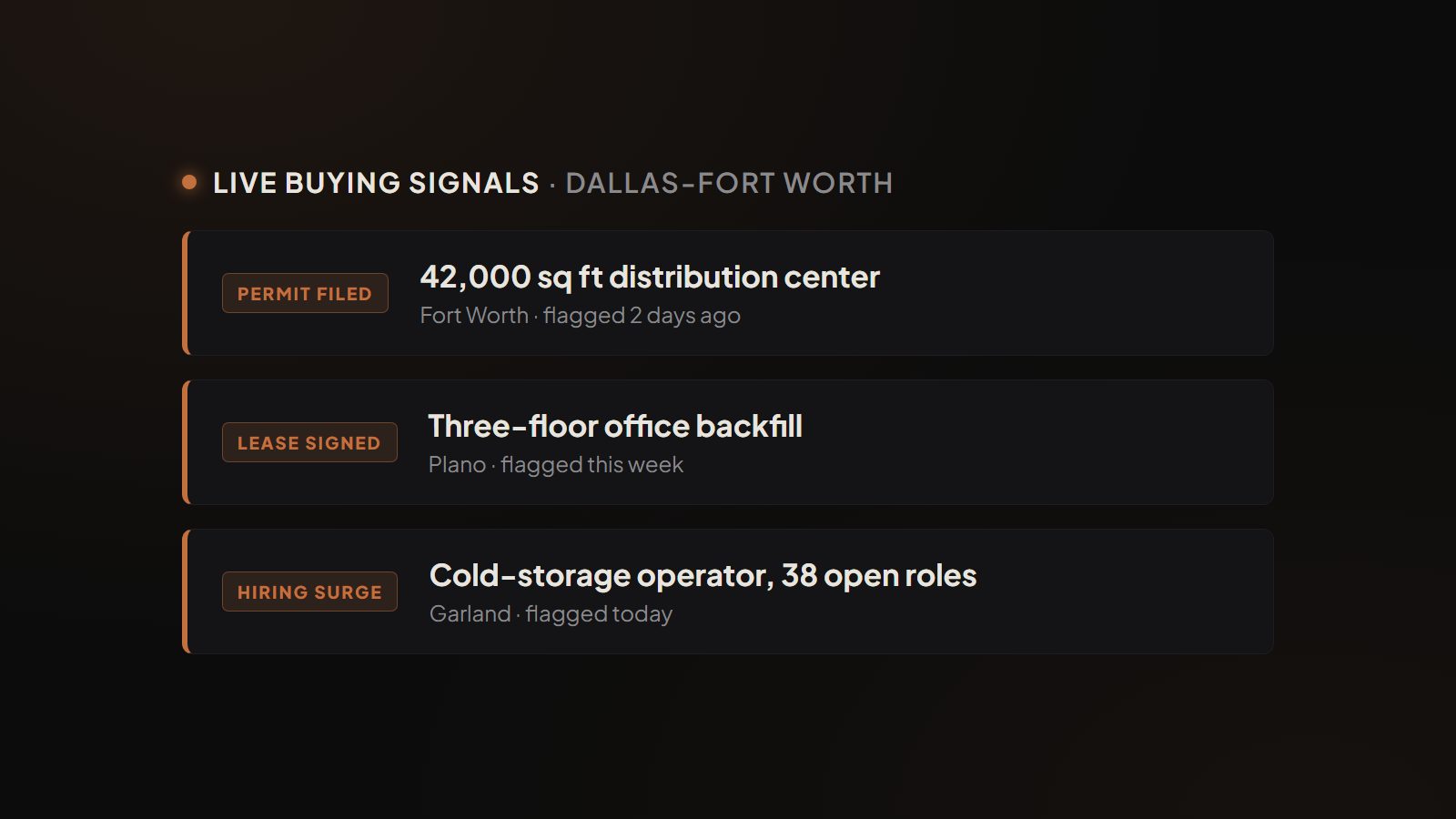
That watching is the job we built Ignitvio’s agency around: done-for-you lead generation for commercial HVAC contractors that monitors those buying-signal triggers, builds a verified list of the right facility managers, property managers, and owners in your service area, sends personalized outreach from your own domain-safe sending setup, and books qualified meetings straight onto your calendar.
The part that makes it safe to test: we agree on a qualified-meeting minimum in writing, and if we miss it, we keep working free until we hit it. A qualified meeting means the right decision-maker for your ICP, a building that fits your size and service area, and a person who genuinely agreed to the call. Run the math as a straight hypothetical: a campaign that books ten qualified meetings a month, closed at 20%, adds two new agreements monthly. Twenty-four a year. Your close rate and your market set the real number, which is why we guarantee the meeting minimum, never revenue.
The same trigger playbook runs in other B2B trades. It is how commercial roofing leads get booked before the bid list forms, and how MSP marketing fills pipeline in a market that stopped answering cold calls years ago.
See what trigger-based outbound finds in your service area
We'll pull a free sample prospect list for your territory before the call. If the triggers aren't there, we'll tell you that too.
Book a 15-Minute Fit CallFrequently Asked Questions
What is included in a commercial HVAC maintenance contract?
How much does a commercial HVAC maintenance contract cost?
Are commercial HVAC maintenance contracts worth it?
How often should commercial HVAC equipment be serviced?
What gross margin should an HVAC maintenance agreement carry?
What counts as a qualified meeting in commercial HVAC outbound?

Jake Melendy
Founder, Ignitvio
Jake Melendy is the founder of Ignitvio. He spent 12 years in enterprise sales and sales leadership, including at Oracle, before building Ignitvio, which runs done-for-you outbound appointment setting for commercial contractors and B2B service companies. He writes about pipeline, trigger-based prospecting, and lead response.