How to Get Commercial Roofing Leads
- Commercial roofing leads come from relationships and building intelligence, and the playbook barely overlaps with residential.
- One property manager can control 30 or more roofs. Winning that relationship outproduces winning any single bid.
- Reroof timing is public data. Permit records and roof age put you in front of a building 12 to 24 months before it buys.
- We called 102 roofing companies in Dallas-Fort Worth in May 2026. 56% never picked up or called back. Basic responsiveness alone beats half your market.
Commercial Roofing Leads Are a Different Sport
Owners who run commercial roofing shops tell us the same story. The prints come down off a plan room, a dozen shops price the same spec, the job goes to the lowest number, and the hit rate lands somewhere between one bid in ten and one in twenty. The owner is the only one selling, and selling stops every time the crew needs another set of hands on a roof. The one time the shop paid for appointments, somebody drove an hour to a walkthrough where the property manager did not remember agreeing to it, then fought the invoice afterward. Every one of those problems has the same fix: get in front of the right person before the job ever hits a board.
A residential lead finds you. Hail hits a subdivision, the homeowner searches “roofer near me,” and whoever answers first wins the shingle job. Commercial runs on a completely different clock: the buyer is a property manager or facility director, the ticket runs six or seven figures, and the budget decision started months before you heard a word about it.
Fewer at-bats. Bigger checks. Longer waits.
The market is enormous and lopsided. IBISWorld pegs the US roofing contractor market at $92.5 billion in 2026, yet Roofing Contractor’s 2026 State of the Industry survey found only 22% of contractors run commercial shops, with another 9% mixed. Most of the industry is elbowing for storm doors while the commercial inbox stays comparatively quiet.
The US roofing contractor market in 2026. Only a fraction of contractors compete for the commercial slice.
Source: IBISWorldThe shops already there are bullish: in Roofing Contractor’s commercial roofing trends survey, 91% expect continued growth through 2028. More crews will chase the same property managers every year. Better to be early.
This guide is how to get commercial roofing leads the durable way: property managers, reroof cycles, inspection reports, bid boards, and trigger events. Running a residential crew? Start with our residential roofing lead generation guide instead.
Win the Property Manager, Win the Portfolio
A storm lead is one roof. A property manager at a mid-size firm carries 30 to 60 buildings across a metro, and every one of those roofs is aging on a schedule. Same sales effort, wildly different ceiling.
One property manager relationship can outproduce an entire season of door knocking.
Here’s the playbook that earns the relationship.
Build the list before you need it
County assessor records give you the owner entity for every commercial parcel in your area. The leasing sign out front gives you the management firm. BOMA and IREM chapter directories fill in the rest, and LinkedIn supplies names and titles. Target output: every PM firm within an hour of your shop, with a named contact at each. One list. Years of at-bats.
One caution owners learn the hard way: the property manager who tells you on site that you have the job is often passing the decision up to an owner or a management group that has never heard your name. Capture the owner entity and the asset manager alongside the PM, so the relationship reaches the person with veto power and the reroof does not stall at the site level.
Get on the approved vendor list
Property managers cannot hire you until you exist in their vendor system. The packet is predictable:
- Certificate of insurance
- W-9
- Safety record and references
- Sometimes a master service agreement
Ask every firm on your list for its vendor packet and turn the paperwork around the same week. Boring work. Real moat. Most roofers never bother.
Sell the inspection first
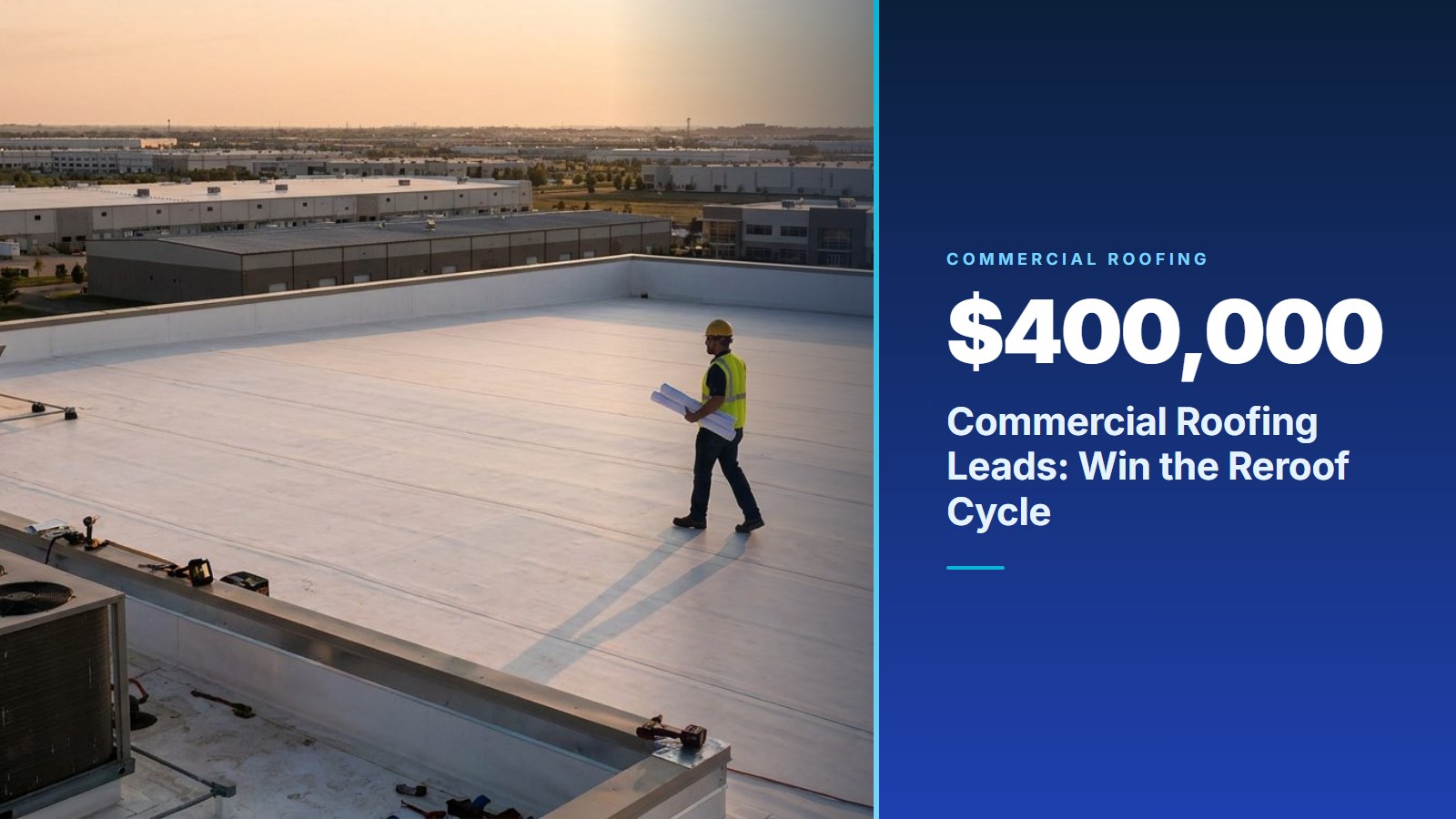
Nobody signs a $400,000 reroof off a cold call. Plenty of PMs will accept a free 20-point roof inspection with a written condition report and photos. That report travels: managers forward it to owners at budget season, and the contractor whose name sits on the assessment usually ends up writing the spec. Free inspection. Paid reroof.
Insurers have made owners receptive, too. Verisk data reported by Claims Journal shows roofs in moderate to poor condition run roughly 60% higher loss costs than well-maintained roofs, which puts roof condition on the agenda at every insurance renewal.
Higher insurance loss costs for roofs in moderate to poor condition versus well-maintained ones. The insurer makes your case for the inspection before you ever call.
Source: Verisk, via Claims JournalEvery commercial trade plays this same approved-vendor game. We broke down the janitorial version in how to get commercial cleaning contracts, and the list-building steps transfer one for one.
The Reroof Cycle Is Public Information
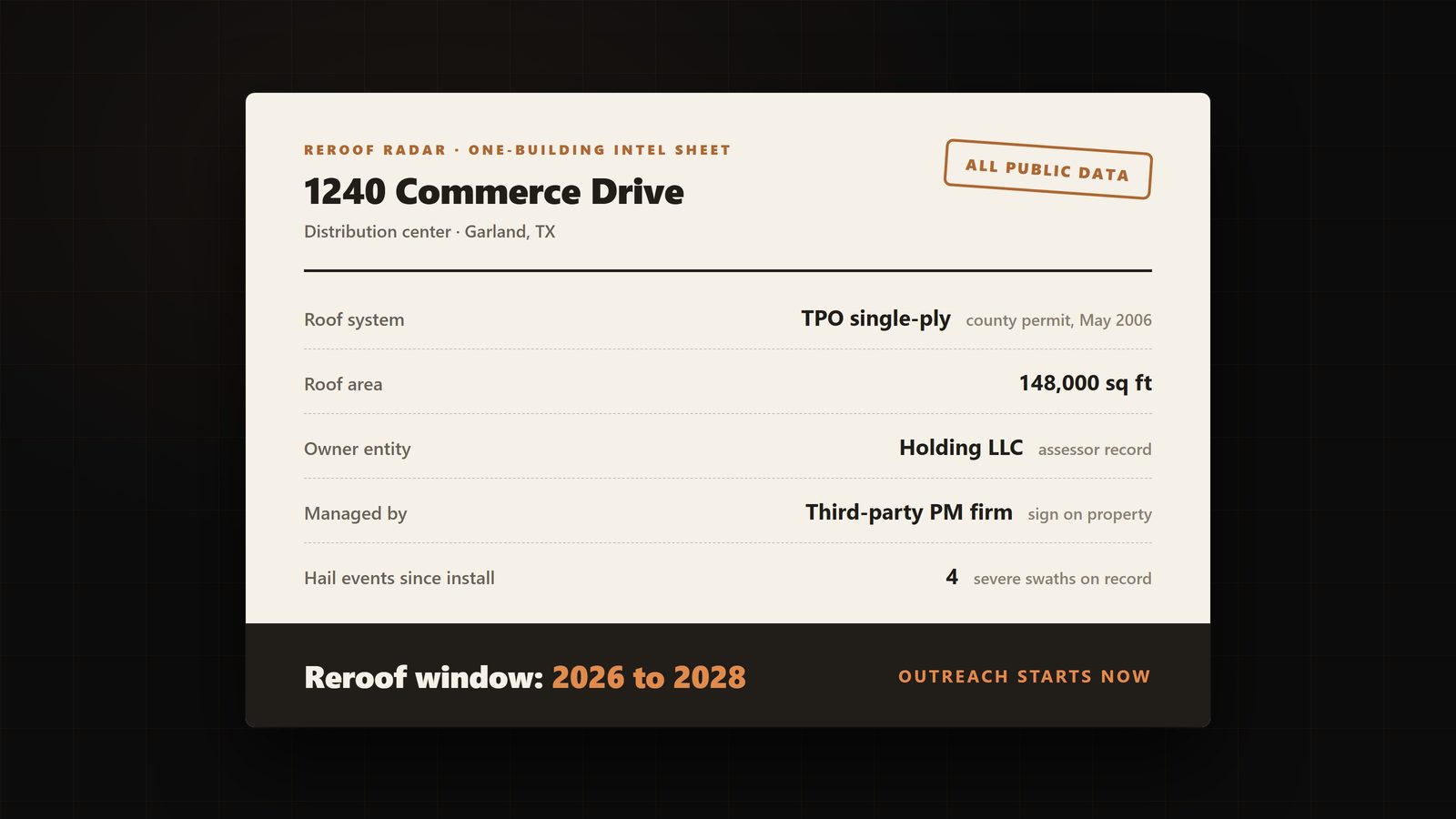
Commercial roofs age on a published schedule. TPO and EPDM systems run 20 to 30 years, per ROOFCORP’s life expectancy guide. Now apply that to the early-2000s construction boom: a distribution center roofed in 2004 is inside its replacement window right now, whether or not the owner has admitted it.
Here’s the thing. Roof age is public record. Construction and reroofing permits sit in county and city portals, searchable by date and parcel. Free to anyone who looks.
Build what I call a reroof radar:
- Pull commercial roofing and construction permits filed 18 to 28 years ago across your service area.
- Cross-check aerial imagery for patched seams, ponding stains, and faded membrane.
- Match each building to its owner entity and its management firm.
- Queue the list for outreach 12 to 24 months before the projected failure window.
Then run inspection-report marketing against that list: offer each aging building a documented condition assessment before capital budgets lock, which for most portfolios happens in Q3. When the reroof gets funded, you are the incumbent with two years of photos on file, and the RFP either never happens or gets written around your spec. Incumbency, on purpose.
The Problem With Bid Boards and Bought Leads
Register on the boards. Dodge, The Blue Book, PlanHub, your city’s procurement portal. The work is real: Dodge Construction Network reported total construction starts up 34.1% in May 2026, with nonresidential building starts up 17.8% the same month.
But understand what a plan-room bid is: five to eight roofers pricing an identical spec for a buyer who has never met any of them. You win on the number. Nothing else.
Low-bid work is where commercial margins go to die.
Get in before it hits the bid board
Owners in the trades describe the plan room as cannon fodder: the GC already knows which roofer he wants, and the other bids exist to keep that number honest. The way out is a conversation instead of a competitive bid. When your name is already on the inspection report and the owner rep already knows your crew, the call you get sounds like “you are a little high, where can you land,” and that is a job you can price for margin. Everything in the property manager and reroof radar sections above exists to put you in that conversation months before the spec goes out.
Bought leads carry the same shape with worse math. Published roofing lead prices run anywhere from $50 to $500 per lead depending on channel, quality, and exclusivity, and commercial work sits at the top of that range. Worse, CRE data platform Biscred warns that a purchased list “may throw as many contacts at you with no regard for their quality, relevancy, or even accuracy”.
Paid appointments sting the most, and owners tell us the same story about them: the caller booked a property manager who only said yes to stop the calls, the estimator drove out to a walkthrough where nobody remembered the conversation or had the authority to sign, and the invoice showed up anyway. A meeting like that costs the afternoon and the fee, and it teaches you to distrust the next vendor before they dial. Any appointment program worth paying for has to let you approve the meeting before it happens and has to eat the ones that fall apart.
Bottom line: boards and bought leads are filler volume. Relationships and building intelligence carry the margin work, and your inbound engine (website, reviews, Google Business Profile) compounds underneath it. We covered that half in our commercial roofing marketing guide.
Trigger-Based Commercial Roofing Lead Generation
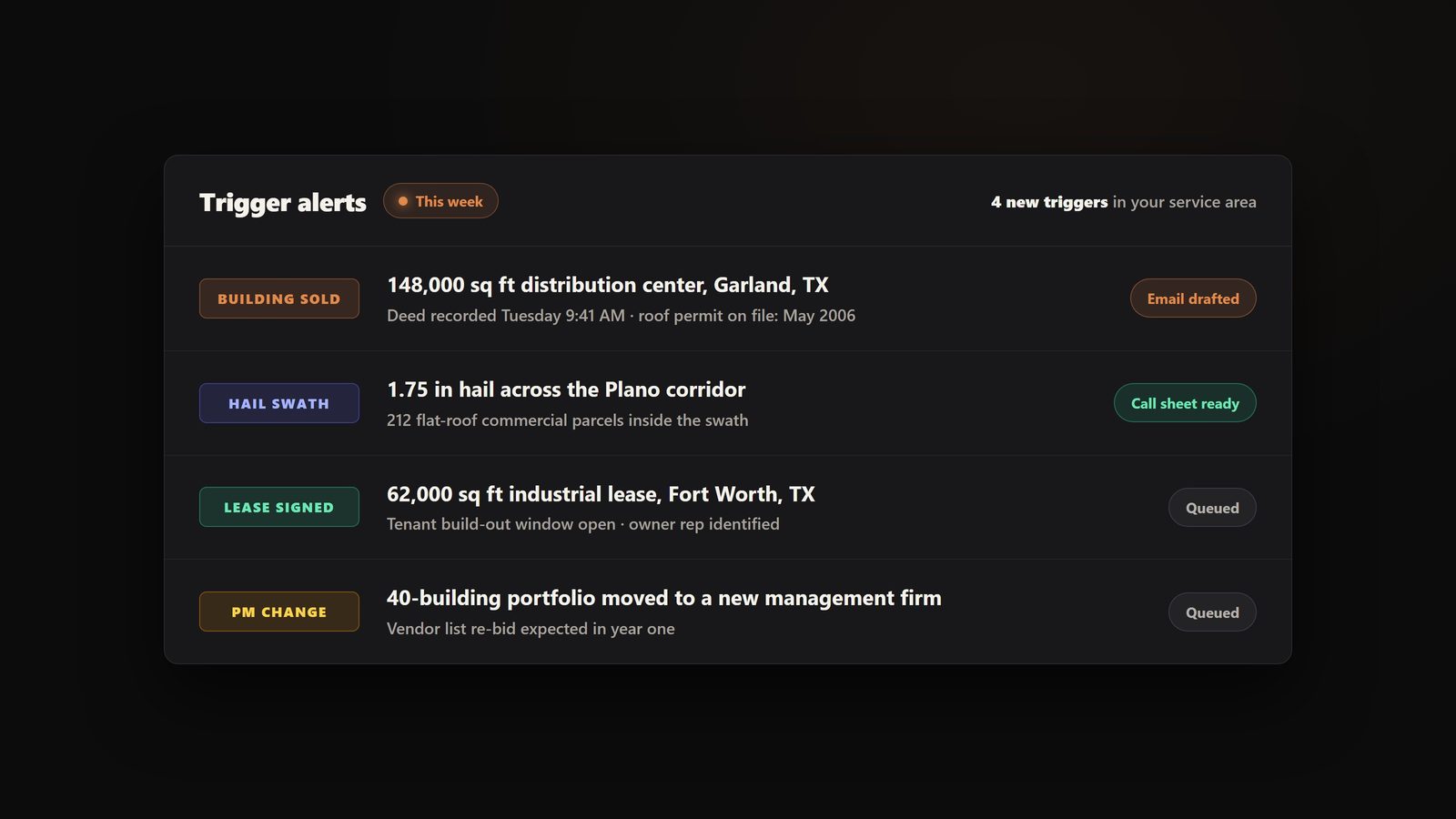
The highest-margin commercial roofing leads never touch a bid board. They come from watching for the events that put a roof on somebody’s desk this week:
- A building sells. New owners audit capital expenses in their first 90 days, and deferred roof work is usually finding number one. Deed transfers hit public record within days of closing.
- A hail swath lands. Overlay the swath map on your flat-roof parcel list and you have a same-week call sheet with a built-in reason to reach out.
- A lease gets signed. Tenant build-outs expose roof condition fast, and a new tenant reporting leaks in month one forces the owner’s hand.
- A facility opens or expands. A company hiring aggressively in your metro is about to need more space, and new space means new vendor relationships. The hiring surge shows up before the press release does.
- A management contract changes hands. New PM firms typically re-bid vendors in year one.
States where severe hail hit 20% or more of roofs in 2025, up from 12 in 2024. Every swath map is a time-stamped prospect list.
Source: Verisk, via Claims JournalStorm chasers understand the hail trigger. Almost nobody works the other four. Four open lanes.
The outreach itself has to be personal or the whole thing collapses. This is the mechanism appointment-setting services and done-for-you outbound shops run for B2B trades: a verified decision-maker list, a dedicated human caller who names the specific trigger on the phone, a short email that repeats it with one line of proof and a single low-friction ask, sent from a warmed-up domain so it actually reaches the inbox, and a LinkedIn touch so the name is familiar before the call. Call centers and AI dialers fall apart here, because a property manager can tell within a sentence whether the person on the line knows the building.
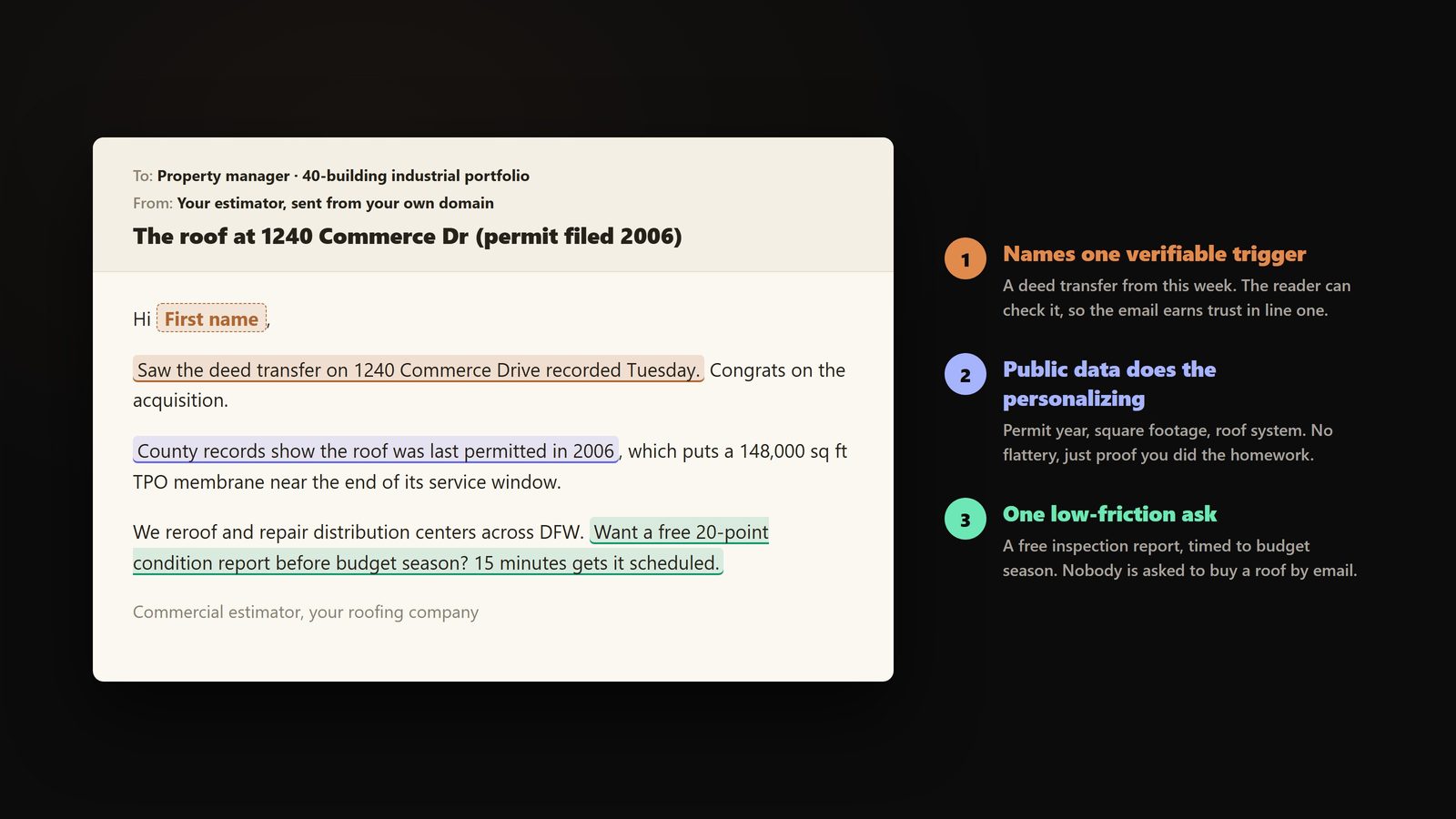
Speed compounds all of it. HubSpot research cited by ZoomInfo puts 35 to 50% of sales with the vendor that responds first. On a trigger event, “first” means the week the deed records, while your competitors wait on an RFP that may never post. A head start measured in months.
What We Learned Calling 102 DFW Roofers
In May 2026 we ran a field test. We called 102 roofing companies across Dallas-Fort Worth during business hours, as a buyer with a real roof problem, and tracked what happened.
56% never picked up and never called back. The gap between the fastest and slowest responders was 30x. Median callback time: 31 minutes.
56% of the roofing companies we called never picked up and never called back. Those buyers went somewhere.
Let’s apply that to commercial. If half the market cannot answer an inbound phone call, almost none of it is running proactive outreach to property managers. The competitive bar is on the floor. Answering and following up fast is the supporting layer, the speed to lead discipline that keeps an inbound inquiry from leaking, and it matters for the same reason the outbound work does: the roofer who shows up early, with a name and an inspection report already on file, wins before price ever enters the conversation.
- Plan-room bids priced against five to eight other roofers
- Storm chasing the same swath as every crew in the metro
- Bought leads resold to whoever else paid
- Pipeline starts the day the RFP drops
- Wins ride on being the lowest number
- Building sales and hail maps surface buyers the week they happen
- Verified property manager contacts with names and titles
- Inspection reports make you the incumbent before budget season
- Pipeline starts 12 to 24 months before the reroof
- Wins ride on the relationship you built first
What a Done-for-You Pipeline Looks Like
Everything above is buildable in-house. The catch is hours: trigger monitoring, permit pulls, contact verification, daily calling blocks, and follow-up sequencing add up to a full-time seat, and your estimator already has one. At $3M and up, the question is usually who should own that seat, and the answer is rarely the estimator.
That gap is what we built Ignitvio’s commercial roofing lead generation service around. The mechanism, end to end:
- We watch your market for triggers. Building sales, hail swaths, lease events, new facility openings, and hiring surges across your service area, plus the signals that run further ahead of the reroof: roofing and construction permits, zoning approvals, personnel changes at the owner or management firm, and contract renewal dates.
- We build the list. Verified property managers, facility directors, and owner reps who match your target building types, checked before anyone picks up a phone or a single email sends.
- A dedicated human caller works the list. One person assigned to your account, never a call center and never AI dialing, who calls each property manager with the trigger in hand and knows which building they are talking about.
- Email and LinkedIn run alongside the calls. Outreach goes out on domain-safe sending accounts built for your company, personalized to the trigger, so replies land in your inbox and the sender reputation belongs to you. LinkedIn touches make the caller’s name familiar before the phone rings.
- Qualified meetings hit your calendar. Each one is screened against criteria we agreed on in writing and sent to you for approval before it counts. You show up and talk roofs.
Qualified has a written definition: the right decision-maker for your target buildings, a fit for your size and service area, and a person who genuinely agreed to the call. An appointment that fails any of those three tests does not count toward your numbers. Neither does one you have not signed off on: every meeting is client-approved before it counts, so a wasted afternoon lands on us, never on the tally.
The guarantee is structural. We agree on a qualified-meeting minimum in writing before kickoff, and if we miss it, we keep working at no charge until you hit it. We never guarantee revenue or signed contracts, because your close rate belongs to you.
On scale: we set the qualified-meeting minimum from your market size and sending volume before kickoff, so the number you hold us to is specific to your metro. Your market, your reputation, and your follow-up decide how many of those meetings become signed contracts.
Who is on the phone, and who decides a meeting counts
The questions owners ask before they sign are the ones a previous vendor left behind, so here are the straight answers. Is it a person or AI? A person: one US-based caller assigned to your account, trained on your building types and your own talk track before the first dial, so the handoff to your estimator never sounds like two different companies. Is “qualified” the honor system? No. Every meeting reaches you before it happens with three options: approve it, send the caller back for more information, or cancel it at no charge. Our callers earn nothing on a meeting that misses the criteria, so they are paid to disqualify.
Is the guarantee real? It is written into the contract itself: the qualified-meeting minimum, the work-free period if we miss it, and the refund election on the build fee at the agreed gate. Nothing to fight over later. And we take one commercial roofing client per metro, so the caller working your list is never also working your competitor’s.
The one result we do publish: a commercial roofing contractor running this program closed its first deal inside 45 days, which put the return past 100% before the second milestone payment came due. One contractor, one metro, and a number specific enough to mean something.
The buildings in your metro announce when they are ready to buy. The only question is who is listening.
Trigger-based outreach is one channel inside a complete lead generation system. It stacks on top of the property-manager relationships and inspection-report work above, and the roofers who run both at once compound fastest.
Done-for-you outbound
Where done-for-you outbound fits
Ignitvio runs outbound for you: a dedicated human caller (never a call center, never AI dialing) working alongside cold email and LinkedIn, armed with trigger data such as permits, zoning approvals, personnel changes, building sales, lease events, and contract renewal dates. Every meeting is qualified against criteria we agree on up front and approved by you before it counts. The qualified-meeting minimum goes in writing, and if we miss it we keep working at no charge until it is hit.
-
We qualify
Every prospect is screened against criteria we agree on with you up front.
-
You approve
A meeting counts toward the minimum only after you sign off on it.
-
You close
Your team runs the meeting and the deal. We keep the calendar full.
Built for commercial roofing companies above $3M.
See your trigger map before you commit to anything
If you want proof the buildings are there before you talk to anyone, start with the Free Pipeline Audit. We pull a sample prospect list and a trigger map for your metro: the commercial buildings and management firms in a buying window right now, surfaced by permits, building sales, renewal dates, and personnel changes. It also includes a lead response check on your own inbound phone line and form, since the DFW numbers above make that worth a look.
Get the Free Pipeline Audit for your metro
A sample prospect list and trigger map for your service area, plus a lead response check on your inbound.
Get My Free Pipeline AuditCommercial Roofing Lead FAQs
What is the fastest way to get commercial roofing leads?
How much do commercial roofing leads cost?
How do I find the property manager for a specific building?
Are bid boards like Dodge or The Blue Book worth it for commercial roofing?
What counts as a qualified meeting in commercial roofing lead generation?
How long does it take to close a commercial roofing contract?
Is it a person cold calling, or is it AI?
What if I show up and the property manager says the caller was pushy and I was just in the area? Do I still pay?
Does a meeting with a property manager count as qualified?
See what a trigger-based pipeline looks like in your metro
Fifteen minutes to check fit: your building types, your service area, and the qualified-meeting minimum we would put in writing.
Book a 15-Minute Fit Call
Jake Melendy
Founder, Ignitvio
Jake Melendy is the founder of Ignitvio. He spent 12 years in enterprise sales and sales leadership, including at Oracle, before building Ignitvio, which runs done-for-you outbound appointment setting for commercial contractors and B2B service companies. He writes about pipeline, trigger-based prospecting, and lead response.