Answer Engine Optimization for Home Services
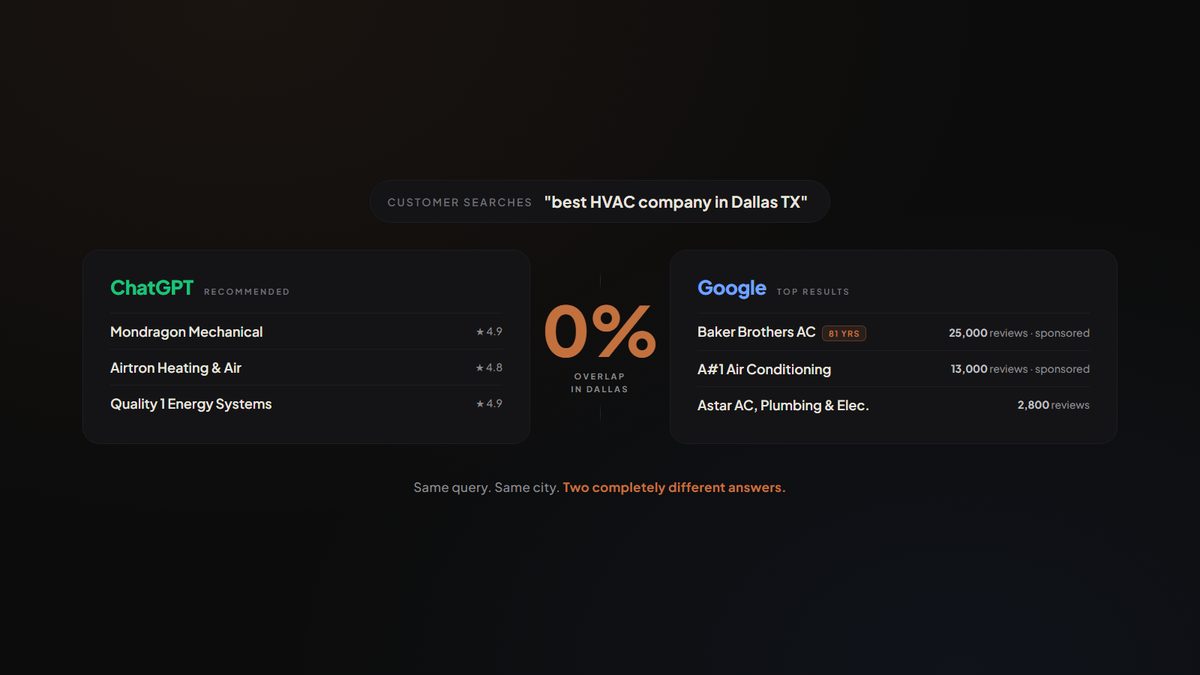
- Answer engine optimization (AEO) is how your business gets named when a homeowner asks ChatGPT, Perplexity, or Google AI Overviews which contractor to call.
- Four signals drive AI recommendations for local service businesses: entity consistency, review velocity, structured FAQ content, and third-party citations.
- 97% of consumers read reviews for local businesses — AI models treat review data the same way potential customers do.
- Businesses with more than 82 reviews earn 54% more annual revenue than average, a gap that widens further in AI-driven recommendations.
- The fastest AEO fix for most contractors: FAQ schema on service pages plus consistent NAP data across 30+ directories.
The Lead Answer Engine Optimization Decides You’ll Never See
A homeowner in Columbus, Ohio types “best plumber near me” into ChatGPT at 8 PM on a Wednesday. ChatGPT names three local plumbing businesses. Yours isn’t one of them.
Your reviews are solid. Your work is good. Your website is functional. The AI has simply never encountered your business name in enough credible contexts to form a recommendation. That gap is what answer engine optimization closes.
AEO is the practice of structuring your business’s digital presence so AI-powered platforms can find it, trust it, and repeat it when customers ask for a recommendation. Traditional SEO optimizes for a ranked list of clickable links. AEO optimizes for the direct recommendation itself — the single contractor a homeowner gets told to call.
According to Think with Google, 76% of people who search on their smartphones for something nearby visit a business within a day. AI assistants and conversational search tools are now how millions of homeowners find HVAC technicians, plumbers, and electricians. If your presence is optimized only for the traditional results page, you’re invisible to a growing share of that traffic.
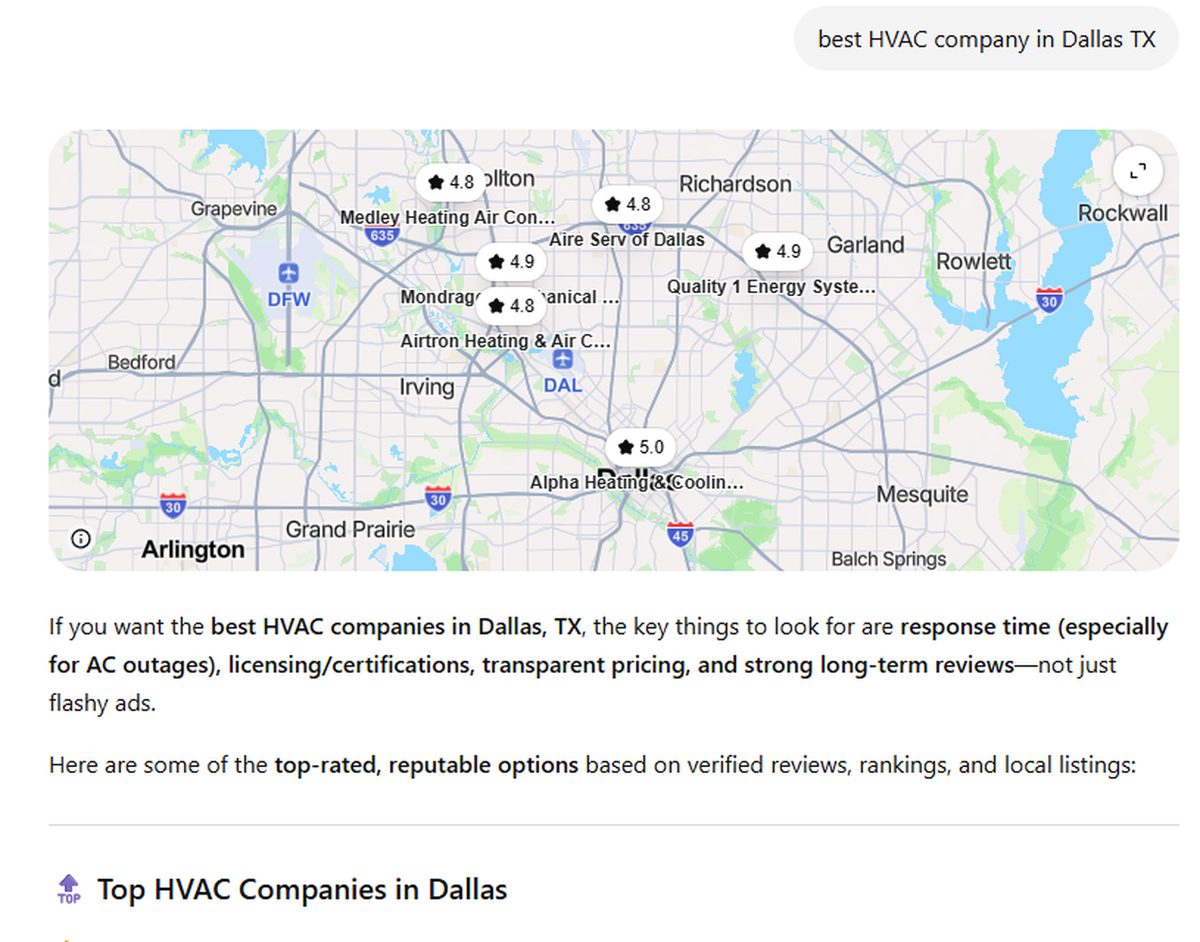
The core mechanic: AI models answer questions by synthesizing patterns from the web they’ve already crawled. When someone asks an AI “who should I call for emergency furnace repair in Denver,” the model draws from review sites, directories, news mentions, blog posts, and structured data — not a fresh live search. Businesses that appear consistently across those sources get recommended. Businesses that don’t, don’t.
Four Signals That Decide Which Contractor AI Recommends
Not all digital presence is weighted equally in AI recommendations. A contractor with 300 reviews and consistent citation data across directories will outperform a competitor with a better-looking website but mismatched listings. Four signals drive most of the outcome.
Entity consistency. Your business name, address, and phone number need to match exactly across every directory, citation, and social profile. A plumbing company in Austin listed as “Hartwell Plumbing LLC” on Google, “Hartwell Plumbing” on Yelp, and “H. Hartwell Plumbing and Drain” on Angi sends mixed signals. AI models cross-reference these sources. Inconsistency lowers their confidence in the entity.
Review volume and recency. AI systems use reviews as a proxy for trust and relevance. According to BrightLocal’s Local Consumer Review Survey, 97% of consumers read reviews for local businesses. AI models do something similar: parsing review data to assess whether a business is active, credible, and worth recommending to a specific caller.
Structured FAQ content. AI answers conversational questions. Your website needs to match that format. A FAQ page that directly answers “how long does a water heater replacement take in San Antonio” is extractable content. A services page listing “water heater replacement” in a generic bullet is not.
Third-party citations. Every independent website that names your business adds another signal. Local news coverage, supplier partner pages, trade association directories, local “best of” roundups — each mention reinforces the AI’s confidence that your business is a real, active entity in a specific trade and location.
Review Velocity Feeds AI Recommendations Directly
Reviews aren’t just for human readers anymore. ChatGPT, Perplexity, and Google AI Overviews use review data when constructing local business recommendations. A roofing company in Nashville with 14 total reviews and no new activity in six months looks very different to an AI model than one with 110 reviews and new ones arriving every week.
MediaPost’s coverage of Womply’s study of more than 200,000 U.S. businesses found that firms with more than 82 total reviews earn 54% more annual revenue than average. That gap exists in traditional search. In AI-driven recommendations, the gap is wider because AI tools aren’t ranking a list — they’re picking one answer. Consistent, recent reviews signal a thriving active business. Nine stale reviews from three years ago signal something else.
A contractor adding 8 to 10 new Google reviews a month looks like a healthy, active business to an AI model. One adding 8 to 10 total per year looks like it might have closed.
The monthly target for home service businesses: 6 to 12 new Google reviews. Achievable when you automate the ask. Send a text to every customer after the job closes. Direct link to your Google review page. One tap. Every job, every time.
Responding to reviews matters too. Search Engine Land’s coverage of Womply shows businesses that reply to reviews at least 25% of the time average 35% more revenue. AI models that parse review data notice engagement patterns. An owner responding consistently within 48 hours looks different from one who never responds.
Build the review ask into your job close-out workflow so it fires automatically after every completed service call, with no one needing to remember.
How to Structure Your Site So AI Can Actually Extract It
Most contractor websites are built to impress visitors on the homepage. They’re not structured for extraction by an AI crawler trying to answer a specific question about a specific service in a specific city.
The fix starts with FAQ content. Every service you offer needs a dedicated FAQ section written the way customers actually ask questions. Not “water heater services” with a generic bullet list. Actual questions: “How long does a water heater replacement take?” “What size water heater do I need for a 3-bedroom house in [city]?” “Does water heater installation require a permit in my state?”
The technical layer on top of good content: FAQ schema markup in JSON-LD format. Adding schema tells AI crawlers exactly which text is a question and which is the answer. Machine-parseable in a way that a block of marketing copy isn’t.
The businesses AI recommends most reliably have one thing in common: their websites answer specific questions the way a knowledgeable person would answer them over the phone. Specific, direct, organized around the question the customer is actually asking.
The content pattern that works:
- One dedicated service page per major offering (not a catch-all “services” page)
- 5 to 8 FAQ items per service page in natural question format
- FAQ schema in JSON-LD applied to each FAQ block
- City-specific landing pages for your top service areas with unique content and localized FAQ variations
None of this requires a developer. Most page builders include FAQ blocks with schema built in. The work is writing real questions and real answers.
The Answer Engine Optimization Tactics That Actually Move the Needle
Certain AEO actions produce measurable changes in AI citation frequency while others change nothing. The short list of what moves the needle:
Fix citation consistency first. Pull your top 30 directory listings and audit NAP data. Whitespark and BrightLocal both have citation audit tools. Unglamorous work, but foundational. AI models encounter your business name across dozens of sources before forming a recommendation. Inconsistency across those sources introduces doubt that reduces how often your business gets named.
Complete your Google Business Profile. Every section. Products and services listed individually. Photos updated monthly. Q&A section filled with your own questions and answers before wrong information accumulates. Whitespark’s Local Search Ranking Factors research continues to treat Google Business Profile signals as central to local pack visibility — and those same signals carry significant weight in AI recommendations for local service queries.
Build third-party coverage. Local press mentions, supplier partner pages, trade association directories, local “best of” roundups — these create independent authority signals. A single article from a local news outlet naming your HVAC company in a winter preparedness feature gives AI models a third-party endorsement with real weight.
Target informational queries with content. Write posts and FAQ pages that answer the questions customers type into ChatGPT. “How do I know if my water heater needs replacing?” “What’s the average cost of AC repair in [city]?” These pages train AI models to associate your domain with authoritative answers in your trade.
For deeper AI search tactics, see how to get recommended by ChatGPT and the full playbook in LLM SEO for local service businesses.
Think with Google research shows “near me” mobile searches with buying intent grew over 500% in two years. The homeowners driving that volume are increasingly using conversational AI tools to find contractors. Building for that behavior now is the version of local SEO that compounds through 2027 and beyond.
Testing Whether AI Already Knows Your Business
Before optimizing, you need to know where you stand. The audit takes 20 minutes.
Open ChatGPT, Perplexity, and Google AI Mode. Run the specific queries your best customers would type. For an HVAC company in Denver:
- “Who are the best HVAC companies in Denver?”
- “I need emergency AC repair in Denver, who should I call?”
- “What HVAC companies do homeowners in Denver recommend?”
Document the results. Note which competitors appear. Note which review sources the AI references when explaining its picks. Note any incorrect information about your business if you do appear. Simple audit. Real data.
That gap analysis tells you where to focus first. Competitors appearing because of review volume: week one, automate your review requests. Competitors appearing because of local press coverage you don’t have: three-month content project. Incorrect information about your business appearing: fix citation consistency immediately.
Run this test quarterly. AI models update as they crawl new content. The contractors showing up in AI recommendations 12 months from now are the ones auditing today.
Connect this to your ChatGPT SEO strategy so AI visibility becomes part of your regular marketing review rather than a one-time check.
How Answer Engine Optimization Pays Off Differently Than Traditional SEO
Traditional SEO delivers traffic you can measure in Google Search Console. Answer engine optimization delivers something harder to track but more valuable: direct recommendations.
When AI recommends your business, the lead arrives pre-qualified. The homeowner asked a specific question about a specific service in their city and was told, by a tool they trust, to call you. That’s not a cold click from a paid ad. That’s a warm referral with zero acquisition cost after the initial optimization work.
The compound effect looks like this: a Scottsdale HVAC company that built consistent review velocity, corrected citation data across 47 directories, and deployed FAQ schema on 8 service pages started tracking inbound calls from customers identifying AI tools as the referral source. One quarter. Fourteen confirmed new jobs. Around $6,300 in revenue from a channel they paid nothing to maintain.
Unlike paid search, it doesn’t stop when you stop spending.
- Invisible in ChatGPT, Perplexity, and Google AI Overviews for local queries
- Review count stagnating under 20 total reviews
- Website content written for humans, not machine extraction
- Inconsistent business name and address across 30+ directories
- Zero third-party citations beyond basic directory listings
- Cited by AI tools for local service queries in your trade and city
- Automated post-job review requests on every completed job
- FAQ schema deployed across all service pages for AI extraction
- Consistent business entity verified across 50+ directories
- Local press mentions and trade association listings as authority signals
The 266% lead difference between a 10-review business and a 50-review business exists in traditional search. In AI-driven recommendations, the gap is more dramatic because AI tools pick one answer — not ten. Getting that slot takes exactly the kind of consistent, complete, well-documented digital presence that answer engine optimization builds.
How Ignitvio’s AEO Platform Works for Home Services
Ignitvio’s answer engine optimization platform is built for home service businesses that want to show up in AI search recommendations without managing 12 tools separately.
The system handles the components most service businesses can’t keep current on their own:
Review automation sends a text request to every customer after a completed job. No manual step. Reviews accumulate at the rate your job volume supports, building the review velocity AI models weight in their recommendations. Negative feedback routes privately before it becomes a public one-star review.
Citation management audits and corrects your business name, address, and phone number across the directories AI models reference most frequently. Inconsistencies that reduce AI confidence in your business entity get fixed systematically.
FAQ content and schema deployment adds structured, machine-readable FAQ sections to your key service pages. The content matches the conversational queries customers type into AI tools, and JSON-LD markup ensures AI crawlers can extract it cleanly.
Authority signal building identifies third-party citation opportunities, supplier partner listings, local press outreach points, and trade directory submissions that add independent mentions of your business across the web.
The whole system runs in the background. An electrician in Salt Lake City enrolled last spring with 14 Google reviews and no presence in any AI search result. Six months later: 91 reviews, cited by Perplexity for four local query variations, and 9 confirmed jobs in a single quarter traced directly to AI-referred callers.
AEO doesn’t replace your existing marketing. It makes every other channel more effective because the brand recognition AI builds converts better at every touchpoint.
Get Your AEO Audit
See Where AI Search Ranks Your Business Right Now
Free written audit. No pitch.
Book a Revenue Audit
Jake Melendy
Founder, Ignitvio
Jake Melendy is the founder of Ignitvio. He spent 12 years in enterprise sales and sales leadership, including at Oracle, before building Ignitvio, which runs done-for-you outbound appointment setting for commercial contractors and B2B service companies. He writes about pipeline, trigger-based prospecting, and lead response.