AI Search for HVAC Companies: 2026 Visibility Playbook
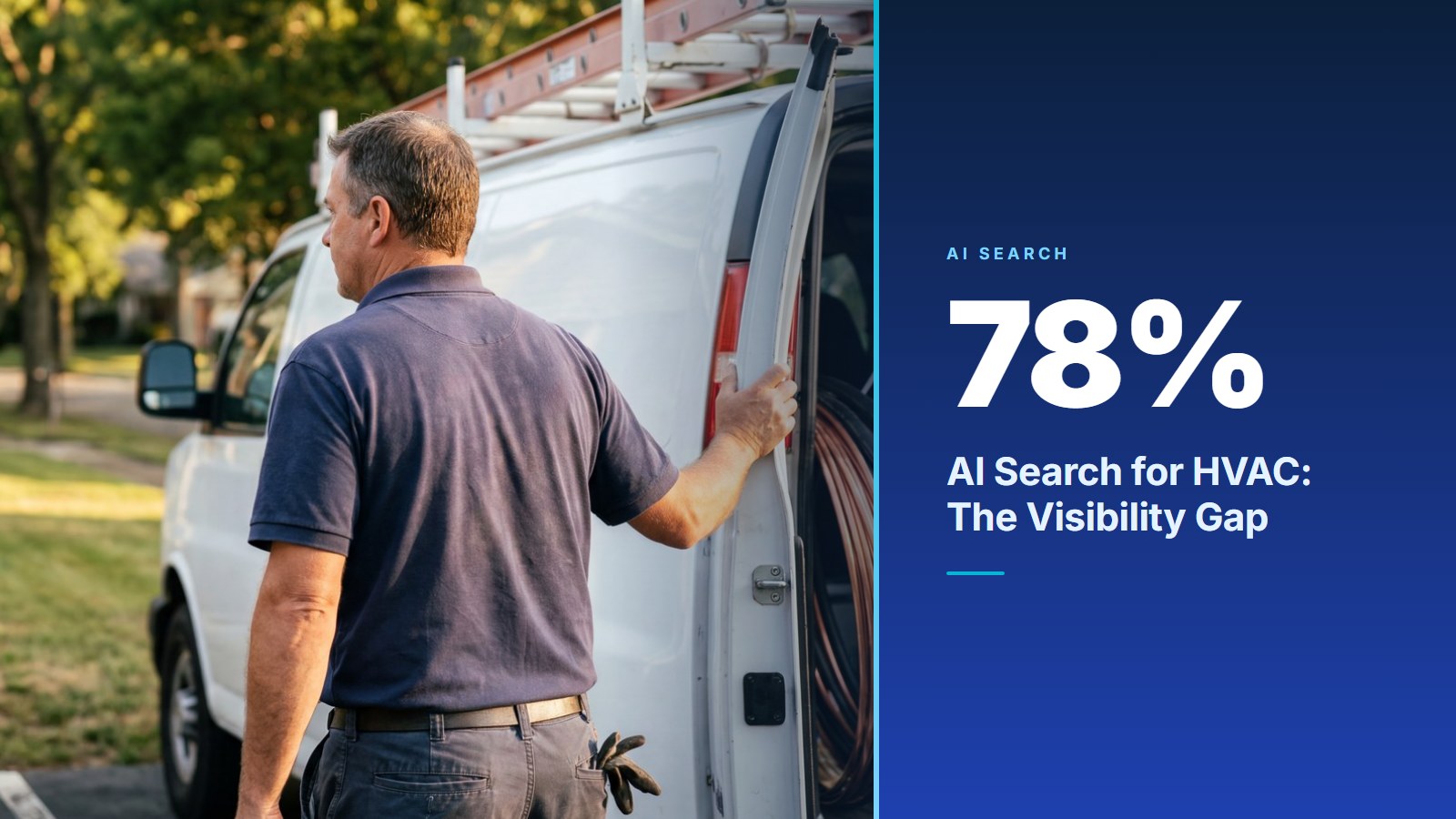
- 78% of HVAC and plumbing brands are completely invisible to AI answer engines, even companies that dominate Google’s paid and organic results.
- ChatGPT recommends only 1.2% of HVAC business locations per city. Being in that minority requires a deliberate strategy, not more Google ad spend.
- AI search ignores your backlink profile, your review count, and your ad budget. It rewards citation density across third-party text.
- HVAC’s seasonal and emergency query patterns make it one of the highest-opportunity categories in AI search right now.
Last summer in Phoenix, an AC died at 2 PM on July 11. The homeowner didn’t open Google. She typed “best HVAC company in Phoenix” into ChatGPT, got three names back, called the first one, and had a tech on-site within four hours. The job: a condenser replacement at $3,800.
The company running the #1 Google Ad for “HVAC repair Phoenix” was not one of those three names. Neither was the company with 14,000 Google reviews. Neither was the 40-year-old family operation that still does Chandler door-hangers every spring.
That’s not an isolated case. That’s how AI search for HVAC companies works in 2026. And it’s why most contractors are losing calls to a channel they haven’t started optimizing.
Most HVAC Companies Are Already Invisible to AI Search
The 5W PR HVAC and Plumbing AI Visibility Index ran 65+ HVAC and plumbing prompts through ChatGPT, Claude, Perplexity, Gemini, and Google AI Overviews during early 2026. Their finding: 78% of local HVAC and plumbing brands are invisible to AI answer engines entirely. Not underperforming. Not hard to find. Absent from every recommendation.
AI search is 30 times more selective than traditional Google. On ChatGPT, only 1.2% of HVAC business locations get recommended for any given city query. On Perplexity, 7.4%. The top of the homeowner’s discovery funnel just got far narrower, and it’s a different funnel than the one most HVAC contractors have been building for a decade.
What makes this sharp: the companies missing aren’t small operators or poorly run businesses. Per the 5W data, the absences include long-tenured, heavily reviewed, well-funded HVAC companies with dominant Google presences built over decades. As our 10-city AEO study across HVAC and roofing markets found, the biggest Google advertisers were the most invisible on ChatGPT in 7 of the 10 cities tested. A century of brand-building transferred nothing.
The mechanic underneath explains everything. And fixing it is more accessible than most contractors assume.
of HVAC and plumbing brands are completely invisible to AI answer engines including ChatGPT, Perplexity, and Google AI Overviews
Source: 5W PR HVAC & Plumbing AI Visibility Index 2026Why AI Ignores the Signals That Built Your Google Ranking
Google ranks HVAC companies based on backlinks, on-page relevance, review count, and ad spend. ChatGPT, Perplexity, and Google AI Overviews do something structurally different.
AI answer engines read text across the open web and learn which businesses get named alongside competitors with a reason. That includes comparison articles, Reddit threads, “best HVAC in [city]” listicles, and detailed review write-ups on Yelp, Houzz, and Angi. The signal is citation density, not domain authority.
An HVAC company in Denver spending $15,000 a month on Google Ads with no comparison content, no Reddit presence, and no listicle inclusions has built zero citation surface. A competitor spending $300 a month on ads but consistently mentioned in those sources beats them on ChatGPT every time.
Ahrefs’ analysis of 1.4 million ChatGPT prompts found that cited pages have an 89.78% match rate when the URL slug semantically aligns with the query. A content-structure signal, not a domain-authority signal. Research from Search Engine Land’s 30-million-source citation study confirms the top source types AI engines pull from are Reddit, YouTube, and third-party comparison articles. Not paid Google placements.
Review count doesn’t translate cleanly, either. The content of reviews matters far more than the number, and neither matters as much as whether your business name appears inside a comparison article that says “in Dallas, these three HVAC companies get recommended for same-day repairs.” The business with 25,000 Google reviews but zero comparison content citations is invisible to ChatGPT. The business with 400 reviews and three comparison article mentions shows up.
HVAC Has an Advantage Here That Most Verticals Don’t
HVAC is a crisis category. When an AC fails in July or a furnace goes out in January, the homeowner’s urgency is at its peak, and they’re asking AI conversational questions before they click a single Google result.
The BrightLocal 2026 Local Consumer Review Survey found 45% of consumers now use AI tools to find local business recommendations, up from just 6% a year earlier. That growth isn’t uniform across categories. Emergency service verticals, including HVAC, plumbing, and electrical, are seeing the steepest AI adoption because homeowners are asking questions like “who does same-day AC repair in Austin in July” rather than scrolling ten blue links.
Those are the highest-value queries in the HVAC business. Angi cost data puts average repair tickets at $300-$500 and system replacements at $5,000-$10,000. An HVAC company capturing three emergency repair calls a week through AI visibility that weren’t coming through Google adds $900-$1,500 per week from a zero-ad-spend channel.
There’s also a seasonal window that most HVAC contractors haven’t found yet. Most “best HVAC in [city]” listicles are published in fall or spring. By June, they’re 6-9 months old. The contractor who publishes fresh comparison content in May, before heat wave season, gets the AI citations through August. The window is real. It closes fast once competitors figure it out.
Getting in early on AI search citations is like claiming a service area on Google Maps before anyone else. The early citation builder gets compounding returns. The late one pays to catch up.
The 4 Pages Every HVAC Website Needs for AI Visibility
The website changes that move the needle for AI search are faster than most contractors expect. Four pages matter most.
Homepage. The H1 should contain the exact phrase a homeowner would type into ChatGPT. “The Best HVAC Company in [City] for Same-Day Repairs” beats “Keeping [City] Comfortable Since 1998.” AI rewards exact-match phrasing in prominent positions, the inverse of Google’s keyword-stuffing penalty. Add a FAQ section with 8-12 questions in literal query format: “What is the best HVAC company in [city]?” “Who does emergency AC repair in [city] at night?” “How much does HVAC repair cost in [city]?” Each answer: 60-80 words, with your business name, your service area, and one specific differentiator.
Local service area pages. One page per major city or neighborhood you serve, each opening with “[Your Company] is the HVAC contractor [city] homeowners call for [key service].” That sentence structure is what AI retrieval systems learn from when building recommendations for local queries.
A comparison page. Write “The 5 Best HVAC Companies in [City] in 2026” and include your business honestly alongside 3-4 real competitors. This is the highest-weight content type for AI citation, per the ChatGPT SEO research for service businesses. Be fair. Cover pricing ranges, response times, service areas. The goal is genuinely useful content, which also happens to be exactly what AI rewards.
An emergency HVAC page. A dedicated URL at /emergency-ac-repair-[city] or similar. Seasonal urgency, local specificity, and service type in one slug. This is the pattern AI retrieves when a homeowner asks “who can fix my AC today in [city].”
Add LocalBusiness, Service, and FAQPage schema to all four pages. The Google Structured Data documentation covers implementation without requiring a developer. Schema removes ambiguity about what you offer and where you operate, two things AI filters use to include or exclude local businesses from recommendations.
Where to Build the Citation Surface AI Actually Reads
Your website can only do so much. The citation surface that most drives AI recommendations is off-site, and for HVAC companies it comes from a specific handful of places.
Reddit. The r/HVAC, r/HomeImprovement, and city-specific subreddits like r/Austin or r/Charlotte carry significant weight in ChatGPT’s citations for local queries. Spend 20 minutes twice a week answering homeowner questions in these threads. Genuine, useful answers. Mention your company when it’s the right answer to the question. One well-placed reply in a thread titled “best HVAC company in Charlotte” is worth more for AI visibility than ten directory backlinks.
“Best HVAC in [city]” listicles. Search that exact phrase on Google. The articles ranking in the top five are exactly what ChatGPT reads when building recommendations. Email each author and ask to be included in the next update. Provide your credentials, a review link, and one or two specific differentiators. Most local writers say yes. This is the single highest-leverage off-site move available to most HVAC contractors, and almost nobody does it. Big mistake.
Angi, Yelp, and Houzz with contextual write-ups. Star ratings alone contribute little to AI citation weight. A review that says “They replaced my Carrier AC in Plano in under three hours, charged $4,200, and cleaned up the access panel” carries real weight. The context is what AI retrieves. Ask your best customers to leave detailed reviews that name the specific service, the neighborhood, and a concrete outcome.
Local press and trade coverage. One feature in a city magazine or a quote in a local news segment functions like five organic citations for AI purposes. Pitch local journalists in April and May, when “preparing your AC for summer” stories run, and offer yourself as a source. For the full off-site playbook covering ChatGPT, Claude, and Perplexity simultaneously, the LLM SEO guide for service businesses covers every citation source type in depth.
Your Google Business Profile Is Still Working for AI Visibility
Google Business Profile has become a direct AI citation surface, not just a local SEO tool. 5W PR’s research found that HVAC companies with complete, active GBPs are 70% more likely to appear in AI-generated local recommendations than those with thin or stale profiles.
The specifics matter. Listing services granularly outperforms listing “HVAC” as a single category. Add “central air conditioning installation,” “heat pump repair,” “emergency furnace service,” “duct cleaning,” and “mini-split installation” as separate entries. AI systems learn your specific capabilities from these labels when matching businesses to queries.
Post GBP updates at least twice a month. Freshness is a real signal. An HVAC company with a May 2026 post about summer AC tune-ups is more likely to appear in June recommendations than one whose last post was in February.
more likely to appear in AI-generated local recommendations: HVAC companies with complete, active Google Business Profiles vs. those with incomplete or stale profiles
Source: 5W PR HVAC & Plumbing AI Visibility Index 2026An HVAC company in Dallas that hasn’t touched its GBP in eight months won’t appear in AI recommendations even if its website is perfectly optimized. Freshness is not optional here. Make GBP maintenance a weekly 15-minute task, not a quarterly project.
The 60-Day HVAC AI Visibility Sprint
If you start this week, here is what 60 days looks like in practice:
Days 1-14. Update your homepage H1 and first paragraph with exact-match query phrasing for your city and top service. Add a 10-question FAQ section. Create one dedicated emergency HVAC page per major city you serve. Add LocalBusiness and Service schema to all key pages.
Days 15-30. Publish one local comparison piece (“Best HVAC Companies in [City] in 2026”). Identify the top five “best HVAC [city]” articles ranking on Google and email every author. This is the step most HVAC companies skip entirely. It’s also the highest-ROI step in the sprint.
Days 31-45. Spend 15 minutes daily on Reddit, answering homeowner questions in r/HVAC, r/HomeImprovement, and your city’s local sub. Start collecting contextual reviews on Yelp and Houzz.
Days 46-60. Open ChatGPT, Perplexity, and Google AI Overviews. Ask “best HVAC company in [your city]” in each. Compare to where you were on day one. First measurable visibility improvements typically show in weeks 6-10 as citation surfaces compound.
The pattern in AI search favors early movers: the operators who move early on AI search build a citation moat before competitors realize there’s a moat to build. The ones who wait spend 2027 and 2028 paying to catch up. One comparison piece per month, two Reddit answers per week, one listicle pitch per month. That cadence, maintained for a year, builds a recommendation footprint most competitors won’t match.
When AI Sends You Calls, Make Sure Someone Answers Them
AI visibility is half the equation. The other half is what happens when those homeowners call.
Per ServiceTitan’s State of the Trades analysis, 14.1% of inbound calls to residential HVAC shops arrived outside business hours in June 2025, the seasonal peak. That’s the exact window when AI-referred emergency calls are most likely to come in: 9 PM in July when an AC fails, 7 AM in January when a furnace won’t start. Build AI visibility and then route those calls to voicemail and the ranking work is wasted on every call that goes unanswered.
The service businesses taking market share right now are doing both: building AI citation surface so the calls come in, and running 24/7 call capture so every call becomes a booked job. One without the other leaves real revenue sitting there.
- Evening and weekend AI-referred calls go to voicemail
- Emergency callers move to the next name on ChatGPT's list
- Manual callbacks happen the next morning. Or not at all.
- AI visibility investment produces phone rings, not booked jobs
- Peak season overflow creates missed calls during highest-demand window
- Every call answered 24/7, including 11 PM in July
- AI-referred leads qualify and book on the first call
- Appointment dropped directly into dispatch software
- Missed call text-back recovers leads who went to voicemail
- AI visibility converts to booked jobs and revenue, not just impressions
Ignitvio is the AI answering and lead capture platform built for HVAC companies and other home service businesses. It answers every call in a natural voice, qualifies the lead, books the appointment into your dispatch system, and sends a summary the moment the call ends. It handles the after-hours and overflow calls that currently go to voicemail.
The math on a combined approach: an HVAC company that adds AI visibility and captures two additional emergency calls per week, at an average $400 repair ticket, recovers $3,200 per month in revenue that previously went to competitors. Layer in system replacement calls at average $7,500, and the number climbs fast. Both pieces together are what turn AI search into a real revenue engine.
For more on how AI answering works for HVAC companies, see the voice AI platform page or the answer engine optimization hub to see how visibility and call capture work together.
Find Out What AI Is Saying About Your HVAC Company
We'll run your business through ChatGPT, Perplexity, and Google AI Overviews, show you exactly where you appear and where you're invisible, and map the fastest path to getting recommended. Free. Results in 48 hours.
Get Your Free AI Visibility Audit
Jake Melendy
Founder, Ignitvio
Jake Melendy is the founder of Ignitvio. He spent 12 years in enterprise sales and sales leadership, including at Oracle, before building Ignitvio, which runs done-for-you outbound appointment setting for commercial contractors and B2B service companies. He writes about pipeline, trigger-based prospecting, and lead response.